


In today’s newsletter:
Lord Hannan argues that protectionism is a policy voters rejected
Wealth taxes add to an overcrowded system
Britain's Welfare Trap | IEA Podcast
An introduction from Economic Affairs editor Maeve Halligan
Another busy week. The economy grew by 0.7 per cent in the third quarter, its fastest pace in two years, prompting at least one former Chancellor to take the credit. Julian Jessop said most of it belongs to the private sector and AI, an area, he notes, the Government has not yet got round to messing up.
We also launched The Higher Education Delusion, our new book on what has gone wrong with the UK’s universities, with Professor Len Shackleton making the case in CapX, City AM and the Telegraph. You can buy a copy here.
Elsewhere, Lord Hannan on what the US midterms say about protectionism, and our podcast asks whether Britain can afford its welfare bill. And do join us on 19 November, when Professor Alex Edmans explains why share prices can fall after a football defeat.
Lord Hannan of Kingsclere is Director General of the IEA.
No one should be surprised by what happened. Travelling through a clutch of Midwestern states last month, I could feel the coming tsunami in the mild autumn air, and was astonished that local pundits were still hedging and hanging back.
The anti-Trump feeling was especially pronounced in the Great Lakes states where I found myself; states that depended heavily on cross-border trade with Canada, importing and exporting component parts; states that had been plunged into chaos by Trump’s constant, petulant trade wars.
Driving out of Milwaukee airport, I passed a large roadside billboard. “What’s worse than Chicago?” it asked, a reference to the city that Milwaukeeans love to hate. “Tariffs!”
The rejection of the central pillar of Trumpism, the only policy that the President and his sycophants have consistently favoured, will have a big bearing on what happens next.
Donald Trump has flip-flopped on almost everything. He decried Obama’s national debt and then promptly doubled it. He wanted America to be strong and respected, but he whined and cringed before autocrats. He promised to stop “forever wars”, and is now stuck in one in Iran.
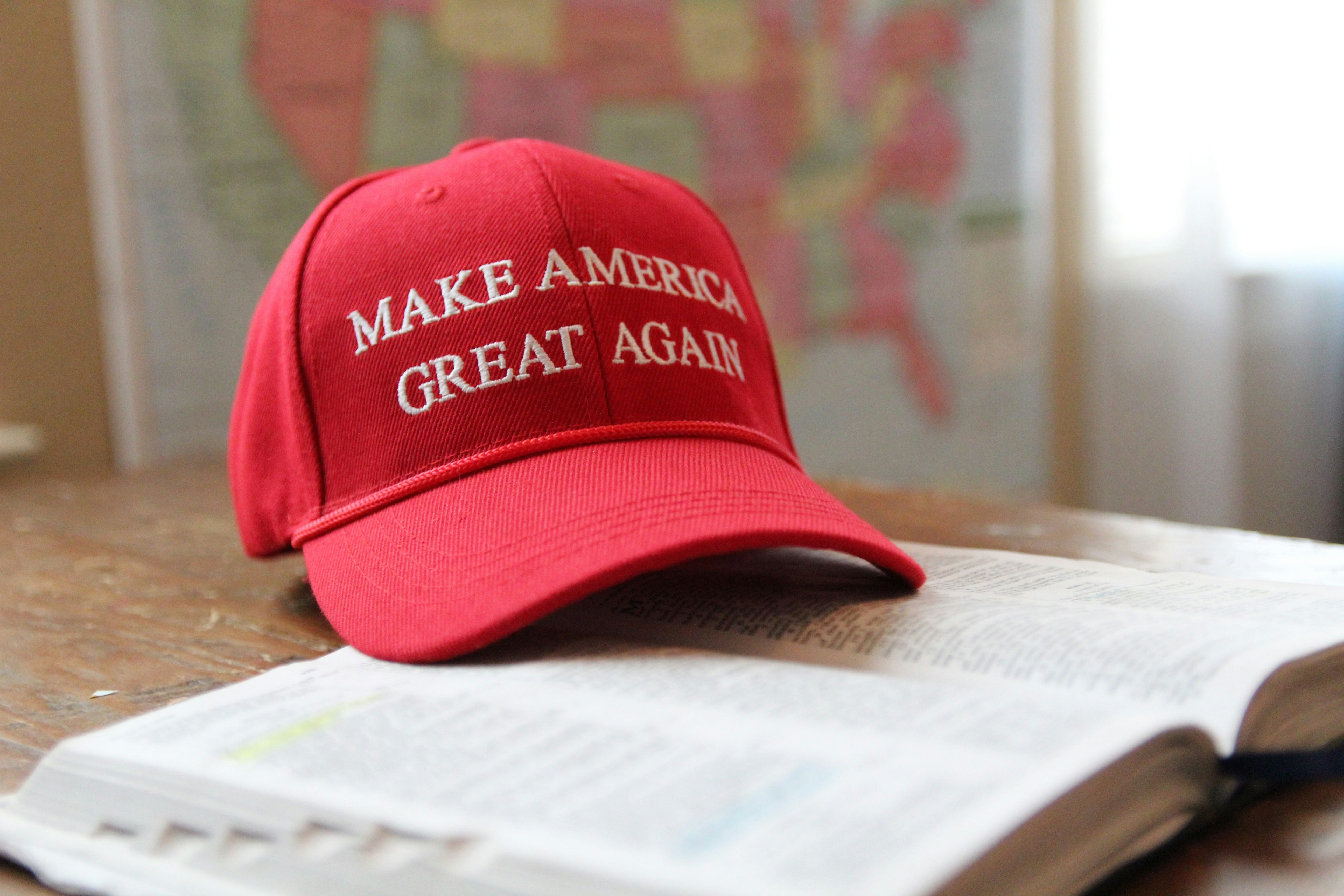
Indeed, it is hard to find any ruling principle behind MAGA beyond the convenience, at any given time, of Trump.
Except one. The President has been a lifelong opponent of free trade. “I am a tariff man,” as he likes to say. Well, all the other tariff men, which is to say everyone in his administration, are now tainted by that association.
They must have known that Trump’s trade policy would fail, for they are not fools. They must have grasped that it would not reshore jobs or raise revenue.
They must have understood that tariffs would fall on American consumers, not foreign governments – which is why no foreign governments are queuing to get their money back following the Supreme Court’s decision that the tariffs were illegal.
Above all, they must have realised that trade deficits, which so obsess Trump, don’t matter. The United States has been running them solidly since 1975, and has outperformed the rest of us.
Basic economics would have told them trade deficits are matched by investment surpluses (or vice versa) and that Trump’s demand for both surpluses and simultaneous increased investment was mathematically impossible.
But, ambitious, obsequious or frightened of the MAGA voting bloc in Republican primaries, they never objected. Instead, they flattered and amplified Trump, like so many eunuchs around a vicious child emperor.
They will surely pay a political price. JD Vance, who had previously been the bookies’ choice to succeed Trump, has seen his stock plummet. Newt Gingrich, the shrewd tactician who led the Republicans to their greatest Congressional victory of the late twentieth century, saw immediately what it meant.
“If the administration had won a big victory, Vice President JD Vance would have had an enormous argument to be the inevitable nominee,” he wrote on X. Instead, he observed, the race was wide open. He listed half a dozen possible candidates: Marco Rubio, Ted Cruz, Tom Cotton, Ron DeSantis, Pete Hegseth, Glenn Youngkin.
In fact, proximity to the regime will do for some of them, too. The Democrats have already moved articles of impeachment against Pete Hegseth, the gormless Secretary of War, whom they blame for launching unconstitutional conflicts without Congressional approval.
The clever thing for Democrats would be to leave Trump alone and impeach some of the more grotesque figures around him; but, under pressure from their own base, I am not sure their members of Congress will be able to resist.
In any event, the Republicans who stood aside from this circus-show of an administration deserve more credit than they have had. Glenn Youngkin, the former Governor of Virginia, kept his distance from MAGA and governed his state in a recognisably conservative way, cutting taxes while running surpluses.
Ron DeSantis, who is coming to the end of his term as Governor of Florida, was the man Trump beat in the last set of primaries, and has never had anything like the recognition he deserves for the success of that sun-drenched state.
Indeed, Florida is a living rebuke to Trumpery: patriotic but cosmopolitan, full of high-skilled legal immigrants, booming and open to the world – it even signed its own separate trade deal with Britain.
“Basic economics would have told them trade deficits are matched by investment surpluses.”
While Trump was musing about whether injecting disinfectant might kill the coronavirus, DeSantis resisted the massive pressure for lockdown, and was as thoroughly vindicated as a man can be in politics. Not only did Florida avoid the economic hit suffered by others; it also had a lower excess mortality rate.
More interesting is the case of Marco Rubio, whom many Reaganites and free-marketeers have until now backed as the most obvious alternative to Vance. The Secretary of State, they say, has moderated Trump’s excesses, tempering the worst of his behaviour.
Perhaps so. Still, it was on his watch that the US embraced the most revolting foreign policy in its 250-year history, turning on long-standing allies while cosying up to autocrats.
It was with Rubio’s hand on the tiller at the State Department that the US demanded the annexation of Canada and launched a trade war against that loyal friend. It was during his time in office that it threatened to seize Danish territory.
It is true that these initiatives were Trump’s, not Rubio’s. I imagine that the Secretary of State viewed them with horror. Still, we must in the end judge a man by his actions, not by his misgivings.
When Rubio began negotiating with the Russians in Riyadh, alongside that prize ass Steve Witkoff, he trotted out the Trumpian line, like a hostage reading his captors’ script, talking of “the incredible opportunities that exist to partner with the Russians”.
Some things, once seen, cannot easily be unseen.
Trump’s characteristic response to the electoral meltdown was to declare: “I wasn’t on the Ballot and if I was, we would have won IN A LANDSLIDE!”
In fact, Trump had been telling his voters at every rally to act as though he were on the ballot. And that is precisely what they did. The MAGA core still exists, but it has shrunk as Trump’s policies have failed in their own terms, and as the wealth of his friends and family has expanded in the manner of an African kleptocracy.
There is a gap in the market for a party that stands for limited government, the rule of law and the principles of the American founding.
Both main parties at present seem to want to mobilise the full coercive power of the state against people they dislike. Both elevate outcome over process. Both are inclined to treat election results as contingent unless they win.
Americans deserve better. Theirs is the world’s greatest republic, designed to be “a government of laws, not of men”.
I see little prospect of the Democrats becoming such a party, at least not in the short term. They have drawn the worst possible lesson from the election result, seeing it as an endorsement of their own most radical policies.
Are the Republicans, as their name suggests, prepared to step up and defend republican principles – the idea that the citizen should be elevated above the government, the individual above the collective?
Someone has to. The rest of the world needs a free America just as Americans themselves do.
The best way to never miss out on IEA work, get access to exclusive content, and support our research and educational programmes is to become a paid IEA Insider.
Can Britain afford its welfare bill? Maeve Halligan, Dr Valentin Boboc and Robert Armstrong weigh up the Conservatives’ plan to cut £36bn from working-age benefits, and whether any party can keep avoiding the question of pensions. They then turn to Alan Milburn’s review of the more than one million young people not in work, education or training, asking whether subsidising employers to hire young people makes sense when employment costs keep rising. Plus, HMRC’s growing powers to take money from bank accounts without a court order, and whether it can be trusted to act as both judge and enforcer. Watch on YouTube
This week in Economic Affairs
“Tax Wealth, Not Work”: the slogan that can’t pay its way

Dr Kristian Niemietz is Editorial Director and Head of Political Economy at the IEA.


News and Views from the IEA
Students are leaving university with £50,000 of debt for degrees that count for less every year. Professor Len Shackleton, Editorial and Research Fellow at the IEA, writes for CapX on why Britain’s universities are no longer fit for purpose. He argues that the sector is failing students, employers and the taxpayer alike, and that reform should make room for new kinds of institution to emerge.
Britain’s universities still call themselves world-leading, but the numbers tell a different story. Professor Len Shackleton writes for City AM on why the UK’s higher education sector is in economic, academic and cultural decline. He argues that mounting deficits, rampant grade inflation and a misleading loan system demand urgent reform, yet no political party has a plan to match the scale of the problem.
Some graduates face effective marginal tax rates of up to 71 per cent, the Telegraph reports. Professor Len Shackleton is quoted discussing The Higher Education Delusion, the IEA’s new book on what has gone wrong with the UK’s universities. He warns that students and taxpayers alike are being failed, as the promise that a degree leads to a better-paid career no longer holds for growing numbers of graduates.
Britain’s economy grew by 0.7 per cent in the third quarter, its fastest pace in two years, the Telegraph reports. Julian Jessop, Economics Fellow at the IEA, is quoted discussing the latest GDP figures. He argues the growth is a tribute to the private sector’s resilience in the face of the energy shock, driven by the rollout of AI rather than anything the Government has done.
Education, Events and Opportunities
Upcoming:
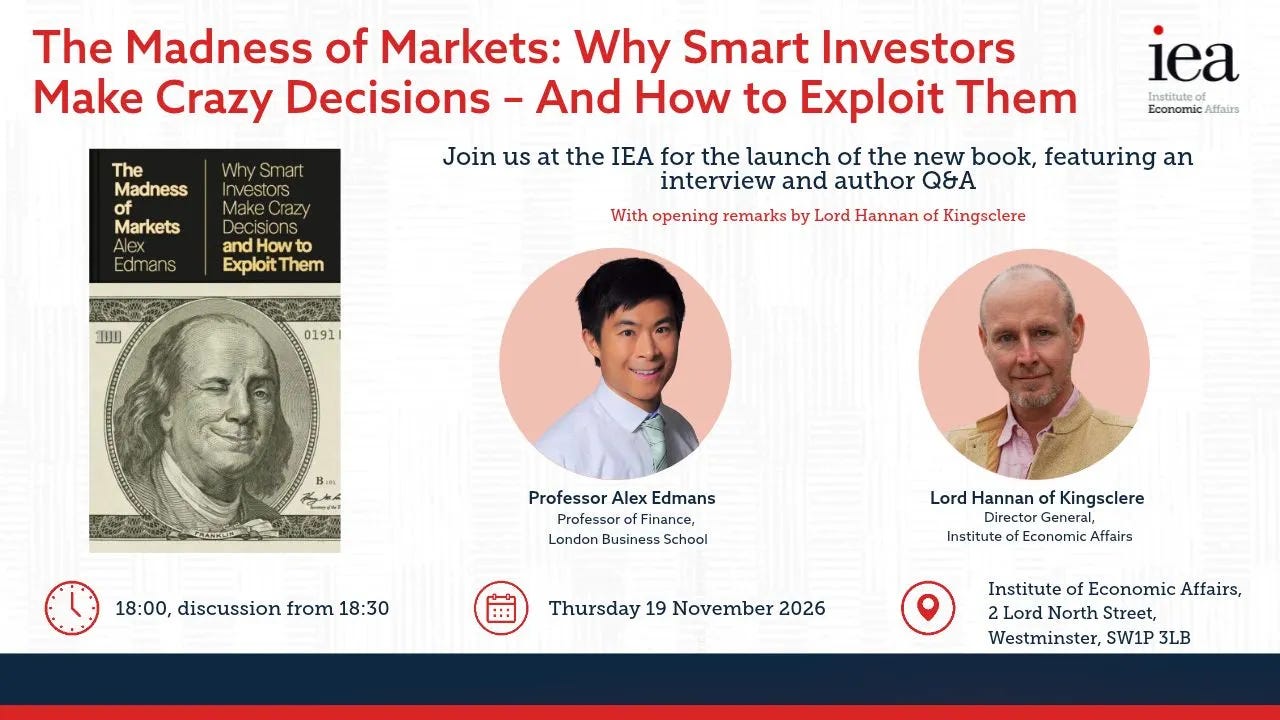
Event description
Markets are supposed to reward cool heads and careful analysis, yet even the most experienced investors are swayed by mood, emotion and the behaviour of the crowd.
In The Madness of Markets, Alex Edmans, Professor of Finance at London Business School, explores why investors pour money into loss-making AI stocks, why they overlook opportunities in plain sight, and why share prices can fall after a football defeat or rise on a sunny day. Drawing on research into market psychology, he shows how social contagion leads even seasoned professionals into irrational decisions, and how investors can avoid costly mistakes and benefit when others get it wrong.
The event will open with remarks from Lord Hannan of Kingsclere, Director General of the Institute of Economic Affairs. Professor Edmans will then present the book and set out its central arguments, before joining Lord Hannan for a discussion, followed by questions from the audience.
We would be delighted if you could join us for this free event, open to all.
Speakers
Professor Alex Edmans is a leading expert on market psychology, with research featured in the Financial Times, Wall Street Journal and BBC, and he has advised sovereign wealth funds, pension funds and asset managers around the world. He has spoken at Davos, given evidence to the House of Commons and reached millions through his TED talks. His previous books include May Contain Lies, an Amazon number one bestseller, and Grow the Pie, a Financial Times Book of the Year.
Lord Hannan of Kingsclere is the Director General of the Institute of Economic Affairs
Event details
Thursday 19 November 2026 at the Institute of Economic Affairs, 2 Lord North Street, London SW1P 3LB.
18:00-18:30 Doors open and welcome
18:30-20:00 Presentation followed by interview and audience Q&A