


Anthony Boutall is Head of Schools Outreach at the IEA.
If you listen to many people of my age or above, they will tell you that young people are a lost cause. They describe a generation fed a toxic diet of lockdown isolation and divisive algorithms, equipped with personal devices designed to entrap them in an artificial online world – devoid of freedom and human flourishing. Whether it’s their psychological resilience or their capacity for critical thinking, the received wisdom is that youngsters are now beyond saving.
Anyone who subscribes to this view clearly hasn’t come across the brilliant young people we met last week from schools in Manchester, Newcastle, Middlesbrough and Edinburgh.
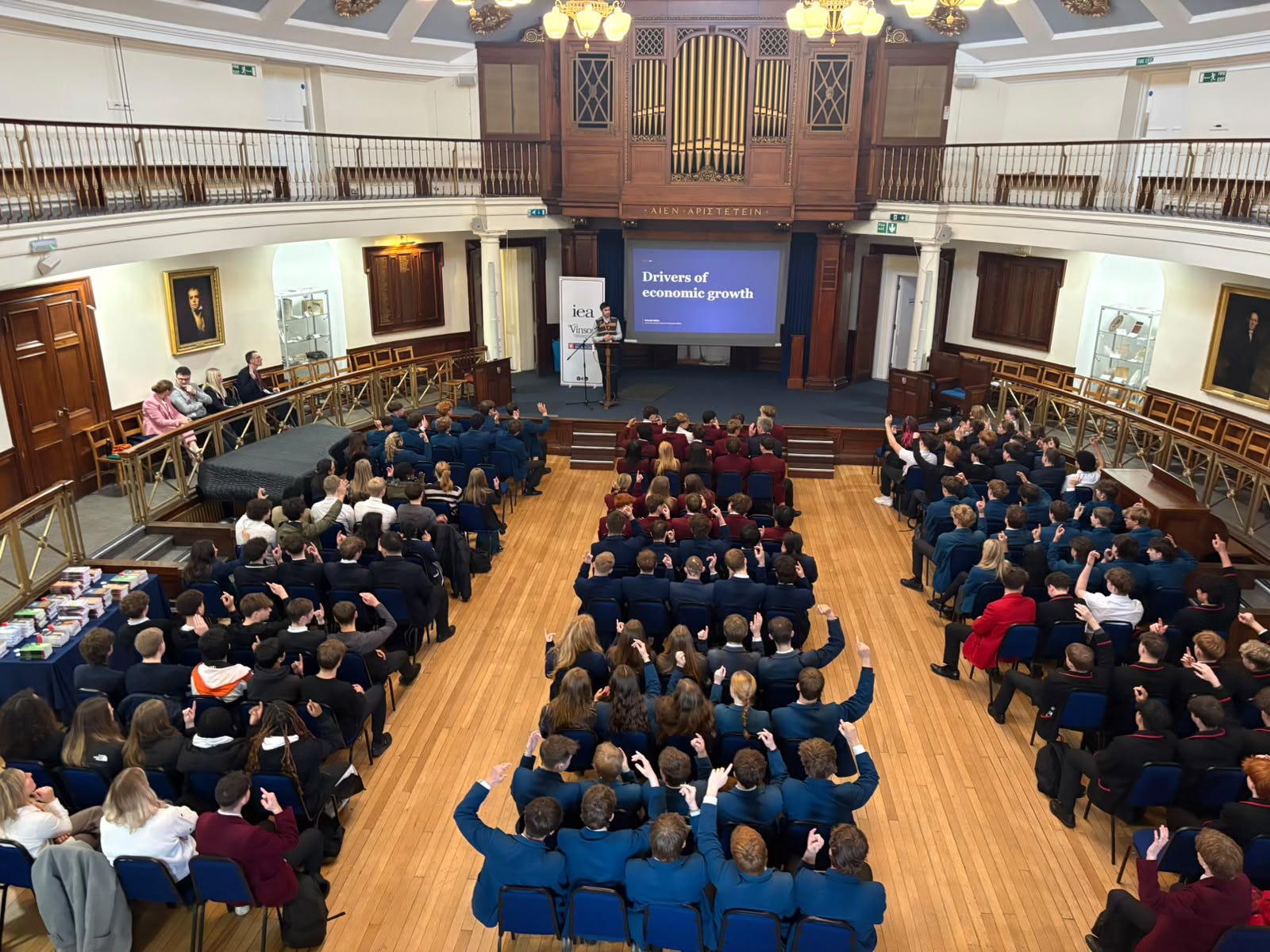
From Wednesday 4 to Friday 6 November, representatives from the Institute of Economic Affairs, the Vinson Centre at the University of Buckingham and the Institute of International Monetary Research (IIMR) toured schools in the north of the UK. Stretford Grammar, Emmanuel College and the Edinburgh Academy hosted us for excellent conferences, designed for their students and those from several other invited schools. Topics included obstacles to growth, debates around inequality, the history of economic crises and, in Edinburgh specifically, the challenges and opportunities of the Scottish economy.
A principal aim of the tour was to further economic understanding in places rarely visited by similar London-based educational charities. Having the likes of Dr Steve Davies, our Senior Education Fellow, and Dr Valentin Boboc, our Chief Economist, arrive at your school is an excellent opportunity to engage with some of the best in the business, and the students rose to the challenge.
Some of the most electrifying moments came from students willing to grapple with ideas and question orthodoxies – either those they previously held or those freshly presented to them. Anyone who doubts young people’s capacity for resilience and critical thinking should witness a sixth-former take the first chance to raise their hand and engage with our economists on one of these days. In a world of polarising narratives, it was genuinely inspiring to see such appetite for open dialogue.
As the IEA’s new Head of Schools Outreach, I want to build on exactly this kind of work. Having spent years as an Assistant Headteacher, I know how much young people gain from these opportunities, which is why I’m delighted the IEA is expanding them.
If we do not make sure young people hear the full range of arguments, we cannot expect anyone else to do this job for us. Many young people are being told that rent controls are the answer to our housing problems, yet few hear that economists from across the political spectrum warn they reduce the supply and quality of homes, which could leave many young people living with their parents well into adulthood.
Others are hearing calls to “abolish” the wealthy, rarely accompanied by any discussion of what that would mean for the tax revenues that fund hospitals, roads, police and our armed forces. Students deserve to weigh up the arguments.
In a world where the poorest 10 per cent in the freest quarter of countries have incomes nearly eight times higher than those in the least free, according to the Economic Freedom of the World report, it is imperative that students are given the facts and encouraged to think critically about the future they wish to strive for.
For some of these students, it was the first time they had really considered the trade-offs involved in pursuing economic equality, or the role voluntary exchange has played in lifting people out of poverty. For others, it was simply a chance to stretch their thinking ahead of their A levels and university applications. That has immense value in itself.
Later this month, we will see 250 students in Hendon, with further conferences already booked this academic year, including in Chelmsford, Reading, Dartford, Peterborough and Bedford. At the Free Minds Economics Conference, hosted by the LSE Hayek Programme in partnership with the IEA, we drew over 350 sixth-form students. We are organising an even bigger event in Yorkshire, God’s Own Country, early next year, with the hope of reaching several hundred young people in a single day.
On top of this, and in partnership with organisations such as the Vinson Centre, the IIMR and the Adam Smith Institute, we run programmes including the Budget Challenge competition, the Monetary Essay Prize, Freedom Week, Future Thought Leaders, Camp Vinson, the Beloff Conference and the Public Policy Bootcamp.
We are also expanding many of these programmes through the Liberty Beyond London project. We are reaching sixth-formers, undergraduates and early-career professionals from across the country. With further support, we want to take this work into every region of the UK.
As John Stuart Mill put it in On Liberty, “He who knows only his own side of the case, knows little of that.” Through our growing education programme, we want the arguments for free minds and free markets to reach as many young people as possible – not so they must accept them, but so they can weigh them up for themselves.
Today’s young people aren’t a lost cause. They are hungry for debate and intellectual challenge. We are ramping up our activities to meet that demand, and we are having a lot of fun in the process!