


In today’s newsletter:
Read Lord Hannan’s Budget analysis
Watch: The Budget Breakdown | IEA Podcast - Bonus Episode
Ballots and Balance Sheets: read the first instalment of the new series in Economic Affairs
An introduction from Economic Affairs editor Maeve Halligan
Budget week has been and gone, and what a week it was: £15 million for Dolly Parton’s literacy initiative, £10 million for craft brewers, and half a million more people dragged into the higher rate of tax. Those hoping for a bold plan for growth may be feeling rather disappointed.
Our team has been busy making sense of it all. Lord Hannan argues in the Daily Mail that we got exactly the Budget we asked for, and IEA Chief Economist Dr Valentin Boboc explains why another record tax burden is now business as usual. Catch up on IEA Budget analysis in our bonus podcast episode.
Beyond the Budget in Economic Affairs this week, read the first instalment of our new series, Ballots and Balance Sheets. It makes a refreshing change to see politicians held to a clear standard, even if the results are rarely flattering. As ever, thank you for reading.
Daniel Hannan is Director General at the Institute of Economic Affairs.
Andy Burnham might as well have stood up and announced that there will be an election on 6 May 2027. Whatever he claims – and the PM has ruled out an early poll in unequivocal language – he is plainly gearing up to go to the country.
The populist handouts, the petty grants, the hike in the minimum wage, the new paternity leave rights – all these things create an immediate feel-good response at the expense of a hit to our economy.
They are what economists call “revealed preference”: a way to judge people by their actions, not their words. The preference revealed here is that of a government that intends to put off all the hard decisions until after polling day.
The two biggest numbers in that Budget were not cited by the Chancellor, John Healey. The first is the reduction in what is called “fiscal headroom”, in other words the amount in any year that can be used to cut taxes, used to pay off debt or blown away in even higher spending.
John Healey confirmed that he is reducing the fiscal headroom from about £24 billion to £15 billion in 2029–30. If he intended to govern for another three years, he would surely have used that extra cash to reduce our debt.
That, after all, is what the 2024 Labour manifesto promised, and what he himself has recommitted to. The last thing he wants is a bond crisis on his watch.
But instead of providing against one, he is frittering the headroom away on various goodies, all of them designed to elicit a single headline, some of them targeted at specific sectors, charities or constituencies.
The second big number is half a million. That is the number of people who will now become higher-rate taxpayers, a consequence of leaving the bands unchanged while inflation continues to erode the value of our money.
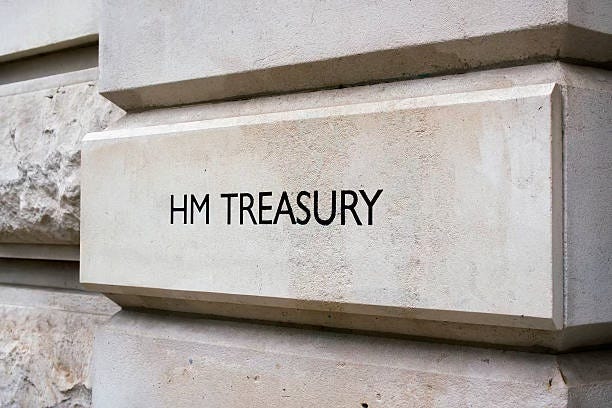
This Budget will, when all the numbers have been run, almost certainly mean the highest tax take in our peacetime history. So will next year’s, and the year after that. Fiscal drag is the engine paying for the massive increase in our social security budget. Everything else is detail.
Still, details matter. Again and again, we heard announcements that sacrifice long-term prosperity to short-term popularity. Special deals for miners, special deals for carers, an extension of maternity and paternity leave. None of these things is cost-free. All have to be paid for. But an electioneering government might reasonably hope to get the good headline now, and the economic pain later.
Will it work? Probably. Frédéric Bastiat famously distinguished good from bad economists by a single test: did they consider second-order consequences? As a nation, we have repeatedly failed that test. We applaud cash handouts without stopping to ask where the money is coming from. We cheer tax rises that we think will fall on other people – bank taxes, mansion taxes, wealth taxes – without stopping to consider how we will suffer from the slower growth that follows. We approve of rises in the minimum wage while simultaneously moaning about how hard it is for young people to find jobs.
“Again and again, we heard announcements that sacrifice long-term prosperity to short-term popularity.”
Our short-termism became especially acute during the lockdown, and our politicians noticed. Hence the sector-by-sector, town-by-town grants announced yesterday: £10 million for brewers, £15 million for Dolly Parton books, £6 million for Glasgow.
Then the brazenness of giving households £100 each, the kind of policy that I associate with the populists of my native Latin America. And it seems to be working.
It is true, of course, that the PM has ruled out a snap election, clearly, repeatedly and recently. Asked earlier this week whether he was softening the country up for an early poll, he replied: “No, I’ve ruled that out.”
Then again, Theresa May ruled out an early election in 2017. Boris Johnson ruled out an early election in 2019. They ruled them out right up to the moment when they called them.
The awful thing about this kind of Peronism is that, in its own terms, it works. Yes, it leaves people poorer, and drains a nation’s wealth. But it creates client groups dependent on the government and builds a statist electoral majority. As the old adage goes, democracies get the leaders they deserve.
The best way to never miss out on IEA work, get access to exclusive content, and support our research and educational programmes is to become a paid IEA Insider.
Is Britain heading down the road to Perón’s Argentina? Maeve Halligan, Lord Hannan and Dr Valentin Boboc look at what the Budget’s £100 winter heating payment reveals about the growing appeal of visible handouts, and what history suggests about where that leads. They then discuss the new surcharge on rental income and tribunals that set “market rents”, before closing with why this may be the largest tax-raising Budget in history. Watch on YouTube
This week in Economic Affairs
Budget analysis:
The IEA’s verdict on Budget 2026

It was an interesting Budget. In absolute terms, this was a Budget with an enormous number of individual policies (98 to be precise) but each measure had a record-low average scorecard value. In a way, you could say that this was a Budget consisting entirely of marginal tweaks.


Also this week:
Lula’s fourth term: a state-heavy platform meets a right-leaning Congress

Ballots and Balance Sheets is a fortnightly series, published on Tuesdays, scoring election candidates worldwide on their free-market credentials.


News and Views from the IEA
Budget Breakdown | IEA Podcast - Bonus Episode
Is this a Budget to put Britain on the path to growth, or one designed to buy time ahead of an early election? Just hours after Chancellor John Healey delivered his first Budget, Maeve Halligan is joined by IEA Director General Lord Hannan and Senior Education Fellow Dr Steve Davies to go through what was announced and what was left out. They discuss fiscal drag, the giveaways that make the tax system ever more complicated, and what the Budget got right. They also ask whether young people are being offered nice-sounding policies that will leave them worse off. Watch on YouTube.
Another Budget, another record tax burden. Dr Valentin Boboc writes for City AM on why this week’s Budget pushes the tax burden to yet another record high. He argues that frozen thresholds and fiscal drag are doing the heavy lifting, while measures such as the First Time Buyer ISA repeat the familiar mistake of subsidising demand while supply stays restricted.
This week, we got the Budget we asked for. Lord Hannan writes for the Daily Mail on why voters keep cheering for “free” stuff without asking who pays for it. He argues that a Budget of small handouts has made the tax system even more complicated, while frozen thresholds drag half a million more people into the higher-rate band.
“We seem unable to process the concept that all these taxes, in the end, fall on us.”
The Government is yet to explain how it will pay for its 3% defence target, the Daily Express reports. Professor Len Shackleton, editorial and research fellow at the IEA, is quoted discussing the Budget, which he called “underwhelming”. He said that funding a lasting defence uplift means either raising taxes or making cuts, both of which carry a political cost.
“Altogether a disappointment […] made up of small and largely insignificant adjustments.”
The middle class is squarely in the firing line of this week’s Budget, the Telegraph reports. Dr Valentin Boboc is quoted discussing fiscal drag. He explained that frozen thresholds on income tax and National Insurance mean the tax burden keeps rising even without any new taxes.
The Government is spending £124bn a year just to service its debt. Dr Valentin Boboc writes for GB News on why the Budget offers little sign of a change in direction. He argues that frozen thresholds will keep pushing taxes up, and that poorly targeted £100 energy payments treat the symptoms of high bills rather than the cause.
“If growth disappoints, taxpayers could once again be left footing the bill.”
Fewer than one in four jobs in Britain generate enough tax to cover the cost of the state, the Daily Express reports. Dr Valentin Boboc is quoted discussing new IEA analysis showing that workers need to earn £42,375 before they pay their share of average government spending per person. He warned the Chancellor against loading heavier taxes onto those already footing the bill.
“Britain cannot keep piling higher taxes onto a shrinking tax base.”
Margaret Thatcher did not lose Britain a trillion pounds. Dr Kristian Niemietz, Editorial Director and Head of Political Economy at the IEA, writes for The Critic on the Chancellor’s sovereign wealth fund claim. He argues that the Thatcher government paid down debt rather than frittering money away, and that a British fund would probably have been politicised.
“Our fiscal woes are the result of multiple bad decisions made over longer periods.”
The UK is now spending more than £100bn a year on servicing its national debt, the Daily Express reports. Dr Valentin Boboc is quoted discussing the Prime Minister’s pledge of fiscal responsibility. He said that further taxes on work and investment risk choking off the growth needed to bring the debt down, and that the Government should curb spending growth and remove planning and regulatory barriers instead.
“Taxpayers cannot keep being handed the bill for commitments politicians are unwilling to fund through savings elsewhere.”
Liberal elites want to talk to the working class but not to listen to it. Mani Basharzad, Junior Research Associate at the IEA, writes for spiked on Daron Acemoglu’s new book, What Happened to Liberal Democracy? He argues that Acemoglu calls on liberals to engage with working-class voters, then waves away their views on Brexit and immigration.
“Acemoglu’s working-class liberalism wants to be all things to all men.”
Big charities have grown expensive and corporate, and donors are falling away, the Telegraph reports. Christopher Snowdon, Head of Lifestyle Economics at the IEA, is quoted discussing how much large charities spend on staff and lobbying. He said that if the public knew where the money went, many would be less inclined to donate.
California is about to vote on a one-off 5% tax on its billionaires, BBC News reports. Dr Kristian Niemietz is quoted discussing why wealth taxes have fallen out of favour across Europe. He said they are hard to administer, suppress investment, drive capital abroad and raise little revenue in the end.
Hundreds of Scottish public sector workers have been paid for years after their roles were abolished, the Daily Mail reports. Dr Valentin Boboc is quoted discussing the Scottish Government’s ban on compulsory redundancies. He said that although redeployment can make sense, managers need the flexibility to reduce staff numbers so taxpayers get value for money.
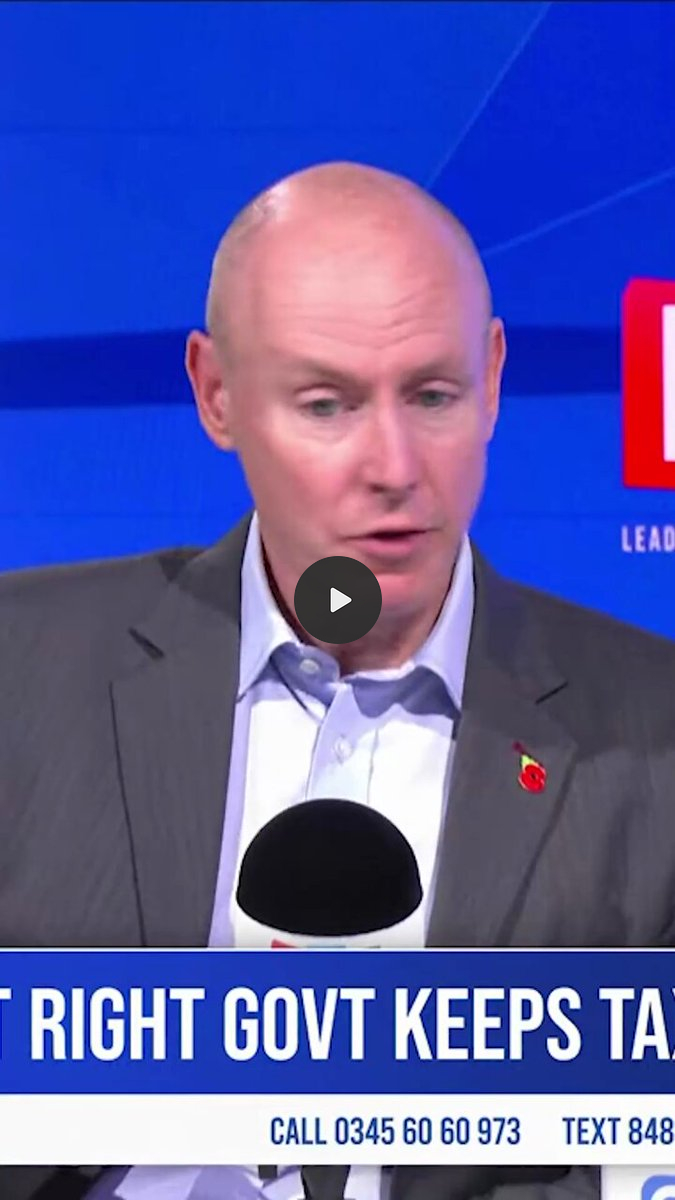
Missed our live Budget 2026 commentary? Catch up here:


Education, Events and Opportunities
The IEA hosts The Tyranny Tracker: Global Trends in Democracy and Authoritarianism
On Monday this week, the IEA hosted guests from The Human Rights Foundation to present their new Tyranny Tracker, which measures democratic resilience, erosion and authoritarian consolidation in every region, separating genuine democracies from hybrid and fully authoritarian regimes.
Javier El-Hage, HRF’s Chief Legal and Policy Officer, presented the index’s methodology and key findings, followed by a panel with HRF researchers and Jesús Armas, a Venezuelan democracy advocate and former Caracas city councillor who was held at El Helicoide from December 2024 to February 2026.
Many thanks to all who attended what was a wonderful event and participated in this important discussion.
Upcoming:
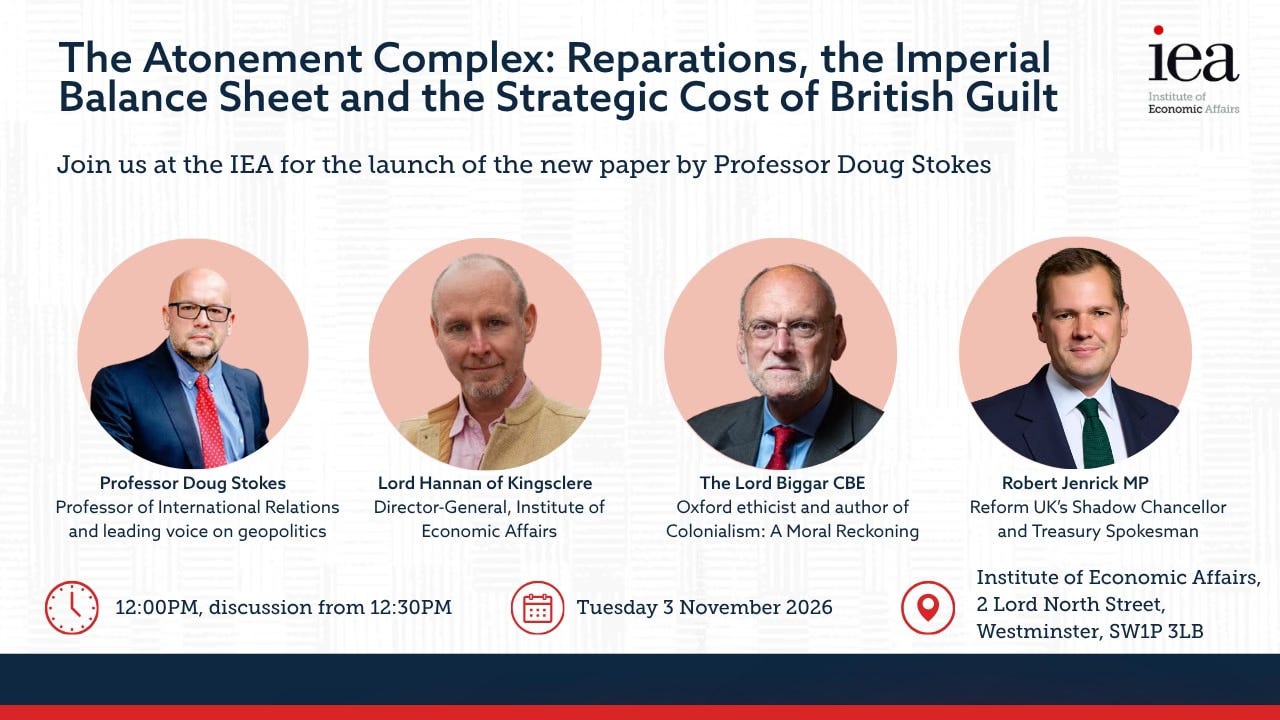
The Atonement Complex - Report Launch
03.11.2026
The campaign for slavery reparations has rarely had more momentum, and its case has rarely been examined less. With Caribbean leaders taking a £18.8 trillion claim to the Commonwealth summit in November, Professor Doug Stokes’s new paper, The Atonement Complex, examines the accounts: who really profited from slavery, what the British public paid to end it, how the trillion-pound figure was built, why other parties to the trade are left out of the story, and how hostile states have turned Western guilt into a tool of statecraft. Join us for this free event, open to all, to mark the paper’s launch.
Speakers
Professor Doug Stokes, Professor of International Relations and Vice President for Institutional Development at Modul University Vienna. An Honorary Professor at the University of Exeter, he advises political and business leaders across the UK and Europe and writes regularly for The Times, The Telegraph, The Spectator and The Critic.
Lord Nigel Biggar, author of The New Dark Age: Why Liberals Must Win the Culture Wars. Emeritus Regius Professor of Moral Theology at the University of Oxford and a Conservative peer in the House of Lords, he is also the author of Colonialism: A Moral Reckoning and Reparations.
Robert Jenrick MP, Reform UK’s Treasury spokesman. MP for Newark since 2014, he previously served as Housing Secretary, Immigration Minister and Shadow Justice Secretary.
Lord Hannan of Kingsclere, Director General, Institute of Economic Affairs
Event details
Tuesday 3rd November 2026 at the Institute of Economic Affairs, 2 Lord North Street, London SW1P 3LB.
12:00-12:30: Doors open and welcome
12:30-13:30: Panel discussion
13:30-14:00: Post event reception; soft drinks provided
The Higher Education Delusion - Book Launch
11.11.2026
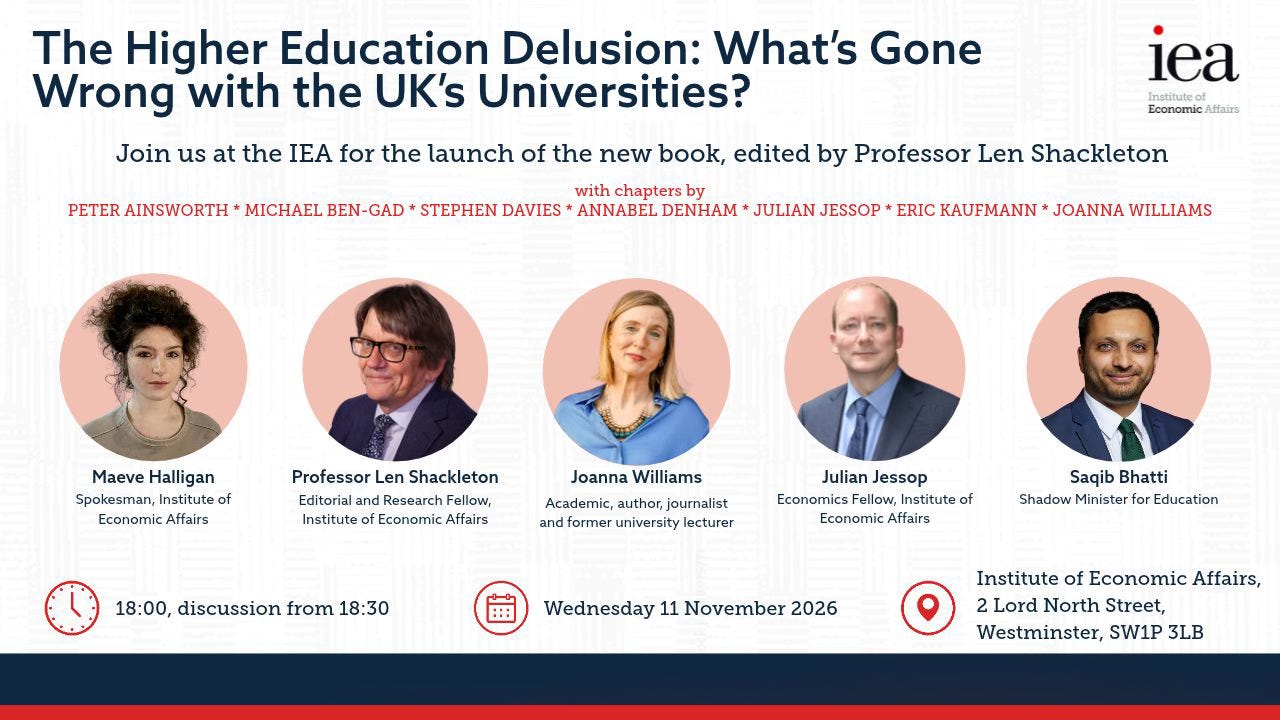
Britain’s universities are still called “world-leading”, yet the sector has rarely looked more troubled. More than a third of institutions are in deficit, first-class degrees have risen from 7% to 30% of all awards, and only around a third of recent students are expected ever to repay their loans in full. In The Higher Education Delusion, ten contributors ask what has gone wrong, from the falling graduate premium and a student loan system that works like a badly designed tax, to universities’ reliance on international students, the political monoculture on campus and the threat posed by artificial intelligence. The book’s editor, Professor Len Shackleton, will join two of its contributors for a panel discussion on the case for radical reform. Join us for this free launch event, open to all.
Speakers
Professor Len Shackleton - Professor of economics at the University of Buckingham and Editorial and Research Fellow at the Institute of Economic Affairs.
Julian Jessop - Economics Fellow at the Institute of Economic Affairs
Joanna Williams - Academic and commentator, and a former director of the Centre for the Study of Higher Education at the University of Kent. She is the author of How Woke Won, Women vs Feminism, Academic Freedom in an Age of Conformity and Consuming Higher Education.
Maeve Halligan - Spokesman for the Institute of Economic Affairs and editor of Economic Affairs, the IEA’s Substack. She comments on free speech, women’s rights and the political attitudes of young people, and has written for The Free Press.
Saqib Bhatti MBE is a British Conservative Party politician who has been the Member of Parliament for Meriden and Solihull East, formerly Meriden, since the 2019 general election. Saqib currently serves as Shadow Minister for Education.
Event details
Wednesday 11 November 2026 at the Institute of Economic Affairs, 2 Lord North Street, London SW1P 3LB.
18:00-18:30 Doors open and welcome
18:30-20:00 Panel discussion
20:00-21:00 Post event reception; refreshments provided