



Matthew Lesh is a Public Policy Fellow at the Institute of Economic Affairs and a Director at Freshwater Strategy.
Chancellor John Healey is in an unenviable position. He had almost no time to prepare for the role and was appointed as a ‘steady pair of hands’ at a time when things were far from stable. The conflict in the Middle East is thought to have stabbed a £12 billion hole in the government finances. Gilt yields are at their highest in decades, meaning we’re paying more to service the national debt before we can spend on public services or tax cuts.
There are continued demands for more ‘cost-of-living’ reliefs in the face of rising energy and food prices, the sort of measures that the Bank of England’s Andrew Bailey has warned would be inflationary. The expectation now is that Healey will impose higher taxes on banks, which the sector claims could cost the British economy tens of billions, while ruling out raising capital gains taxes. Other nitpicky tax rises could also be on the way, despite some positive moves to reduce the red-tape burden on businesses.
In our City AM / Freshwater Strategy poll earlier this month, we asked voters what they expect from the forthcoming Budget. Perhaps the most comforting news for the Chancellor is that the public’s expectations are pretty low. A majority (54%) expect to be personally worse off as a result of the Budget; just 6% expect to be better off. A plurality, two fifths, expect the economy to worsen, while just one fifth expect it to improve after the Budget.
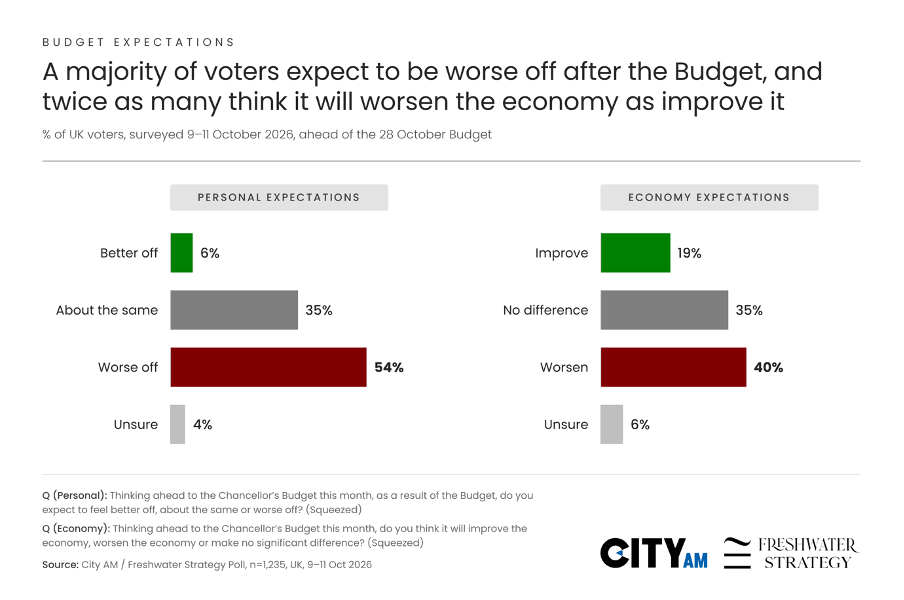
If the Budget leaves people about where they are today, the ‘do no harm’ minimalist approach that has largely been briefed to the media, the public may just be pleasantly surprised, especially compared to Reeves’ damaging tax-raising Budgets. The trouble with that strategy, however, is that it shifts the difficult decisions, particularly on spending and deficit reduction, into the future. It also doesn’t set the country up well for the much-needed growth to get us out of our current rut; for example, what is the plan to reform Britain’s Byzantine tax system, which creates all sorts of disincentives to work and invest? Where are the measures to address the ballooning welfare budget and growing worklessness? How will promises around defence spending be funded?
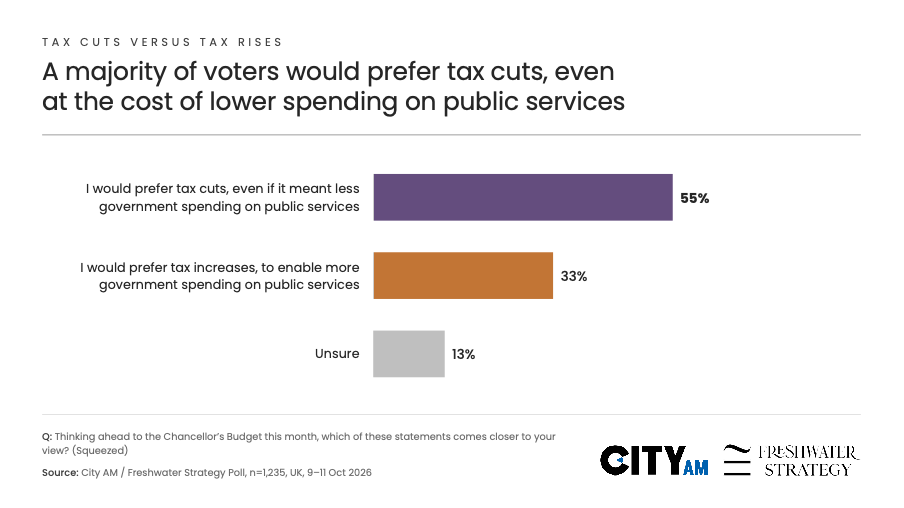
On the fiscal direction voters want, the answer has shifted from what is often asserted in public debate. A majority (55%) of voters now prefer tax cuts, even if it means less government spending on public services, compared with just one third (33%) who want tax increases and more government spending. With Britain now approaching post-war highs in tax take, the public have flipped since the Tories took power, moving towards wanting a smaller rather than a bigger state.
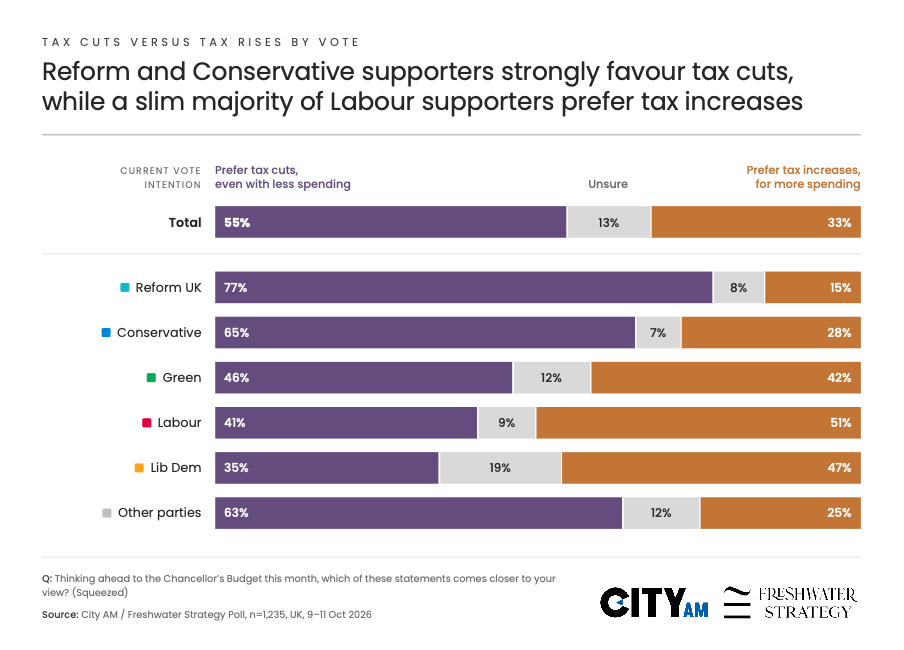
However, views differ by party vote: Reform voters most want tax cuts (77%), followed by Tories (65%), while Lib Dem (47%) and Labour (51%) backers tend to want higher spending.
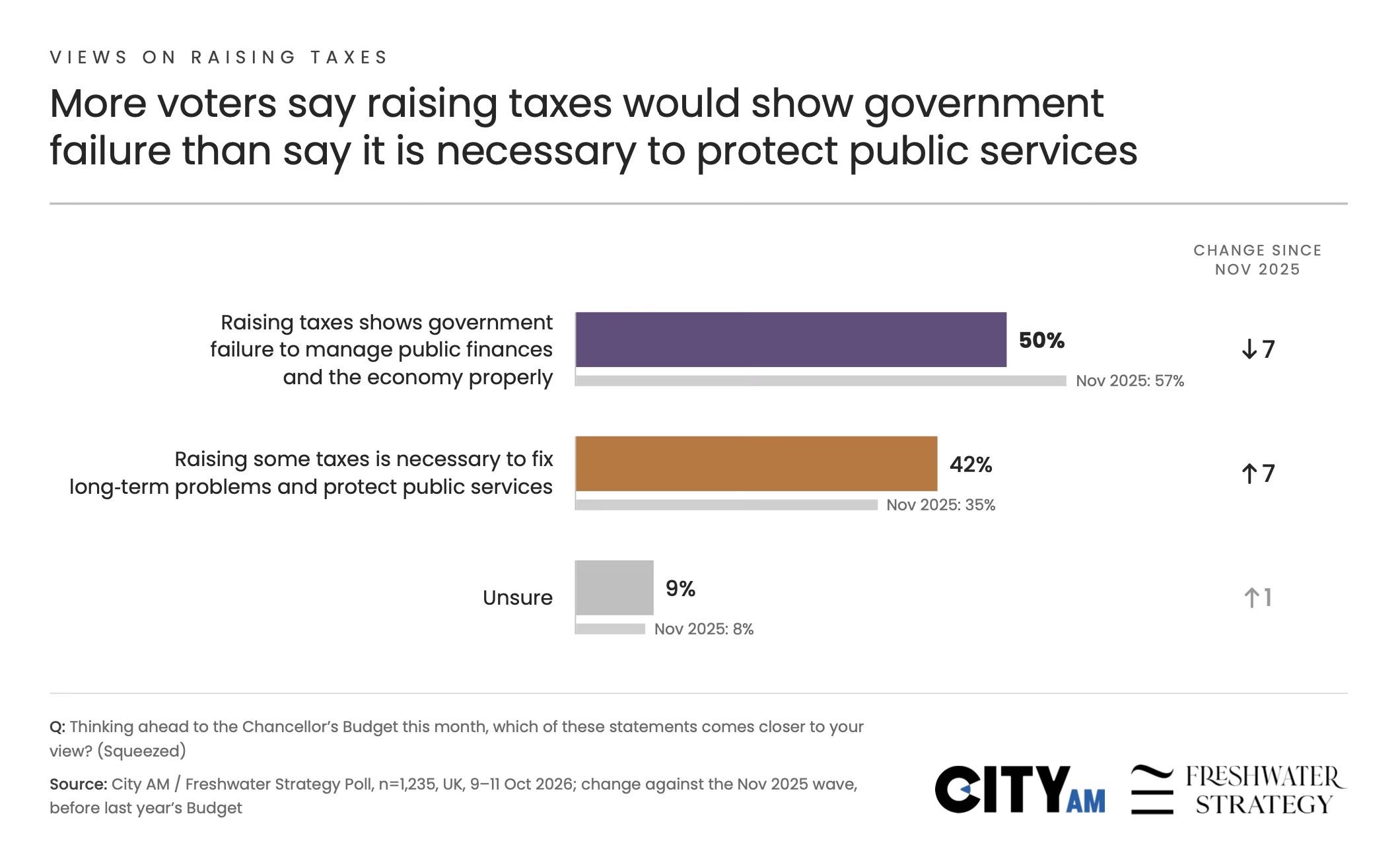
Finally, on who will be blamed, about half (50%) of voters say raising taxes would reflect a failure to manage public finances and the economy well, compared to two fifths (42%) who would say it’s necessary to fix long-term problems and protect public finances. Compared to when we last asked this question, ahead of the Budget in November 2025, the public have become more sympathetic to the view that tax rises may be necessary, up 7 points.
Healey will deliver the Budget amid immense pessimism. Elsewhere in the survey, we find that half (50%) of the public expect the economy to worsen over the next year, up 6 points in October since the Burnham optimism bounce evident in the previous two months, and with two thirds (65%) not confident in the Government’s plan to achieve growth. Few people expect the Chancellor to turn this around, and perhaps that lack of hope will be Healey’s saving grace on the 28th.
I am constantly amazed that contributors to this site appear not to consider the poorer members of society, and pillory any government that does! Why?
“ The conflict in the Middle East is thought to have stabbed a £12 billion hole in the government finances. ”
Tripe!
Fiscal incontinence for the last 20 years by successive Governments, the ballooning welfare state and bureaucracy that goes with it, 15 million new welfare recipients imported from abroad, suicidal energy policy, far too big public sector and general incompetence and economic illiteracy have caused it.
I have lived through umpteen conflicts in the Middle East, most far worse than now, counting from the 1960s: Six Day War, Arab-Israel War, Iraq-Iran War, Gulf War I, Gulf War II, Libyan Civil War - and there are others.
None of these produced “black holes” in UK budgets.
Everything gets blamed, Russia/Ukraine, war with Iran, Trump, Brexit, and everybody’s current chew-toy, Putin - the ONLY cause, as ever, is Government.