


Rt Hon Steve Baker FRSA is Chairman of Fighting for a Free Future.
Readers of Economic Affairs know how this Budget has landed: very flat indeed. As I write, I see the technocratic Institute for Fiscal Studies has said the Budget has done nothing to ease household pain, adding that there could be “brutal” cuts to public services next year. It seems the Budget has merely bought breathing room for the Government, not for the rest of us. And does anyone believe that Parliament will vote for cuts when they come?
The post-Budget has laid out the key points. Overall, the fiscal impact of Budget measures will be negligible even as taxes and borrowing are up. Still, the Chancellor has relatively scant fiscal headroom. Inflation is expected to rise. Welfare will balloon. Household incomes and living standards will fall. Interventions in housing and energy are weak palliatives that do not address ultimate causes. Accumulated capital will face higher taxes, prejudicing future prosperity. This Budget presents a dismal picture even in its own terms.
But the fuller official picture of the public finances is still worse. The Office for Budget Responsibility (OBR) Fiscal risks and sustainability report of July 2026 shows the public finances are not sustainable beyond the Budget forecast horizon. It explains that choosing to delay policy action – cuts – “would require a more significant, and therefore more painful, fiscal tightening in the future”.
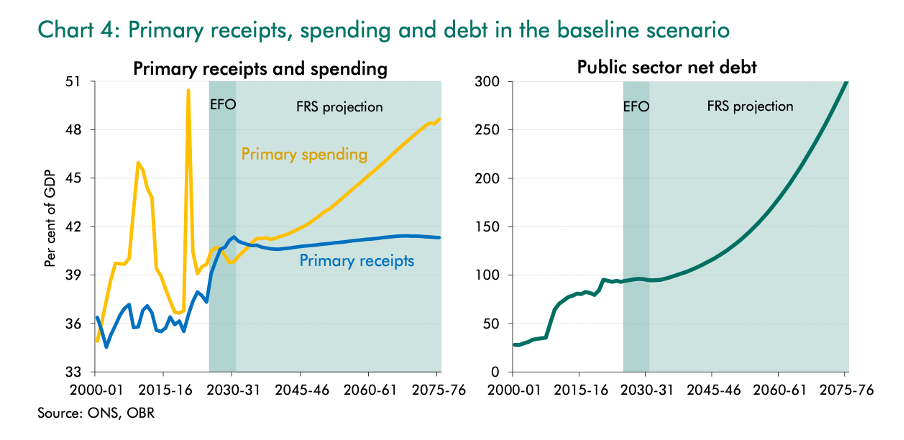
This Budget was poor and unequal to our immediate challenges, but it descends into tragedy when we look up and ahead. The OBR report is clear: age-related spending is driving public debt onto “an unsustainable ever-rising trajectory”.
Raising taxes is not a solution. In a report for Politeia, economist David B. Smith argued in 2020 that the UK tax and spending burden was already high by historic standards. He showed it has been difficult to keep the non-oil tax burden above 39 per cent of factor-cost GDP for any length of time. It appears we are at the limits of taxation.
Young and old, our politics is failing you. If you are my age – 55 – don’t expect even today’s relatively poor public services and state pension in 20 years. If you are young, expect to grind miserably forwards under intolerable taxation and inflation, unable to buy a home, start a family or flourish like generations before you, as ever greater debt is thrown on your shoulders.
You are right to be angry. But fury cannot secure a bright future. It is time to take stock.
Are we in this pickle thanks to years of laissez-faire regulation, low taxes, government surpluses and sound money? To ask is to answer: whatever our problems, they do not arise because of what is disingenuously called “neoliberalism”. What is failing is managerialism, of which Tony Blair’s “Third Way” was one version.
That managerialism emerged out of the two world wars and led to the establishment of welfare states. Alan Greenspan forecast what would happen in an essay he never disowned, Gold and Economic Freedom: for robust public-choice reasons, welfare states would live beyond the means of taxpayers and fund themselves through chronic inflation. Look at a chart from the ONS and House of Commons Library showing consumer price inflation since 1750 and you see a clear discontinuity.
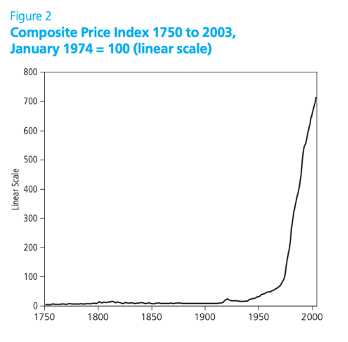
Money broadly held its value through the Industrial Revolution and up to the First World War. It then lost value steadily, and the end of Bretton Woods in 1971 severed the last link to a commodity of relatively fixed supply. As Greenspan predicted, inflation has been the neglected stealth tax we barely discuss. Check the Bank of England’s inflation calculator: what cost you £100 in 2010 would cost you over £160 today. Money has lost 38 per cent of its purchasing power, with a big hit after a pandemic in which the Bank of England covered, to a reasonable approximation, all the Government’s bond issuance with new money.
No wonder the nation and the western world groan under a sense that life does not work for too many people any more. How can it be otherwise when we so abuse our currencies?
Authors like Keynes and Mises, Hayek and Rand understood and explained the insidious effects of chronic currency debasement to sustain public spending. Readers of Economic Affairs are amongst the few who might now explain the scale of our predicament.
Alas, here we are: a system of society founded on dishonest promises to provide security for everyone at the expense of everyone else is now running into the limits of taxation, the limits of debt and the consequences of debauching the currency for a lifetime to keep the bond markets going. You can find my paper, with the data, here.
Disaster lies ahead, and that is why this useless Budget must be a clarion call to free-market economists.