


In today’s newsletter:
The NEET crisis won’t be resolved unless hiring young people gets cheaper
Reforming Road Tax - the new report from the IEA, by Professor David Bailey
Jorge Ruiz on drug trafficking and the parallel economy
An introduction from Economic Affairs editor Maeve Halligan
Whether they’re out of work, out of school or just out of luck, this week’s newsletter is dedicated to Britain’s young people.
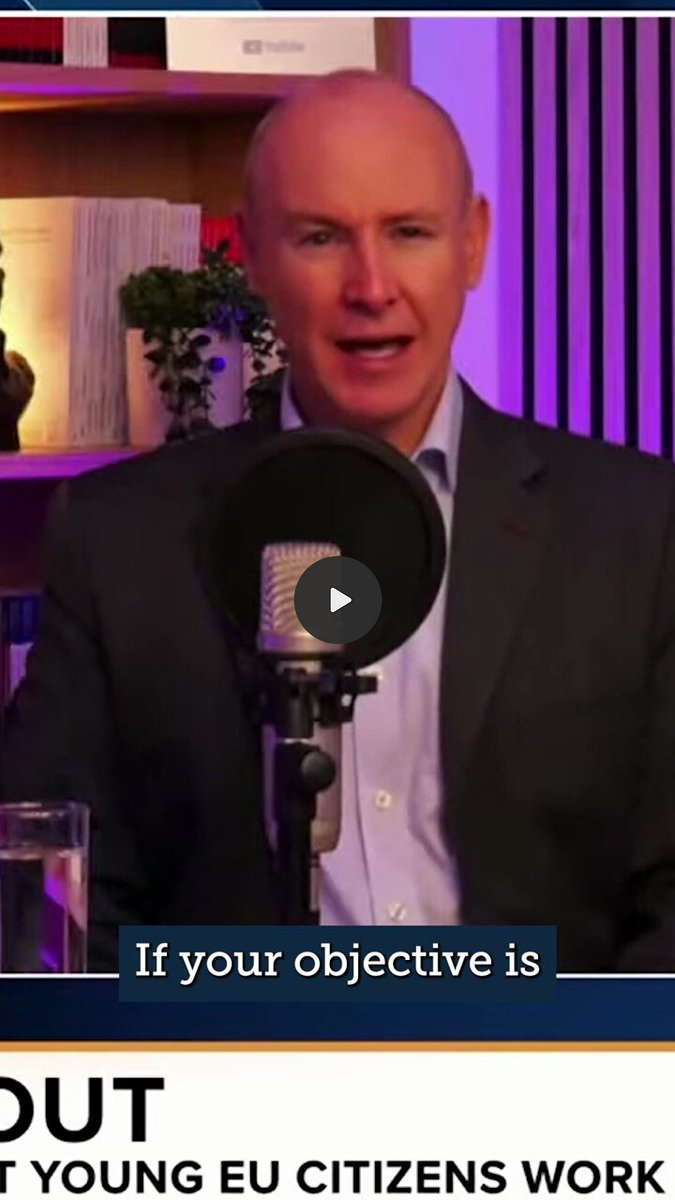
On Tuesday, Alan Milburn delivered his proposals for how to address the problem of one million 16- to 24-year-olds who are neither learning nor earning. Catch up on our same-day response in a bonus episode of the IEA Podcast. One reason why so many Gen Zs are sitting idle could be that lockdown lumped young people with a less-than-keen work ethic, argues Lord Hannan in this week’s column.
Julian Jessop, meanwhile, follows up on the recent launch of the IEA’s new book, The Higher Education Delusion. Included topics such as grade inflation, student loans and AI are unpacked in this week’s IEA Interview with Saqib Bhatti MP, Shadow Minister for Education.
On the podcast, we ask why growth is at a two-year high even as inflation and borrowing costs climb, and what a new food deal at the UK–EU summit could mean for Britain.
Plus, read Reforming Road Tax, the new IEA report by Professor David Bailey, which makes the case for a pay-per-mile charge that replaces fuel duty rather than adding to it.
Don’t forget to sign up to The Future of Money on Tuesday 8 December, marking 50 years since Hayek’s The Denationalisation of Money.
Professor Len Shackleton is an Editorial and Research Fellow at the Institute of Economic Affairs.
Maeve Halligan is an IEA spokesman and editor of Economic Affairs.
A year ago, the Work and Pensions Secretary, Pat McFadden, asked Alan Milburn to find out why so many young people in Britain are neither earning nor learning. Milburn, Health Secretary under Tony Blair and later chair of the Social Mobility Commission, published an interim report in May that diagnosed the problem without making recommendations. His final report, From a Welfare State to a Working State, first promised for the summer, was published this morning.
The scale of the problem explains the attention it has received. Around one million 16- to 24-year-olds, roughly one in eight, are not in education, employment or training (NEET). Most of them are not even looking for work, and six in ten have never had a job. Milburn puts the cost to the country at £125bn a year.
The report proposes a sweeping overhaul. Under-25s would no longer be able to claim the health element of Universal Credit, and would instead receive a new “youth allowance” paid at the standard under-25 rate of Universal Credit, while Personal Independence Payment (PIP) would be replaced by a new Additional Cost Allowance for those with significant, ongoing disability costs. There would be legal guarantees of opportunity and support, and those who persistently refuse to engage could lose their benefit.
Responsibility for long-term sick notes would move away from GPs, and employers would be paid £3,000 for taking on a young person who has been NEET for six months, with £2,000 more where the young person faces greater barriers.
The threshold at which employers in retail and hospitality start paying National Insurance for 21- to 24-year-olds would double from £5,000 to £10,000 over five years, but only “when fiscal conditions allow”. The headline ambition is to cut the NEET rate from 13 per cent to around 5 per cent by 2036, which Milburn says would help 440,000 young people into sustained work.

A diagnosis without a cure
Astonishingly, Milburn says that virtually everything the Government has done since coming into office has reduced the attractiveness of employing young people. Yet he cannot bring himself to call for immediate reversal of these policies, simply hinting at a long-term “glide” in NICs to a lower level.
Taking on an inexperienced 19-year-old is always a gamble for any employer: the recruit may turn out to be excellent, or may need months of supervision before earning their keep. Every policy that raises the cost of that gamble, or makes it harder to undo if it goes wrong, makes employers less likely to take the punt. A higher wage floor, a bigger National Insurance bill, sick pay from day one and stronger protection against dismissal all make young people a riskier and more expensive hire, as Milburn appears to accept.
But it was the Government that cut the threshold at which employers pay National Insurance from £9,100 to £5,000 in April 2025, a change Milburn himself says hit particularly hard. He would raise it again for just one age group in two sectors, over five years, and only “when fiscal conditions allow”. Given the state of the public finances, that may never happen.
More advisers, more guarantees
What we get instead are proposals for a range of organisational changes in the Department for Work and Pensions (DWP) and the NHS, the employment of large numbers of extra staff to advise and counsel, and the return to job and service “guarantees” of the kind used to little effect under the last Labour government’s “New Deal”.
Cost savings are projected to result only years down the road: spending rises to nearly £6bn a year, welfare savings do not begin until 2029–30 and the package does not pay for itself until 2036–37. Even then, his own modelling gets the NEET rate down only to 6.8 per cent by 2036, with the rest of the way to his 5 per cent target resting on hopes of faster growth. And this all assumes we start this stuff more or less immediately, though the reality of parliamentary processes and consultations means that we would struggle to get anything going before 2028.
A guarantee sounds generous, but it is only as good as the jobs behind it. Where employers are not hiring, the state ends up supplying the placements itself, through subsidised roles and training schemes that do little to give young people the experience employers value. The risk is that we spend billions moving young people from one programme to another while the underlying barrier, the cost and risk of hiring them, stays exactly where it is.
Meanwhile today’s youth unemployment figures, though marginally down on the last quarter, remain unacceptably high. Unemployment among 16- to 24-year-olds stands at 15.1 per cent, more than three times the overall rate, and vacancies are at their lowest level in more than a decade outside the pandemic.

What the review leaves out
Milburn’s analysis of the problems of youth inactivity misses out several important factors. For all its emphasis on local delivery, the review says little about regional unemployment, which places a limit on what can be achieved in putting young people into “real” jobs in some parts of the country. A guarantee of work means one thing in a city with a strong jobs market and something quite different in a town where vacancies are scarce and transport is poor.
One way round this which he suggests, though without making a formal commitment, is to impose youth recruitment quotas on the public sector, and also on private contractors competing for public service provision under the “social value” framework. Such measures are likely to make the task of raising the public sector’s abysmal productivity ever more difficult.
He has half a paragraph on variations in NEET incidence by ethnicity, though these differences are large and persistent and any serious strategy needs to understand them. There is nothing about the benefit culture in some communities, where worklessness passes from one generation to the next and work is no longer the expected path into adult life.
There is one line about drug abuse (which likely accounts for a significant part of the growth in mental health issues) and nothing at all about drug crime (which provides a lifestyle for many NEETs who have no intention of working). Milburn acknowledges that he chose not to address drug and alcohol services, focusing instead on mental health.
A review that puts so much weight on rising mental ill health should take seriously the role of cannabis and other drugs. One that hopes to draw young people back into the labour market should recognise that, for some of them, the informal economy pays better than any job likely to be on offer.
The real lesson
Milburn deserves credit for stating plainly that the Government’s own labour market policies have made young people harder to employ. But having made that diagnosis, his review turns away from the obvious remedy. The surest way to get young people into work is to make them cheaper and less risky to hire, not to build a new layer of advisers, counsellors and guarantees around them.
Milburn hopes his package will get 440,000 young people into sustained work by 2036. Until the Government is willing to revisit the policies he himself identifies, that looks optimistic.
Will the Milburn Review Fix Britain’s NEETs Crisis? | Bonus IEA Podcast
Can the Milburn Review really get Britain’s young people back into work? In this bonus episode, Maeve Halligan, Lord Hannan and Shimeon Lee of the TaxPayers’ Alliance look at why 270 pages of recommendations are projected to save just £200 million over ten years, and why the review identifies the real barriers to hiring young people without recommending that any of them be reversed. They then assess the new youth allowance and job guarantee, before asking whether the review treats the symptoms of Britain’s welfare problem rather than the causes. Watch on YouTube
The best way to never miss out on IEA work, get access to exclusive content, and support our research and educational programmes is to become a paid IEA Insider.
Is Britain’s economy finally turning a corner? Maeve Halligan, Dr Valentin Boboc and Robert Armstrong look at why growth is at a two-year high even as inflation and borrowing costs climb, and why the least regulated parts of the economy seem to be doing best. They then ask whether the new Commonhold and Leasehold Reform Bill will do anything to bring down the costs facing flat owners, before closing with a preview of the UK–EU summit and their predictions on what a new food deal could mean for Britain. Watch on YouTube
This week in Economic Affairs


Lockdown created a nation of Rab C. Nesbitts

Lord Hannan of Kingsclere is Director General of the IEA.


News and Views from the IEA
Saqib Bhatti MP on the Crisis Facing UK Universities | IEA Interview
New report: Reforming Road Tax
Pay-per-mile charging should replace existing motoring taxes, not pile on top of them. In a new IEA paper, Reforming Road Tax, Professor David Bailey of Birmingham Business School argues that fuel duty and the planned electric car charge should be gradually replaced with one pay-per-mile charge for all cars, so the typical driver pays no more than now.
“Public acceptance requires a genuine tax switch, not an additional levy.”

Job vacancies have fallen to their lowest level in 12 years outside the pandemic, the Telegraph reports. Professor Len Shackleton, Editorial and Research Fellow at the IEA, is quoted discussing the Milburn Review and youth unemployment of 15.1 per cent. He argues that the review admits the Government’s policies have made young people less attractive to hire, yet offers more advisers and job guarantees instead.
To what problem is the EU reset a solution? Lord Hannan, Director General of the IEA, writes for the Daily Mail on why the Government’s deal with Brussels gives away far more than it gains. He argues that Britain has accepted the EU’s demands on food standards, energy and budget payments without securing any of its own.
“This EU ‘reset’ is not a deal; it is a diktat.”
Brexit paperwork is not to blame for the price of British milk and eggs, the Daily Mail reports. Julian Jessop, Economics Fellow at the IEA, is quoted discussing why the UK–EU reset will not lower food prices. He argues that the main drivers of higher prices are global or down to Government policies on labour costs, energy and tax.
“Exporting more food to the EU will not reduce prices at home.”
The first-class degree has gone the way of the pound in your pocket. Maeve Halligan, spokesman at the IEA and editor of Economic Affairs, writes for ConservativeHome on why a degree is worth less than ever while costing more.
“Grade inflation, like the monetary kind, happens when those printing the currency have every reason to print more.”
Why should anyone who wants to change politics stay out of it? Kristian Niemietz, Editorial Director and Head of Political Economy at the IEA, joins Frei heraus, the podcast of the German think tank R21, to discuss why we urgently need think tanks. He explains how Hayek’s advice inspired the founding of the IEA in 1955, how think tanks paved the way for Margaret Thatcher’s reforms, and what liberals can learn from socialists.
Enquest is quitting the North Sea for south-east Asia after the windfall tax made its UK operations unviable, This Is Money reports. Dr Valentin Boboc, Chief Economist at the IEA, is quoted discussing the exodus of firms from Britain’s oil and gas sector. He argues that the Government is discouraging domestic production while leaving households and businesses exposed to volatile international markets.
“Britain cannot simply wish away its dependence on oil and gas.”
Average pay is set to trail inflation into 2027, Personnel Today reports. Julian Jessop, Economics Fellow at the IEA, is quoted discussing the rise in inflation to 3.6 per cent in October. He argues that the uptick was led by fuel and tobacco, and that unchanged services and core inflation suggest prices are unlikely to spiral out of control.
The Milburn Review leaves out the factors that matter most, Intelligent SME.tech reports. Professor Len Shackleton, Editorial and Research Fellow at the IEA, is quoted discussing the gaps in Alan Milburn’s plan to tackle youth inactivity. He argues that the review says little about regional unemployment, and that it brings nearly £6 billion a year in extra costs with savings only years down the road.
“In the short run we face extra costs of nearly £6 billion a year and no cuts in welfare spending.”
Britain cannot Net Zero its way to prosperity. Kristian Niemietz, Editorial Director and Head of Political Economy at the IEA, writes for The Critic on why politicians must stop pretending that costly policies come free. He argues that Net Zero, like defence spending, falls for the broken window fallacy, creating jobs in one sector only by taking resources from another.
“Supporters of Net Zero should find the courage to defend the cost of their policy.”

Education, Events and Opportunities
Upcoming:
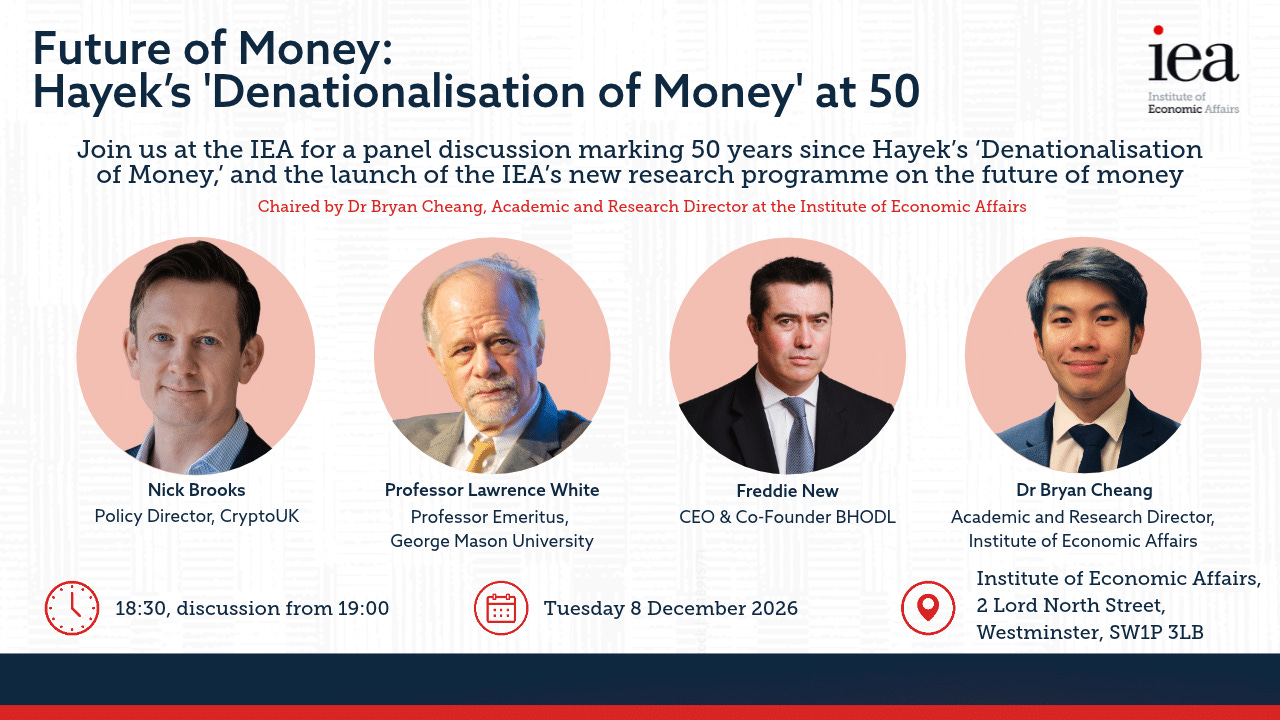
The Future of Money: Hayek’s Denationalisation of Money at 50
08.12.2026
Fifty years ago, Friedrich Hayek argued that if competitive supply improves the quality of most goods, money is unlikely to be different. Among the IEA’s proudest publications, The Denationalisation of Money proposed ending state monopolies on the issue of currency, and allowing market mechanisms to do the work conventionally entrusted to central banks.
Our current world of stablecoins, digital currencies, and renewed debate over the character of money might delight the heart of Hayek, and it might not. The questions he raised have lost none of their relevance, and have gained much ground to cover. To explore them again, the Institute of Economic Affairs shall host a panel discussion on its original context, arguments, and legacy.
This event will not only commemorate the 50th anniversary of Hayek’s essay but also launch the IEA’s new research program on the future of money.
Speakers
Lawrence White is Professor Emeritus at George Mason University in Fairfax, VA.
Freddie New is the CEO and co-founder of BHODL, a UK-listed Bitcoin treasury company focused on Lightning, Bitcoin's second layer payments network.
Nick Brooks is Policy Director at CryptoUK, the UK's crypto industry association.
Chairperson and Moderator:
Bryan Cheang is the Academic and Research Director at the IEA. He is also an academic at the London School of Economics where he teaches PPE and runs the Hayek Program.
Event details
Tuesday 8 December 2026 at the Institute of Economic Affairs, 2 Lord North Street, London SW1P 3LB.
18:30-19:00 Doors open and welcome
19:00-20:30 Panel discussion