


Ebeling in Brief is a weekly series, published every Saturday, of shortened chapters from economist Dr Richard M. Ebeling’s Liberty and the History of Economic Ideas: From the Ancients to the Austrian Economists (2026).
This is instalment No. 5: Edwin Cannan
Dr Richard M. Ebeling is an American libertarian author who was the president of the Foundation for Economic Education from 2003 to 2008.
In the years following the First World War, the countries of Europe were trying to recover from the consequences of the cataclysm that shook the European continent. It was not only the human casualties and physical destruction, which included the deaths of upwards of 20 million people and military expenditures of over $5 trillion (in today’s dollars); it was also the political and ideological legacies of the war.
The relatively classical-liberal institutions that had generally prevailed in many of the Western nations before the war had been weakened by the wave of wartime controls and central planning introduced by the belligerent governments. Socialists were calling for the end to capitalism and its permanent replacement with government peacetime central planning. Others called for a new “social liberalism” of extensive and intrusive government interventions and welfare-state redistribution.
Few were the voices still emphasising the importance of a free-market order and the value of personal liberty from overbearing government.
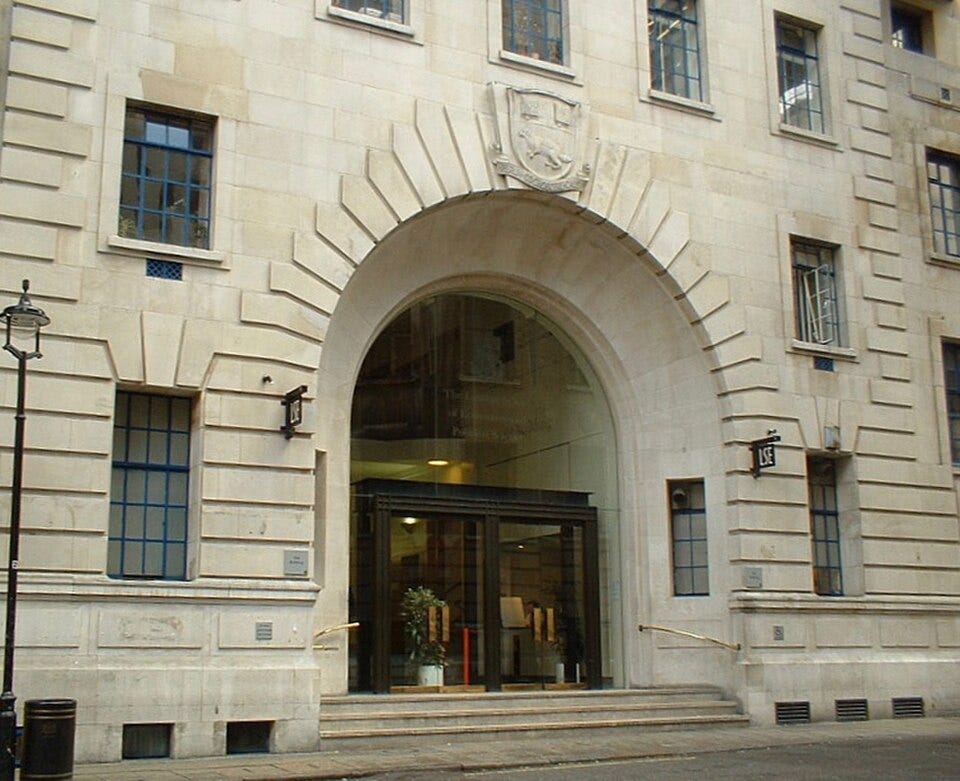
One of those voices was the British economist Edwin Cannan (1861–1935), who taught at the London School of Economics from 1895 to 1926 and continued to lecture and publish until his death in the mid-1930s. He influenced an entire new generation of British economists to be critical of any unreflective advocacy of socialism, nationalism and interventionism.
While not an advocate of laissez-faire, he strongly emphasised the importance and superiority of the competitive free market and drew attention to the power of markets to bring about a global system of peace and prosperity.
Emphasising the Prosperity and Peace from the Free Market
Before the war, Cannan had already considered it his duty as an economist and a citizen of a free country to challenge the growing collectivist delusions creeping into the public mind. I must confess that one of my favourites of his many works is a collection of essays published in 1912, The Economic Outlook. In a presidential address delivered before the British Association in 1902 entitled “The Practical Utility of Economic Science”, Cannan said that the first and most important lesson a professor can share with his students “is to try to open the eyes of his pupils to the wonderful way in which people of the whole civilised world now cooperate in the production of wealth”.
To do so, he suggested, a professor should ask his students to consider the daily feeding of London:
“There are, he will point out, six millions of people in and about London, so closely packed together that they cannot grow anything for their own consumption, and yet every morning their food arrives with unfailing regularity, so that all but an infinitesimal fraction would be extremely surprised if they did not find their breakfast ready to hand.”[1]
All of this comes about through the incentives and opportunities of free-market exchange in a system of division of labour that covers the world, with each participant guided by his own self-interest and the hope of personal gain in this global arena of voluntary association. Or as he expressed it in another place, “Modern civilisation, nearly all civilisation, is based on the principle of making things pleasant for those who please the market and unpleasant for those who fail to do so, and whatever defects this principle may have, it is better than none”.[2]
Explaining Economic Complexity in Understandable Terms
Cannan bemoaned the economic stupidity of too many in society who considered the exporting of goods a good thing in protecting domestic employment, while considering imports as a bad thing that benefits only the foreign sellers. Here, too, a clear and convincing presentation of basic economic truths needed to be offered:
“What is required is a much more simple, vigorous, and convincing exposition of the fact that employment is only a means to the attainment of an end, which is the acquisition of goods and services, and that we trade with foreigners, as we trade with those whom we serve and those who serve us at home, not to give ourselves employment, but in order to get the things and services we want more easily – cheaper, if you like – than if we produced them for ourselves.”[3]
Say’s Law and Free Markets for Full Employment
Cannan was also a strong and articulate defender of Say’s Law of Markets. If idle resources and unemployed workers widely exist in society, it is not because of a deficiency in “aggregate demand”. It is due instead to wrong (or disequilibrium) pricing of goods and factors of production. His analysis of the problem of economy-wide unemployment is found in his 1932 presidential address, “The Demand for Labour”, presented before the Royal Economic Society and reprinted in his collection of essays Economic Scares[4] under the changed title of “Not Enough Work for All”, in which he argues it is never the case for labour and all other factors of production not to be able to find work when they are rightly priced in the market.
There is always work to be done; the wants and desires of human beings are never completely fulfilled since the achievement of some goals soon sets men’s minds moving in new directions, and shifts any point of satiation further out to new points on the never-reachable horizon of human wellbeing. If we start with Robinson Crusoe alone on his island, it is clear that his labour time and efforts are never redundant, with plenty of work to still attend to, if not in one direction, then in another, to satisfy his own wants. It is no different when Friday comes along on his island, because now Crusoe may be able to get some things from Friday that he cannot produce for himself or not as cheaply in terms of his own labour time and resource use as getting them from his new companion. He can then devote more of his efforts, making things better or less expensive than Friday can, which he will then offer in trade.
The same process applies within the greater complexity of a modern, money-using economy, in which many people offer their labour services to employers who pay them salaries for work that the entrepreneur directs into lines of production he believes will result in the manufacture of products that might be profitably sold to consumers. If demands shift or supplies change, some workers may have to change what they do and where they do it, possibly at a lower wage than they previously earned. But if the needed adjustments are made in terms of work and wages, everyone wanting employment may successfully find it, with no idle hands left unemployed.
Cannan delivered this address during the depths of the Great Depression, when it seemed that there were plenty of hands looking for employment but too little demand for all those wanting work. But even in a situation like that in the early 1930s, insisted Cannan, it remained the case that “General unemployment appears when asking too much is a general phenomenon”.[5] If employment were to be restored, “Money-wages and salaries should be allowed to be reduced without resistance” if employers are to once again find it profitable to increase hiring. In other words, a competitive market needed to determine prices and wages to successfully restore full employment.[6]
Cannan also pointed out the perverse effects of unemployment insurance in creating disincentives for the unemployed to search for new and available employment by reducing the cost of being out of work, an argument that he offered in his article “The Post-War Unemployment Problem” (1930).[7]
Cannan as Influential Teacher for Economic Liberalism
Austrian economist Friedrich A. Hayek once praised Cannan’s writings because of their pointed “simplicity, clarity and sound common sense [which] make them models for the treatment of economic problems, and even some that were written before 1914 are still astonishingly topical”.
Due to these writings and his influence on that generation of British economists at the London School of Economics, he helped to create an “important centre of the new [classical] liberalism” in the English-speaking world.[8]
That is what makes reading and learning from an economic “protestor” like Edwin Cannan as relevant and useful today in the cause of economic liberty as when he first wrote his books and articles and influenced
[1]Edwin Cannan, “The Practical Utility of Economic Science” (1902), in The Economic Outlook (1912), reprinted in Collected Works of Edwin Cannan, vol. 4, ed. Alan Ebenstein (London: Routledge/Thoemmes Press, 1997), 174.
[2]Edwin Cannan, An Economist’s Protest (1927), reprinted in Collected Works of Edwin Cannan, vol. 6, ed. Alan Ebenstein (London: Routledge/Thoemmes Press, 1997), vi–vii.
[3]Edwin Cannan, “The Need for a Simpler Economics”, Economic Journal (September 1933), 372.
[4]Edwin Cannan, “The Demand for Labour” (1932), reprinted as “Not Enough Work for All” in Economic Scares (1933), in Collected Works of Edwin Cannan, ed. Alan Ebenstein (London: Routledge/Thoemmes Press, 1997), 21–41.
[5]Cannan, “Not Enough Work for All”, 38.
[6]Cannan, “Not Enough Work for All”, 41.
[7]Edwin Cannan, “The Post-War Unemployment Problem”, Economic Journal (March 1930), 45–55.
[8]F. A. Hayek, “The Transmission of the Ideals of Economic Freedom” (1951), in The Collected Works of F. A. Hayek, vol. 18, Essays on Liberalism and the Economy, ed. Paul Lewis (Chicago: University of Chicago Press, 2022), 43.