


In today’s newsletter:
The Nobel Prize and the limits of economic planning
Eben Wilson sets out a plan for social care in the first instalment of The Providence Papers
Last chance to get your free ticket to The Alternative Budget - 19.10.2026
An introduction from Economic Affairs editor Maeve Halligan
Welcome to this week’s newsletter. The IMF has upgraded Britain’s growth forecast for this year and downgraded next year’s in the same breath; the economic equivalent of a sunny spell with rain to follow.
On the podcast, we discuss the forecast alongside Manchester City’s finances and folic acid in bread. Never let it be said that a free market angle can’t be found on almost everything. Chris Snowdon also finds a nanny state measure he approves of, so mark the date.
Elsewhere, Daniel Hannan wants new homes on the stretches of green belt nobody would put on a postcard. Kristian Niemietz has no deep moral objection to wealth taxes, but notes that most of Europe tried them and then abolished them, which is usually a clue.
And John Redwood points out that buying AI and using it well are not the same thing, a lesson the private sector learned some time ago.
Finally, don’t forget to book your free tickets for our upcoming events at 2 Lord North Street! Folic acid not included.
Mani Basharzad is a Junior Research Associate at the IEA.
Bryan Cheang is a Research Fellow at the London School of Economics and Director of the LSE Hayek Programme.
In a 2003 lecture, Nobel laureate in economics Robert Lucas said, “macroeconomics in this original sense has succeeded: Its central problem of depression prevention has been solved”. Five years later came the 2008 financial crisis. Indeed, macroeconomics is arguably the subject over which economists disagree most. There is greater consensus on microeconomics, it is in macroeconomics that the rival schools of thought divide. It is easy to see why: macroeconomics has a history of failure, from the collapse of the Keynesian consensus in the 1970s to the 2008 crisis.
“There is no such thing as macroeconomics”, said Armen Alchian, an economist who many believe should have won the Nobel Prize in Economics. His work on property rights and the theory of the firm influenced several later Nobel laureates. Had he lived to see it, he would surely have welcomed this year’s Nobel Prize in Economics, awarded to Robert E. Hall and Michael Woodford for their work on the microeconomic foundations of macroeconomic stabilisation.
What was the failure of macroeconomics? In his 1974 Nobel lecture, ‘The Pretence of Knowledge’, F. A. Hayek warned that many people came to economists seeking solutions to inflation, forgetting that the solutions offered by those economists had helped create the mess in which they found themselves. The fatal error of macroeconomics was the illusion that exact relationships could be found between aggregates, such as the relationship between unemployment and inflation. Observed patterns led economists to believe that these outcomes could be controlled from the top down. Roger Scruton warned against the temptation to “pretend that there was an expert science that could amend and replace the findings of common sense”. That warning applies with particular force to macroeconomics.
The problem was the belief in macrofoundations: that we could identify relationships between aggregate outcomes and therefore control them. What was missing was the recognition that aggregate concepts such as unemployment and productivity have no meaning without microfoundations. This is what research into the microeconomic foundations of macroeconomic stabilisation has shown. In this respect, it echoes an older insight of economists such as Hayek, Ludwig Lachmann and Alchian, who took it much further. Taken seriously, microfoundations reveal the way in which various capital goods and resources are constantly being shuffled across a variety of ends by entrepreneurial agents serving consumers. Such micro-level activity cannot be planned, anticipated or manipulated by policy aggregates.

Robert E. Hall and Michael Woodford have helped develop modern macroeconomics through microfoundations. They sought to understand macroeconomics through the lens of microeconomics. Rather than simply blaming unemployment on insufficient demand, Robert Hall studied search and matching frictions in the labour market. He modelled unemployment as the result of individuals navigating information gaps and transaction costs. Michael Woodford, in his major work, Interest and Prices, brought the insights of microeconomics to the understanding of monetary policy. Individual firms adjust prices at different times and in response to localised information, meaning that changes in monetary policy can create relative price distortions.
Their work is often read as a guide to how central banks can stabilise the economy, and the Nobel committee praised it in those terms. But taking microfoundations seriously carries a broader lesson: economic policymakers have less power than is often assumed. They cannot simply solve our growth problems, and the power of monetary policy is limited. Growth comes from the decisions of individuals and firms. In simple terms, a top-down approach to managing the economy does not work as policymakers often imagine. What really creates growth is individuals having greater freedom to innovate, move their capital, trade and take risks. Rather than trying to engineer market forces, politicians should understand how restricted their power is. That, in our view, is the most important lesson of microfoundations for macroeconomics: in a world where people have expectations and change their behaviour accordingly, monetary policy has limited power. This difficulty stems from the diversity of human plans and their dynamic changes in an open society.
What really creates growth is individuals having greater freedom to innovate, move their capital, trade and take risks.
This is the insight behind the ‘Lucas critique’, named after Robert Lucas, one of the main figures behind this line of research. If a government tries to stimulate growth simply by pumping money into the economy to raise aggregate demand, a purely macroeconomic model might predict smooth and predictable growth. However, a microfounded view warns that individuals will change their behaviour in response to that policy. If business owners anticipate future inflation or higher tax rates as a result of government stimulus, they may freeze hiring and pull back on investment, undermining the intended growth.
The problem of macroeconomics is not solved, and perhaps it never can be. Economics is not an exact science, and there are no optimal solutions but, as Thomas Sowell said, “only trade-offs”. The sooner economists and policymakers understand this simple lesson, the better. The idea of macroeconomic policymakers as operating a stabilising hand that smooths business cycles at just the right time, with the right levers and at the right magnitude, is a technocratic fantasy.
Policymakers are once again learning this lesson the hard way, as governments that promise more than they can afford find bond markets less forgiving. In France, markets are losing confidence; in Britain, long-dated gilt yields have reached their highest levels in decades. We need to adjust to this reality. A government that wants to achieve everything may ultimately achieve nothing. Yes, market failure exists, but government failure is more common and costly.
In The Theory of Moral Sentiments (1759), Adam Smith used the example of chess to illustrate the danger of top-down planning. Social engineers, or what he called the “man of system”, are mesmerised by the “supposed beauty” of their top-down plans. They imagine they can manage society like a game of chess, moving its pieces as they please. But, as Smith said, on the “great chess-board of human society, every single piece has a principle of motion of its own”. The Nobel Prize has embraced microfoundations; perhaps it is time for our politicians to do so as well.
The best way to never miss out on IEA work, get access to exclusive content, and support our research and educational programmes is to become a paid IEA Insider.
Should Britain trust the IMF’s rosier growth forecast? Maeve Halligan hosts the IEA Podcast with Valentin Boboc and Chris Snowdon on the IMF’s upgrade for Britain, from whether the official plan to close the deficit by 2030/31 is credible to why the country has chosen not to make more of its own North Sea energy, plus Manchester City’s £830 million spending case and why wealthy owners have been good for fans, and why a lifestyle economist who opposes most nanny state measures is backing folic acid in flour. Watch on YouTube
This week on Economic Affairs
A better way to pay for social care

This is the first paper of a three-part series, published weekly.


News and Views from the IEA
Inside the Most Powerful Bank You’ve Never Heard Of | IEA Interview
IEA Managing Editor Daniel Freeman speaks to historian and author Adam LeBor about the new edition of his book Tower of Basel and the secretive history of the Bank for International Settlements. They discuss how the supposedly neutral bank accepted looted Nazi gold during the Second World War, why its warnings before the 2008 financial crisis went unheeded, and the risks LeBor sees in the central bank digital currencies its research has made possible. Watch on YouTube.
Britain’s tax burden is rising faster than in any other G7 economy. Dr Valentin Boboc, Chief Economist at the IEA, tells The Sun that the IMF’s latest warning gives the Chancellor cover to resist costly commitments such as public sector pay settlements and blanket energy subsidies.
“The Chancellor should also resist the temptation to spend any additional revenues from stronger-than-expected growth.”
What mistakes should the Chancellor avoid in his first Budget? Professor Len Shackleton, Editorial and Research Fellow at the IEA, tells the Express that the pitfalls include raising capital gains tax, extending the freeze on income tax thresholds and subsidising energy prices.
“[Capital gains tax] would have all sorts of undesirable effects which would ultimately be passed on to people who never had a capital gain in their life.”
The IMF has upgraded its forecast for UK growth this year, but warns of a slowdown in 2027. Dr Valentin Boboc, Chief Economist at the IEA, tells GB News that Britain has shown resilience but that the Chancellor must focus on removing obstacles to growth. He warns: “The longer term outlook remains disappointing due to high taxes, expensive energy and other impediments to investment.”
No, folic acid is not going to kill us. Dr Christopher Snowdon, Head of Lifestyle Economics at the IEA, writes for The Critic on why most flour sold in Britain will contain folic acid from December, and why the campaign against it rests on misinformation. He argues that fortification is tried and tested in around sixty countries, has cut cases of spina bifida, and costs almost nothing.
More than three million of the 3.7 million payroll jobs added since 2014 have gone to non-British workers, the Daily Express reports. Professor Len Shackleton, Editorial and Research Fellow at the IEA, is quoted discussing the findings. He points out that migrants are more likely to take up “old” jobs that are freed up as people move on, and says the real issue is the number of Britons out of work.
“The Chancellor cannot keep reaching into taxpayers’ pockets to plug holes in the public finances.” The verdict of Dr Valentin Boboc, Chief Economist at the IEA, in This Is Money, as rising inflation and frozen thresholds look set to hand the Treasury a £9 billion stealth tax windfall. With Britain’s tax burden already historically high, he argues the answer is to rein in spending, not send taxpayers another bill.

Education, Events and Opportunities
Upcoming:
The IEA’s Alternative Budget - Launch Event
19.10.2026
The Institute of Economic Affairs invites you to the launch of its Alternative Budget, a fully costed programme setting out what a Budget built for growth could look like, ahead of the Government's own Budget on 28 October.
A panel including the IEA's Director-General Lord Daniel Hannan will present proposals on tax, spending and reform, offering a rigorous, pro-growth alternative to the Government's approach. Rather than simply critiquing policy, this event sets out a genuine blueprint for serious economic reform, delivered by leading thinkers at a critical moment in the Budget debate.

Speakers
Lord Daniel Hannan - Director-General, Institute of Economic Affairs
Dr Valentin Boboc - Senior Economist, Institute of Economic Affairs
Further panellists to be announced
Event details
Monday 19 October 2026 at the Institute of Economic Affairs, 2 Lord North Street, London SW1P 3LB.
18:00-18:30 Doors open and welcome
18:30-19:30 Panel discussion
19:30-20:30 Post event reception; refreshments provided
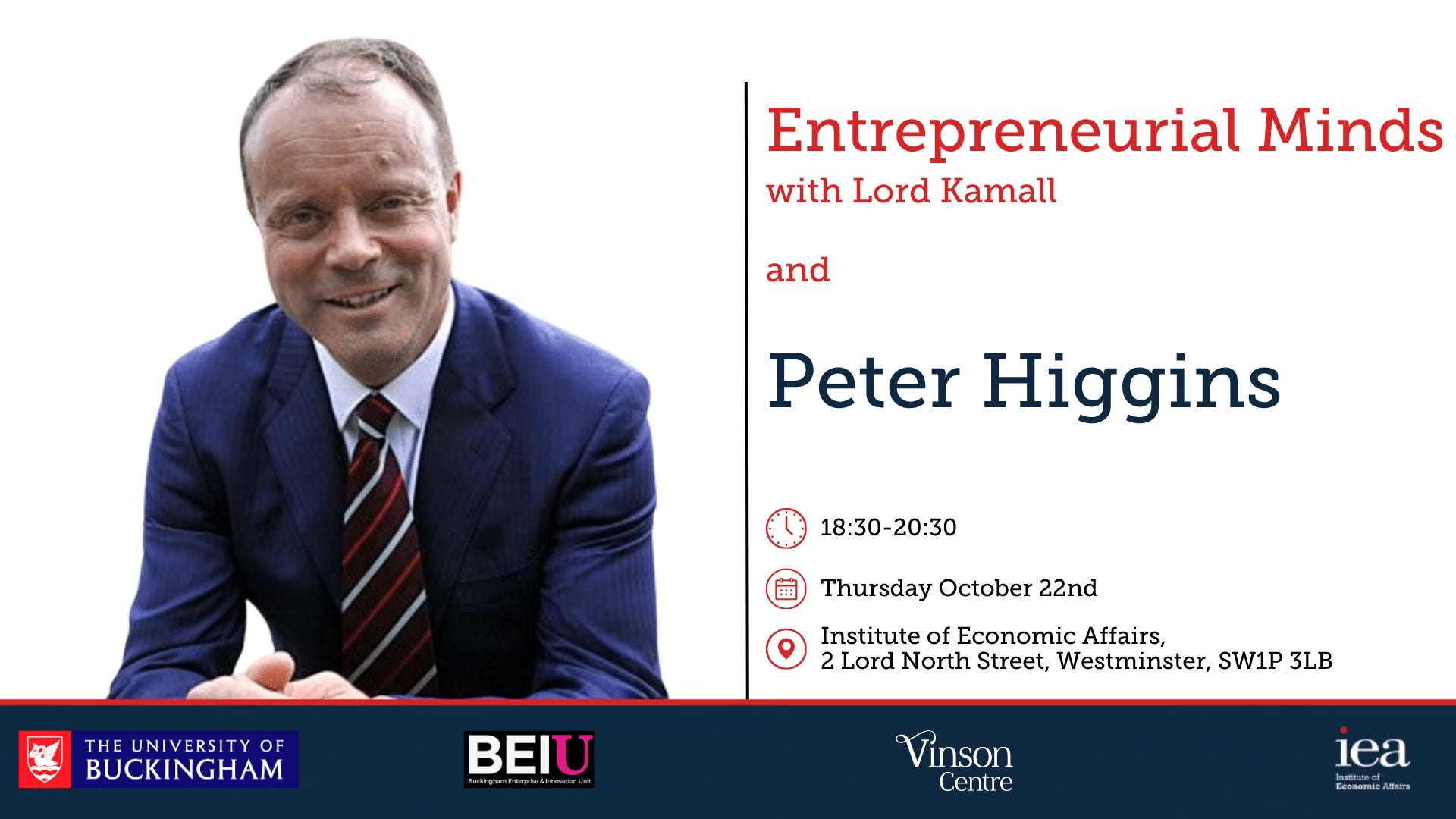
Entrepreneurial Minds with Lord Kamall and Peter Higgins
22.10.2026
In the latest event in the IEA’s Entrepreneurial Minds series, Lord Kamall talks to Peter Higgins, co-founder of Charles Tyrwhitt. Since 1990, Peter has helped build the company into a global shirt brand with turnover of more than £440 million, and has also chaired Cath Kidston and ME+EM through periods of growth and successful sales.
Join us to hear about the challenges and triumphs of building a British business, and what aspiring entrepreneurs can learn from his journey from Harrow classics teacher to retail leader.
Speakers
Peter Higgins is co-founder of Charles Tyrwhitt and former Chair of Cath Kidston and ME+EM.
Lord Kamall is a Conservative peer and former Health Minister who represented London in the European Parliament for 14 years.
Event details
Thursday 22nd October 2026 at the Institute of Economic Affairs, 2 Lord North Street, London SW1P 3LB.
18:30-19:00: Doors open and drinks reception
19:00-20:00: Presentation and discussion
20:00-20:30: Post event drinks reception
The Tyranny Tracker: Global Trends in Democracy and Authoritarianism
26.10.2026
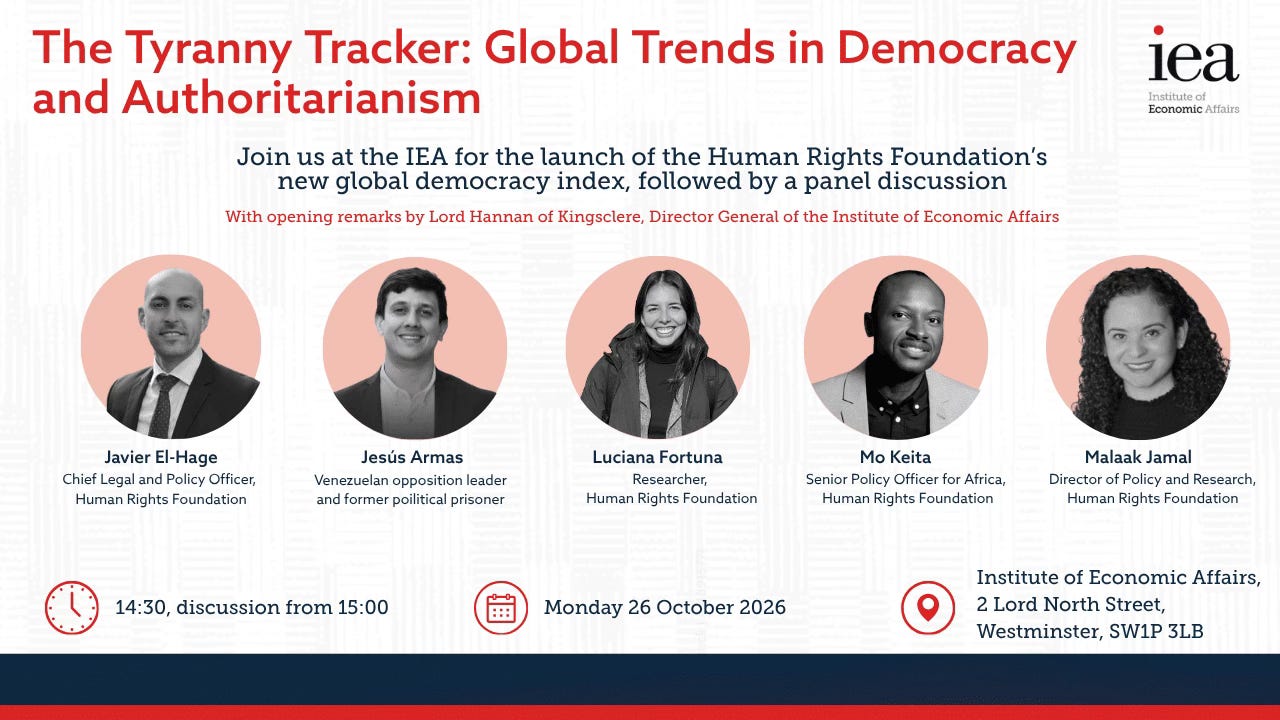
Many of the freedoms once thought secure are being eroded across the world, as authoritarian rule becomes more entrenched. The Human Rights Foundation’s new Tyranny Tracker measures democratic resilience, erosion and authoritarian consolidation in every region, separating genuine democracies from hybrid and fully authoritarian regimes.
Javier El-Hage, HRF’s Chief Legal and Policy Officer, will present the index’s methodology and key findings, then chair a panel with HRF researchers and Jesús Armas, a Venezuelan democracy advocate and former Caracas city councillor who was held at El Helicoide from December 2024 to February 2026. Lord Hannan of Kingsclere, Director General of the IEA, will open the event.
Speakers
Javier El-Hage, Chief Legal and Policy Officer at the Human Rights Foundation, where he directs the Tyranny Tracker project. He is a Bolivian-American attorney who specialises in comparative constitutional law, international human rights law and democracy law.
Jesús Armas, Venezuelan democracy and human rights advocate and former Caracas city councillor. He was a political prisoner from December 2024 to February 2026.
Luciana Fortuna, Research Fellow at the Human Rights Foundation and DPhil candidate in Politics at the University of Oxford. Her research examines democratic erosion, legislatures and governing coalitions in Latin America.
Malaak Jamal, Director of Policy and Research at the Human Rights Foundation.
Mo Keita, Senior Policy Officer for Africa at the Human Rights Foundation.
Lord Hannan of Kingsclere, Director General, Institute of Economic Affairs
Event details
Monday 26 October 2026 at the Institute of Economic Affairs, 2 Lord North Street, London SW1P 3LB.
14:30-15:00: Doors open and welcome
15:00-16:30: Presentation followed by panel discussion