


This is the first paper of a three-part series, published weekly.
Eben Wilson is a political economist, entrepreneur and industrialist, and former Director of TaxpayerScotland.
Prime Minister Andy Burnham has recently announced the creation of a “National Care Service”, with details yet to be determined depending on the findings of an ongoing expert review. For reasons already explained by other IEA authors (which we need not go into here again), this would almost certainly be a bad idea, leading to both higher costs and lower quality of care. Here, instead, we propose an alternative based on Social Providence Accounts.
An alternative: Social Providence Accounts
A Social Providence Account (henceforth an SPA) is an accrued fund allocated to, and statutorily protected for, an individual to be used for, initially, social care expenditures. The rather ugly technical term is “individuation”, with the process of individuation being done through the equally ugly term, “hypothecation”, of an element of the individual’s taxation. It is therefore a mandatory thrift measure. The following framework applies.
Through time, the accruals on all SPAs are allocated to the individual’s account with one proviso. An Equalisation Levy is applied to all gains of the fund (not the principal, which would be double taxation) on an annual basis.
SPAs have a maximum pay-out obligation, an amount above which social care costs are not paid for out of the fund.
SPA funds can be used, initially, only for social care support. Elderly care would be targeted first. (The Social Providence Accounts Scheme, or SPA Scheme, needs time to become sustainable.)
These first elements echo other self-support approaches, but the SPA offers further elements to induce and align incentives.
SPAs are individual funds accessible by families. They are transferable between members of close family: grandparents, parents, children, siblings and grandchildren. Funds can be transferred both to members of a higher age and of a lower age in the family. (In reality, there would be no reason not to extend this to near family, or indeed any other individual, by those with no close family.)
SPA accruals lie outside of any inheritance tax obligation. The purpose of these accruals is to create a long-term societal social support fund, where families gradually accrue and spread wealth holdings at zero cost to the central state.
Payments into an account above the maximum obligation would be continued, but they must then be transferred within one accounting year. It would be at the liberty of the owner to decide the recipient of the funds, the proviso being that that recipient was either a near family member or a human social support charity.
In time, as accrued funds grow across the population, there could be scope to release some funds for wider uses based on a minimum holding requirement. For example, Singapore’s Central Provident Fund (CPF) started in 1955 as a contributory retirement savings scheme and was then expanded to housing costs (1968) and healthcare costs (1984 and 1990).
The Scheme, involving only six core principle measures, is designed to be simple in execution and understandable from the point of view of taxpayers. This simplifies the policy introduction, and the implementation in itself provides relief for politicians from the burden of centrally administered state schemes.
Long-term policy measures are not well handled by politicians due to their need to focus on the electoral cycle. SPAs, using a distributed non-state approach, take the prospect of failure away from parliamentarians as long as the base principles of personal thrift apply and are recognised by the Scheme’s participants.
But this does not deny flexibility in the maxima or the equalisation measures. Democratically, what is important is the transparency of the fund accrual and levy transfer elements. If there is a desire to adjust the weightings, that is a democratic battle that can be fought – but in this Scheme the outcomes will be quickly visible, for example in the reduction of the individual and overall fund accrual rate or subsequent levy flows. That transparency is of value to voters in the assessment of effective governance and acts as an incentive to political constraint.
The actuarial flows of SPA implementation
The SPA Scheme is at root a collective self-insurance system with a support mechanism for the less well-off. The objective, in a world where policy choice is constrained by “There Is No More Money” realities and hence intense competition for funding, is to replace a quasi-Ponzi arrangement with sustainable social care funding streams based on accrued SPAs.
Note the dynamic here: any actuarial analysis of what is possible has to look at flows of funds, not the cardinal value of user holdings. It is also unwise to make any heroic assumptions about any particular class of individuals; frailty in old age has a genetically based randomness in its burdens: in duration, running costs and across localised groups. The SPA Scheme, through its family focus, transferability of funds and its Equalisation Levy, has the goal of spreading and levelling out risks, while retaining incentives that optimise a balance between the inflow and outflow of funds.
The dynamic is also important with respect to implementation: it takes time for SPAs to build, and in the early years some accounts will see their funds depleted rather than accrued. What matters is how long it takes for sustainability to be made actuarially reliable.
Two cohorts: Accruers and Depleters
A modelling exercise has been done by this author that recognises two sets of SPA participants: those in work who are accruing SPA funds for up to 40 years – the Accruers – and those above age 65 who, under the SPA Scheme, use their accrued funds to support their needs in older age – the Depleters. It is important to recognise that potential Depleters who are healthy and active will in fact also still be Accruers prior to any drawdown on their account. Around twenty per cent will never need to draw down at all.
In the UK today there are just over 30 million employees. HMRC/ONS PAYE Real Time Information (RTI) on pay distribution and Class 1 NIC payments allows us to model ten deciles of mean pay rates and hence present-day NIC payments. The model uses 2024/25 data as a baseline. From this, it is possible to posit ten rates of flow from the hypothecation of a proportion of NIC payments into the SPA Scheme.
The rate of transfer from old to new scheme would have to be slow for political acceptability. Escape from any Ponzi assurance offer inherently requires payment of the prior debts of that scheme plus funding outlays for a new scheme. Funding transferred to the SPA of an individual aged between 16 and 65 is a lost payment to the Exchequer – reduced by a) the Equalisation Levy receipts from those Accruers with accrued funds and b) any inter-account transfers between younger families/individuals in support of elderly SPA holders. It does, however, prepare a growing capital base for the funding flows required due to the expected reduction in the worker/pensioner ratio over the coming decades.
The counter gain here is the gradual accumulation of Equalisation Levy funding from SPA fund accruals. Social care for the elderly costs around £14bn a year across the UK today (roughly £12bn in England and £2.3bn in Scotland). From day one, the SPA Scheme begins to reduce this.
The calculation of individual and societal accruals – the Accrual Model
Employment income in the UK today (HMRC figures) is reported as £1.08tn. Total reported Class 1 employee and employer NIC payments are around £165bn. (The model includes some adjustments and so uses a figure of £158bn for onward calculations.)
The model then allocates transfers for each decile of NIC payers into their SPAs. The initial rate chosen for this was 10.5% of present NIC contributions. This equates to a shift of 2.5% in present NIC tax collections from an inflow into the UK’s General Treasury Fund to the overall Social Providence Accounts Scheme. This is the basic loss of inflow to the Exchequer. No assumption was made as to whether the transfer is made from an employee collection or an employer collection; again, the political choice here could be phrased as “a transfer for your personal future” or “a co-payment transfer from your employer” depending on which obfuscation was enjoyed more by a particular political perspective.
It is notable that in 2021 the Conservative government raised NIC by 1.25 percentage points with the promise that it would become a “Health and Social Care Levy”, a promise that was rescinded by Chancellor Kwarteng in 2022. Intriguingly, a change in the triple lock to a “double lock”, as proposed by Andy Burnham, could potentially cover the loss to the Exchequer if inflation were low. The world of ‘There Is No More Money’, when controlled by politicians, offers some “flexibilities”. The SPA Scheme does not deny politicians adjustability within its constraining framework of the rate of transfer of NIC contributions to SPAs and the Equalisation Levy rate.
Adjustments for earnings and tax thresholds
The core Accrual Model was then adjusted for an annual earnings increase of 2% across all deciles. Fiscal drag was also removed by increasing the NIC employee rate primary threshold, the employer NIC threshold and the Upper Earnings Limit (UEL), above which higher earners pay 2% rather than the standard 8% rate. Recent history of using fiscal drag to increase flows of taxation into HM Treasury suggests that these adjustments are mildly heroic on the predictions of the Accrual Model, but it is important to be conservative here.
An accrual calculation for each income decile was then taken, initially, for the first ten years of the SPA Scheme, then expanded through three further decades – not far from a working lifetime.
This used the assumption that accruals on escrowed funds would average 3%, while 30% of those accruals would be transferred away as annual Equalisation Levies in the first two decades, reducing to 25% in the third decade, and 20% in the fourth. The reason for these secondary adjustments is provided below.
SPA holdings under these raw model assumptions are, for four of the ten deciles, after ten, twenty and forty years:
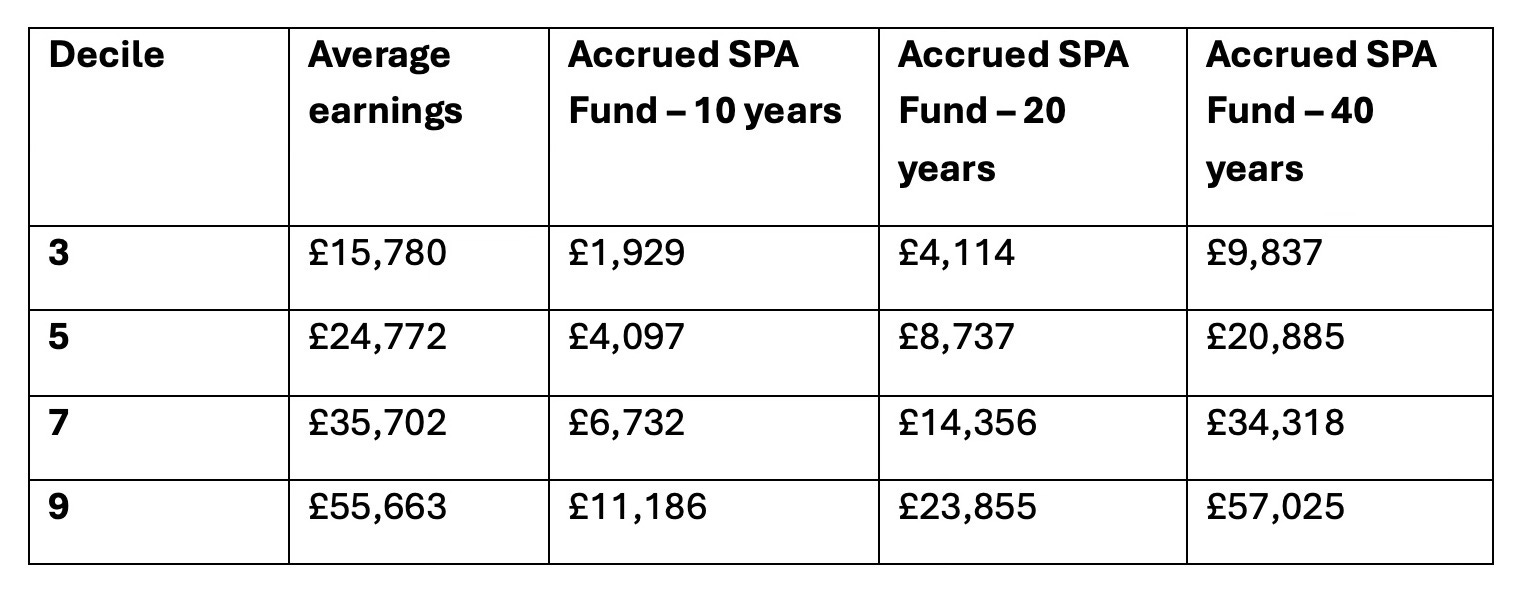
Today, the average lifetime costs of care are £134,992 over an average of 17.9 months, so even the ninth decile (earning above £55,500 pa) on this raw model is not fully covered near their retirement.
While these accruals may seem low, there are practical and political issues embedded here in obtaining cross-party consensus to a rate of accrual, balanced against the fact that these funds would be in escrow until age 65. However, note the geometric progression of accruals as higher years pass. Additionally:
No account is taken of cross-family support post age 65.
There are gross unspent accruals within the escrowed funds held by 20% of SPA holders who will not need social care and so never draw down on these funds after the age of 65.
It must also be remembered that around 60% of social care of the elderly today is already privately funded from family savings.
There are incentives under the SPA Scheme to push down on costs through forward planning by families. The SPA fund accrual incentivises intra-family intergenerational planning where no inheritance tax burden is present.
And, of course, overall accruals offer a gradual annual reduction in the future social care spending commitments of the central state (eventually to zero). The figures create a near-trillion-pound family support capitalisation in 40 years (about the same as today’s total ISA holdings). They assume a reduced Equalisation Levy rate to 25% and 20% respectively in the third and fourth decades. Those Equalisation Levy funds can be redistributed as providential support across the income spectrum.
Using a 3% cost inflator for today’s UK social care cost of around £14bn suggests annual support costs of £19bn and £25bn in 2036 and 2046 respectively.
The SPA Scheme produces annual levies of £8bn in ten years, but £24bn in twenty years. Einstein’s view of the power of compound interest holds: “He who understands it, earns it; he who doesn’t, pays it”.
Retaining, and indeed enhancing, the present centralised monolithic approach, which has clearly failed, reminds me of another aphorism (apparently wrongly) ascribed to Einstein: “The definition of insanity is doing the same thing over and over and expecting different results.”
We will provide greater detail on the workings of the envisaged SPA Scheme in a sequel.
Eben rightly highlights the dangers of a state-monopolised National Care Service, and shifting the focus toward individual ownership and family wealth is a welcome move.
However, the proposal retains two fundamental contradictions:
1) Mandating thrift is still state coercion: Forcing individuals into state-sanctioned savings vehicles prevents the government from acting as a neutral umpire and maintains paternalistic compulsion.
2) Statutory protection keeps bureaucracy in the game: Ring-fencing accounts via special legislation requires state regulators to police how citizens spend their own money, leaving the rules vulnerable to political meddling with every election cycle.
A genuinely free society shouldn't rely on state-managed financial planning, but on voluntary savings, private contract, and civil society. I explore this tension further in tow posts, Can a Free and Prosperous Society Survive an Expansive Welfare State? - https://fightingforafreefuture.substack.com/p/can-a-free-and-prosperous-society and Umpire or Player: What Should The State Be? - https://voices.fightingforafreefuture.com/p/umpire-or-player-what-should-the