


In today’s newsletter:
Matt Ridley on what we lose when managerialism takes over
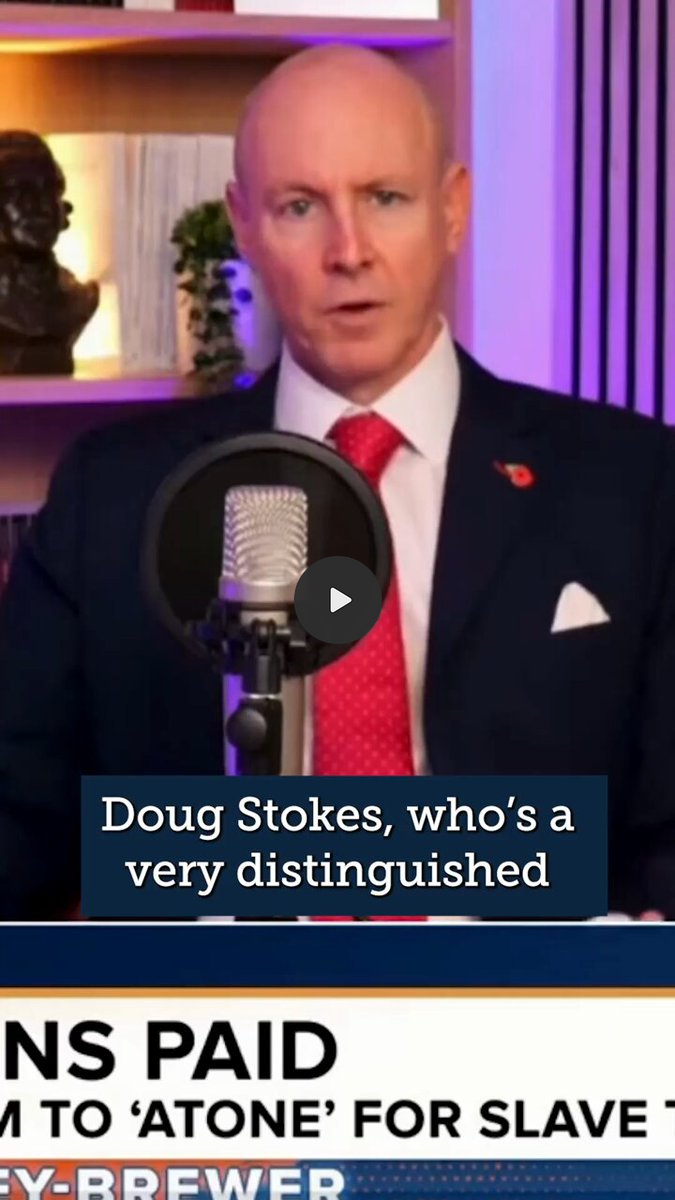
Watch: The Atonement Complex | IEA Events
Five lessons from the OBR forecasts
The IEA’s Northern Schools Tour
An introduction from Economic Affairs editor Maeve Halligan
Welcome to this week’s newsletter. Britain is now set to spend more on debt interest than on education, which is one way to teach the country a lesson. Meanwhile, households heeding the Government’s call to “Be Ready” have cleared Ocado of 40 varieties of tinned soup.
On the podcast, Lord Hannan and Robert Armstrong ask whether tariffs just lost Trump the midterms. Matt Ridley argues that the line that matters in the economy is not between employers and employees, but between those with skin in the game and those without. And if the Budget left you none the wiser, we draw five lessons from the OBR’s forecasts.
Elsewhere, the new IEA report authored by Professor Doug Stokes, The Atonement Complex, takes a hard look at the £18.8 trillion reparations claim and the bill Britain footed for ending the slave trade. If you missed the launch, you can catch up below.
Finally, book your free tickets for the launch of The Higher Education Delusion this Wednesday 11 November. Come along to find out what is going so wrong at some of the UK’s most historic universities, and whether getting a degree is still worth it at all.
Matt Ridley is a science writer and a former member of the House of Lords.
“I don’t think employers are working people.” When Emma Reynolds, Chief Secretary to the Treasury (effectively Britain’s deputy finance minister), uttered those words in a recent television interview, her words were widely shared online. She was given two chances by her interviewer, Camilla Tominey, to back down – but she doubled down instead. “The distinction I am drawing is between employees and employers,” she said, while acknowledging that she employs a cleaner.
It is a fascinating glimpse into old-fashioned, almost Marxist, view of the economy. On this view, it seems, we are back in the nineteenth century when top-hatted plutocrats sit back and enrich themselves off the back of hard-toiling employees. You are either one or the other.
Except it was not true then either. At the weekend I happened to be reading about Sir Amos Nelson, a man who went to work in a cotton mill part time at the age of 8 (full time from 13) and ended up the stupendously wealthy owner of a large country estate in Yorkshire on which he built a brand-new stately home, Gledstone Hall. Was he not a “working person”?
My point here is not political point scoring, however. It is to suggest a more valuable distinction: whether you have skin in the game. Both employers and employees can be great if they really care what happens to their organisation, or really useless if they don’t.
A friend once asked about my experience of leaving employment to work for myself as a freelance writer. A few weeks later he messaged me: “You never warned me that when you work for yourself, your boss is a bastard.” The most driven and motivated people I know are self-employed sole traders, the founders of their own businesses.
That’s why Marc Andreessen, the founder of Netscape and star venture capitalist, prefers to back founders rather than hired MBAs. He refers to the 1940s book The Machiavellians by James Burnham, which saw the world of “bourgeois capitalists” who built their own businesses – Henry Ford and co – being replaced by the world of managerialists trained and hired to run firms.
Andreessen thinks management as a skill set that can be used to run many different kinds of business, in the public as well as the private sector, is the cause of many of our problems. “If there is one dominant theme in the last 30 years in the west it is that managers generally, writ large, are not doing a great job.”
Imagine Elon Musk’s firms run by hired Harvard or Stanford MBAs. They would never have dared try half the outrageous things he has pulled off.

The story of Mike Lynch, founder of the software firm Autonomy, exemplifies the issue in two ways. As recounted in Katie Prescott’s excellent book The Curious Case of Mike Lynch, published in November last year, Autonomy was a brilliantly successful company built by a founder with a devout obsession to work hard and grow the firm, admittedly accompanied by sometimes tyrannical behaviour towards others in the company.
But when Autonomy floated on the stock market, different incentives began to dominate. The pressure to keep growing the company’s share price turned Lynch and his colleagues into managerialists who rushed to acquire other firms and sign up clients at any cost to please market analysts. Soon the company was cutting corners at best, or, according to the US courts that convicted its former finance director, booking revenue improperly at worst.
Whether that amounted to fraud, let alone justified the criminal persecution Lynch received in the United States after Hewlett Packard vastly overpaid to buy Autonomy, is a different question. Lynch was eventually acquitted of criminal charges before dying in a freak yacht accident, but Hewlett Packard has been awarded £920m in damages against his estate to compensate it for the embarrassment of having not done its homework before the deal.
“Founders drive change, disrupt monopoly, challenge stagnation and make the future happen.”
My point is that both firms, Autonomy and Hewlett Packard, were ruined by managerialism losing touch with founderism.
The world needs more founders. They drive change, disrupt monopoly, challenge stagnation and make the future happen. Some, like Elizabeth Holmes of Theranos, poured their entrepreneurial energy into fraud, but most get rich by improving the lives of their customers. From Thomas Newcomen to Andrew Carnegie to Elon Musk, they drive down prices for all.
So here’s my question. Are there enough potential founders out there at any time, or could we do with flooding the market – and stifling the supply of managers? I am not generally a fan of the great man theory of history. I think that if the likes of Gates and Jobs, Bezos and Zuckerberg did not exist, other names would still have come forward.
But Musk gives me pause, I admit. The world of space, of cars, of tunnels, of social media would look very different if he had not existed. And it must be true that an economy which incentivises founders at the expense of managers (in both the private and public sectors) would be one that grew faster, innovated more richly and solved more problems.
So yes, let’s at least give it a try: see what happens if we incentivise more working people to start their own businesses. Just as every common soldier was said by Napoleon to carry a marshal’s baton in his knapsack, so perhaps every pie-shop owner carries a tech mogul’s black T-shirt in his tote bag.
The best way to never miss out on IEA work, get access to exclusive content, and support our research and educational programmes is to become a paid IEA Insider.
Did tariffs just lose Trump the midterms? Maeve Halligan, Lord Hannan and Robert Armstrong look at what the Democrats’ historic gains reveal about voters’ verdict on protectionism, and why free trade has suddenly become an election-winning issue. They then turn to the UK–EU summit and a draft deal that would tie Britain to EU food rules, asking whether the Government is trading sovereignty for a smoother border, before closing with whether rejoining the EU is a realistic prospect. Watch on YouTube
This week in Economic Affairs


How the state tried to eliminate slums – and created even worse ones

Rainer Zitelmann holds doctorates in history and sociology. He is the author of 32 books, translated into 35 languages, including The Power of Capitalism, How Nations Escape Poverty and New Space Capitalism. His writing has appeared in the Wall Street Journal, Financial Times, The Times and Newsweek, among others.


News and Views from the IEA
The Atonement Complex | IEA Events
The campaign for slavery reparations has rarely had more momentum, and its case has rarely been examined less. With Caribbean leaders taking a £18.8 trillion claim to the Commonwealth summit in November, Professor Doug Stokes’s new paper, The Atonement Complex, examines the accounts: who really profited from slavery, what the British public paid to end it, how the trillion-pound figure was built, why other parties to the trade are left out of the story, and how hostile states have turned Western guilt into a tool of statecraft.
Catch up on the report launch event:
Calls for Britain to pay slavery reparations to the Caribbean come under scrutiny. Professor Doug Stokes, author of the recently published IEA paper The Atonement Complex, is quoted on why the economic legacy of slavery is not as simple as the case for reparations assumes.
“The dynamics of slavery are complex. While it enriched small groups of Britons, it did not enrich the nation.”
Ending slavery cost Britain far more than it ever profited from the trade. Professor Doug Stokes writes for the Daily Mail on why the case for slavery reparations does not stand up to the historical evidence.
“Britain must always refuse to accept liability for a trade it spent 60 years and thousands of lives suppressing.”
Commonwealth leaders should focus on modern slavery rather than reparations, GB News reports. Professor Doug Stokes is quoted arguing that the £18.8 trillion reparations estimate rests on highly sensitive assumptions, and that Britain’s campaign to suppress the slave trade cost around 1.8 per cent of national income a year for 60 years.
If rights are available even to people working illegally, what does it mean to be a citizen? Lord Hannan, Director General of the IEA, writes for the Daily Mail on why Britain should replace refugee status with a small, capped number of discretionary admissions set by Parliament.
“Modern states work on the basis of an implied contract between government and citizens.”
Britain is set to spend more on debt interest than on education for the first time, This is Money reports. Julian Jessop, IEA Economics Fellow, is quoted on how to bring the debt burden under control, arguing that “the Government needs to free the economy to grow faster.”
Households are hoarding cash at home on the Government’s advice, the Daily Mail reports. Lord Hannan, Director General of the IEA, is quoted on the Government’s “Be Ready” campaign, arguing that “the last thing we need is a Government encouraging people to panic.”
The Government’s planned ban on new North Sea oil and gas moves a step closer, GB News reports. Andy Mayer, IEA Energy Fellow, is quoted discussing the Energy Independence Bill, arguing that it has collapsed investment in new fields, reduced future tax receipts and increased the UK’s dependence on imports.
“The Energy Independence Bill is rooted in a delusion that the Government can centrally plan energy, and, in particular, a low-carbon transition for the North Sea.”

Education, Events and Opportunities
The Northern Schools Tour
Three cities, three days and plenty of big economic questions. This week, the IEA’s Northern Schools Tour took our speakers to sixth-form students at Stretford Grammar School in Manchester, Emmanuel College in Newcastle and The Edinburgh Academy, in partnership with the Vinson Centre.
Across the three conferences, students explored what drives economic growth, why trade matters, how we should think about inequality and opportunity, and what past economic crises can teach us. The tour closed in Edinburgh with a focus on liberty, choice and responsibility.
The real highlight was the students themselves, who brought sharp questions and lively debate to every session. Our thanks go to the schools, speakers and students who made the tour such a success. Economic education shouldn’t stop at the classroom door, and we look forward to the next one.

Upcoming:
The Higher Education Delusion - Book Launch
11.11.2026
Britain’s universities are still called “world-leading”, yet the sector has rarely looked more troubled. More than a third of institutions are in deficit, first-class degrees have risen from 7% to 30% of all awards, and only around a third of recent students are expected ever to repay their loans in full. In The Higher Education Delusion, ten contributors ask what has gone wrong, from the falling graduate premium and a student loan system that works like a badly designed tax, to universities’ reliance on international students, the political monoculture on campus and the threat posed by artificial intelligence. The book’s editor, Professor Len Shackleton, will join two of its contributors for a panel discussion on the case for radical reform. Join us for this free launch event, open to all.
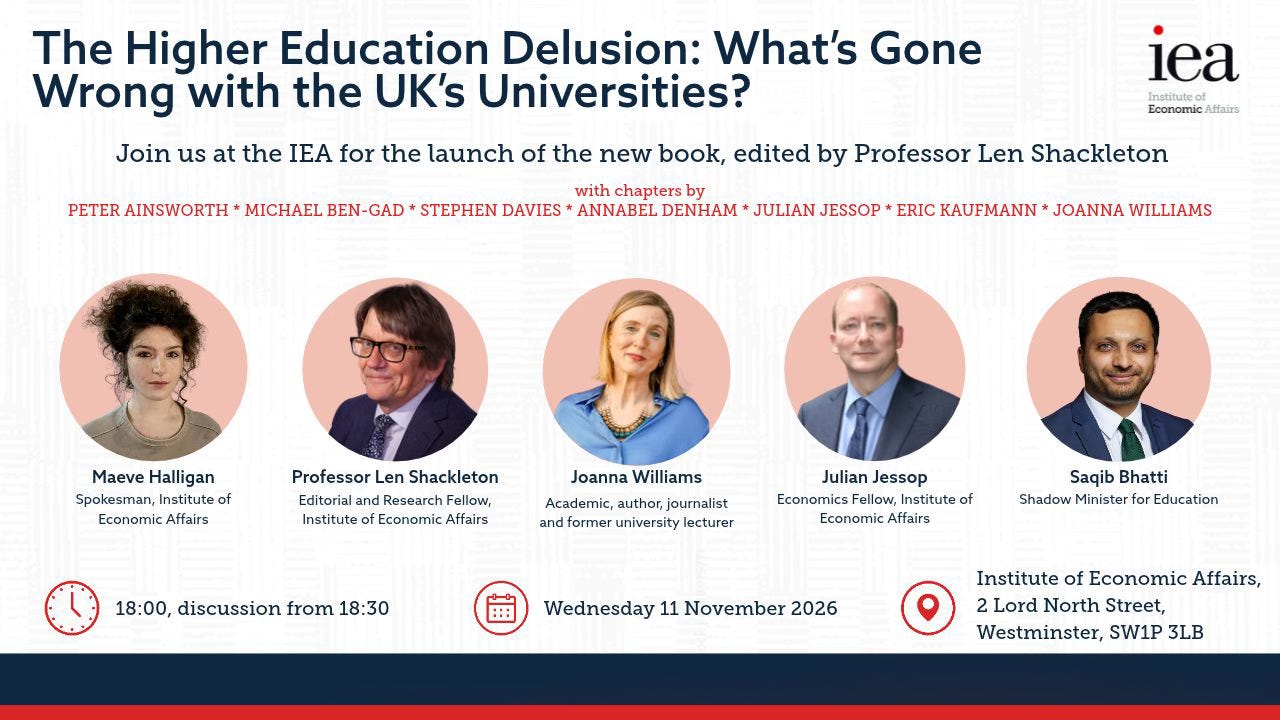
Speakers
Professor Len Shackleton - Professor of economics at the University of Buckingham and Editorial and Research Fellow at the Institute of Economic Affairs.
Julian Jessop - Economics Fellow at the Institute of Economic Affairs
Joanna Williams - Academic and commentator, and a former director of the Centre for the Study of Higher Education at the University of Kent. She is the author of How Woke Won, Women vs Feminism, Academic Freedom in an Age of Conformity and Consuming Higher Education.
Maeve Halligan - Spokesman for the Institute of Economic Affairs and editor of Economic Affairs, the IEA’s Substack. She comments on free speech, women’s rights and the political attitudes of young people, and has written for The Free Press.
Saqib Bhatti MBE is a British Conservative Party politician who has been the Member of Parliament for Meriden and Solihull East, formerly Meriden, since the 2019 general election. Saqib currently serves as Shadow Minister for Education.
Event details
Wednesday 11 November 2026 at the Institute of Economic Affairs, 2 Lord North Street, London SW1P 3LB.
18:00-18:30 Doors open and welcome
18:30-20:00 Panel discussion
20:00-21:00 Post event reception; refreshments provided