



Ryan Bourne is the R. Evan Scharf Chair for the Public Understanding of Economics at the Cato Institute.
It is always dangerous to read public policy lessons into election results, especially so soon after polling day. Midterm outcomes are overdetermined, the president’s party almost always loses ground, and factors like local candidate quality and, recently, mid-cycle redistricting complicate any evaluation of what happened.
Still, there’s good evidence that the Republican wipeout in the US midterms was not helped, shall we say, by President Trump’s key economic policies. His approval rating stood at a historically low 38 per cent in exit polling, with 89 per cent of voters saying the cost of living was a major or crucial factor in their vote. It wouldn’t be the first time inflation has claimed the scalps of incumbent politicians in the past decade.
This amounts, though, to a stunning reversal for a party whose president won in 2024 because voters hated the price surge on Joe Biden’s watch. That post-COVID inflation – peaking at 9 per cent, the highest since 1981 – left real scars.
Research by Erik Hurst and co-authors found that by the end of 2024, 58 per cent of workers had wages below their pre-pandemic trajectory, and 37 per cent had seen their real pay actually fall. The average worker who stayed at the same firm in 2020–24 lost 9 per cent of their real purchasing power.
That left voters furious with President Biden, whose team had first promised to “run the economy hot” with fiscal and monetary stimulus and then blamed one-off supply shocks and greedy corporations for the resulting price-level spike.
Unlike in the UK, real growth held up in the US, so supply shocks couldn’t explain much of the enduring rise in the price level. It was excess demand. And President Trump promised not just to defuse it, but to bring prices back down, “starting day one”.
Two years later, voters have now delivered a vote of dissatisfaction against Trump and the Republicans’ approach.
That raises the question of what, exactly, voters are mad about where living costs are concerned. Republican camps seem to be splitting into two big schools of thought here. One, held by many old Reaganite types, is that the tariffs explain such anger. The more paleo-conservative wing pins the blame exclusively on the Iran war and the shock to gas and diesel prices it generated. Vice President JD Vance posted as much on X the morning after the election: “The reason we lost is the war.”
The truth, however, is that discontent with Trump on inflation was growing pre-Iran. President Trump’s net approval on inflation in the Economist/YouGov poll slid steadily throughout 2025, even as real average hourly earnings were improving. By February 2026, before any strikes, Trump’s net approval on inflation had fallen to –28, a level not dissimilar to that Joe Biden suffered in the dying days of his presidency.
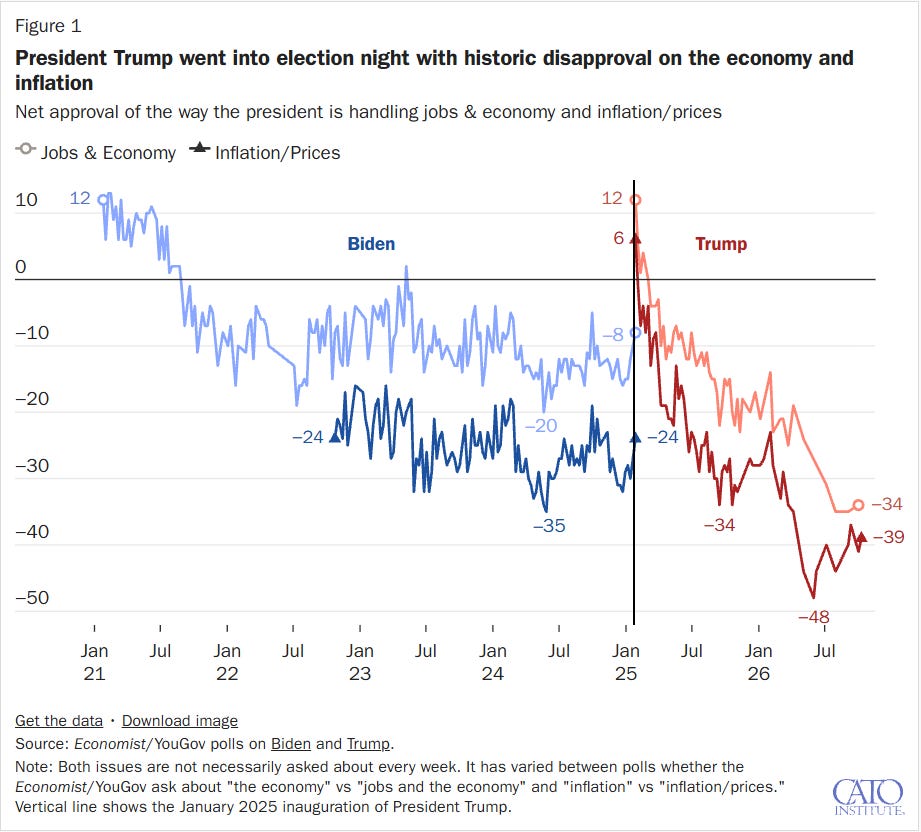
The explanation is twofold. First, polling regularly showed that a large chunk of voters believed the president when he said he’d deliver deflation. They really did think he would bring down prices across the board and got more agitated as it became evident he couldn’t.
Even today, supermarket prices feature heavily in public complaints, despite having risen only 1.9 per cent over the past year. It’s the “sticker shock” of consumer prices having risen by 30 per cent since 2020 that still rankles for many.
Second, every major plank of the president’s economic policy has made the cost of living worse, at least at the margin. Tariffs are a tax paid largely by Americans, and voters noticed the higher prices that resulted.
Enormous ongoing budget deficits are putting upward pressure on interest rates. Demanding the Federal Reserve cut rates could’ve de-anchored inflation expectations somewhat, while Trump’s recent ode to inflating away the national debt sent the same signal. Deportations, and the fear of them, disrupted agriculture and construction.
Then the Iran war began, and the bottom dropped out on Trump’s support. By April, the president’s net approval on inflation, at –35, matched Biden’s worst in the history of the poll; at one stage it fell to –48.
Gas prices are today up almost 50 per cent on January, and rose 9 per cent in September alone. This cost shock pushed headline inflation back up to 3.7 per cent, meaning prices are once again outstripping wage growth. Inflation-adjusted hourly earnings have fallen by 0.7 per cent over the past year.
That alone would have made this election very difficult for Republicans. In NBC’s exit poll, 62 per cent blamed higher prices more on Trump’s policies than on factors beyond his control, while 65 per cent said his policies had made the economy worse. And almost two-thirds said his tariffs hurt the national economy, while over 80 per cent said they were worried about the price of necessities like gas and diesel, food and groceries, utilities and healthcare.
In the coming weeks, other analysts will seek to unpick the relative contribution of these factors compared with, say, individual candidate quality or other gripes, such as concerns about ethics in the administration.
But the economic headwind on living costs is undeniable. Having won an election because people hated high inflation, the president over-promised that he would deliver deflation, imposed tariffs, badgered the Fed for rate cuts, green-lit enormous budget deficits and took the US into a Middle Eastern conflict that drove up gas prices. Now, his party has reaped the backlash.
Celebrating freedom means refusing to bow to Trump’s policies or the suffocating cult built around him. It’s a declaration that democracy isn’t a stage for one man’s ego, nor a playground for fear‑mongering. It’s choosing truth over propaganda, institutions over tantrums, and courage over submission. Real freedom is the act of standing up, speaking out, and rejecting any leader who demands loyalty instead of accountability.