


In today’s newsletter:
Read the IEA’s Alternative Budget and additional analysis
Berlin’s 2020 rent cap cut rents by 10 per cent but halved the supply of rental flats
Ebeling in Brief - read the first instalment of the new series
An introduction from Economic Affairs editor Maeve Halligan
With the Chancellor’s Budget arriving on Wednesday, the IEA has done him the courtesy of writing one in advance. Our Alternative Budget cuts income tax, scraps stamp duty and does away with inheritance tax - keep reading for further commentary from Lord Hannan and IEA Chief Economist Valentin Boboc. The headline? Balancing the books takes surprisingly little.
On the podcast, hear discussion surrounding how Britain may have missed out on a Norwegian-style oil fund and why France has the riots of austerity without the austerity. Elsewhere in Economic Affairs, we find that Berlin’s rent cap brought rents down by 10 per cent and halved the number of flats to rent, a trade-off that may interest anyone following the Renters’ Rights Act.
Don’t forget to read the first instalment of Ebeling in Brief, a new weekly series of shortened chapters from Dr Richard M. Ebeling’s recently published book.
Valentin Boboc is Chief Economist at the Institute of Economic Affairs
One of the most enjoyable things about working on the Alternative Budget was that even when you think you have a reasonable idea of how fiscal dynamics work, there is always room for surprise.
Of course, surprises occur when you do research in preparation for the work itself, but one of the most valuable things about the Alternative Budget was the opportunity to share it with the world and get questions from the audience. Depending on your audience, questions can be quite brutal, but they are useful because people often point out things you didn’t necessarily think about or didn’t think about addressing separately in the first instance.
So I thought I’d share some of the surprising and interesting things I’ve learned along the way as I wrote the Alternative Budget and received feedback from experts and from members of the general public.

It takes surprisingly little to balance the books. This is perhaps because even experts who read obsessively about government spending every day have a slightly warped view of what the everyday role of the state is. Things most people would describe as core functions of the state, such as defence, policing and the courts, account for a relatively small share of spending. Given the sheer size of the welfare budget, which has been growing rapidly in recent years and is projected to continue growing, freezing it in cash terms and then making small cuts of 0.85% a year until the end of the current Parliament would, alongside the tax proposals in the Alternative Budget, be sufficient to bring Britain’s current budget into surplus.
Britain raises a larger share of its tax revenue from personal income taxes than the OECD average. This isn’t surprising to anyone who studies the British tax system, but what surprises me time and again is the extent of that reliance. In 2023, the British Government collected 30.2% of its tax revenue from personal income taxes and 30.2% from taxes on consumption, compared with OECD averages of 23.7% and 31.3% (see e.g. OECD Revenue Statistics). High marginal income tax rates can discourage work and deter people from pursuing higher incomes, and earning more is one of the most important ways to improve one’s quality of life.
People seem to believe that change is a means of punishment. The overall perception is usually that taxes are designed to ‘punish’ someone and exemptions are designed to ‘reward’ someone else. Whilst that can be true in the sense that governments occasionally attempt to reward their political constituencies through subsidies and tax exemptions, there seems to be an inherent belief that any tax is a form of targeted punishment. And perhaps, to some extent, people are right. Income taxes ‘punish’ people who pursue higher incomes at the margin. Stamp duty ‘punishes’ people who want to move house. The great thing about the Alternative Budget is that all the proposals are focused on creating a broader and lighter tax burden. In other words, the Alternative Budget wants to make sure that we ask a lot less from a lot more people, so that everyone feels as ‘unpunished’ as possible.
VAT rises don’t have to lead to persistent inflation. A rise in VAT can increase the prices people pay, but it does not follow that those prices will keep rising faster. In fact, if VAT is increased and firms choose to pass it all on to consumers, then after a year the inflation rate will be the same as it would have been if VAT had not risen. The Bank of England explained this ahead of the VAT rise in 2011. Moreover, VAT changes are not necessarily passed on to consumers in full. Research by the IMF suggests that the impact of VAT changes on prices differs between changes in the standard VAT rate, lower VAT rates and changes in the classification of goods. It’s quite likely the proposed changes could alter the prices of some goods and services without causing persistently higher inflation.
If you want to stop spending money, you have to start spending political capital. Most people seem to agree it’s a no-brainer that the Government should reduce its spending and address the debt and deficit issues. However, everyone would prefer it if the spending cuts could begin somewhere else. The issue with Britain’s complex tax system is that taxes, exemptions and subsidies have grown ever more specific, creating very clearly delineated political constituencies. And so making the Government less costly is incredibly politically costly.
The main point about the Alternative Budget is that Britain has choices. If we simply wanted a budget surplus, the changes required would be surprisingly small. If we could combine these changes with a better tax system and sensible pro-growth measures, we could achieve a better economic trajectory with somewhat stronger growth and healthy public finances.
The best way to never miss out on IEA work, get access to exclusive content, and support our research and educational programmes is to become a paid IEA Insider.
With national debt nearing £3 trillion, can Britain ever get back to surplus? Lord Hannan, Dr Christopher Snowdon and Dr Kristian Niemietz ask whether Britain really missed out on a Norwegian-style oil fund, and how far the IEA’s Alternative Budget could take the country back to surplus ahead of the Chancellor’s Budget. They then discuss France’s riots and fiscal crisis and whether Britain faces similar pressures, before closing with a Manchester rent tribunal ruling that shows the unintended consequences of the Renters’ Rights Act. Watch on YouTube
This week in Economic Affairs
John Stuart Mill on Liberty, Tyranny and Restraints on Government

Ebeling in Brief is a weekly series, published every Saturday, of shortened chapters from economist Dr Richard M. Ebeling’s Liberty and the History of Economic Ideas: From the Ancients to the Austrian Economists (2026).


Berlin’s rent cap: cheaper rents, fewer homes

Rainer Zitelmann is the author of the book The Power of Capitalism.
News and Views from the IEA
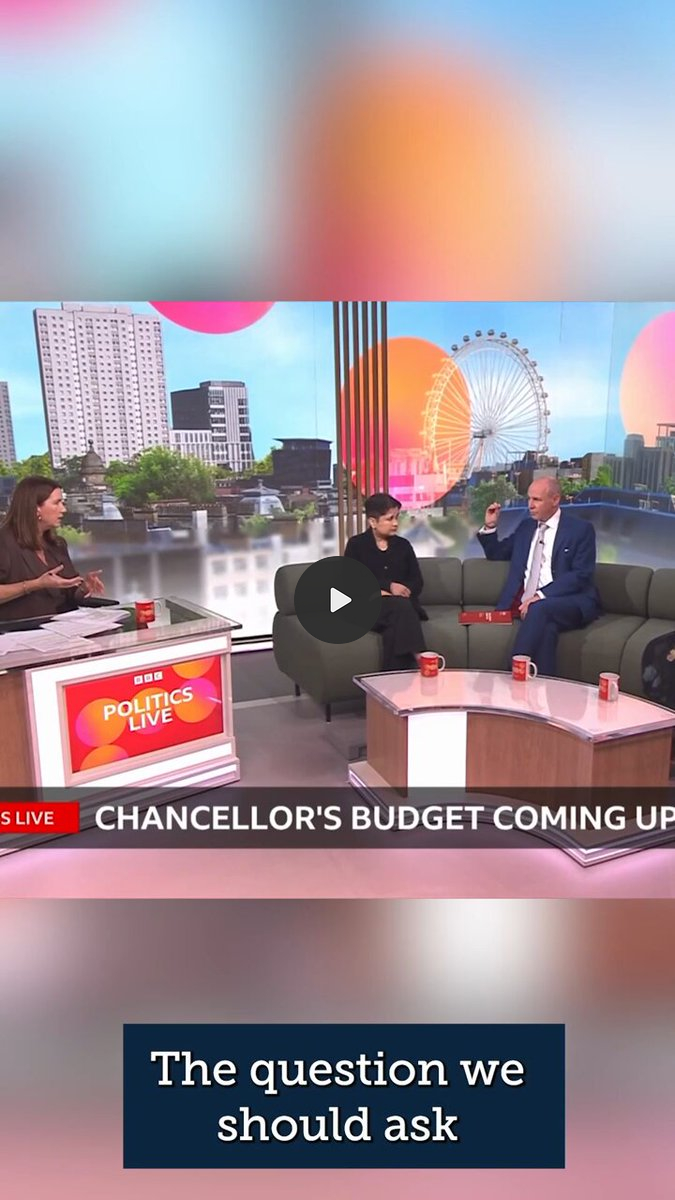
Mr Healey, the IEA’s Alternative Budget would cut the deficit without raising taxes. Lord Hannan, Director General of the IEA, writes for the Telegraph on how the Chancellor could get the public finances back on track in Wednesday’s Budget. He argues that the Government should scrap the most damaging taxes and replace them with simpler, cheaper ones that do less harm to growth.
“The Chancellor can replace perverse, disruptive and expensive taxes with more effective and cheaper ones.”
Andy Burnham told to freeze the State Pension. The Express reports on the IEA’s Alternative Budget ahead of next week’s Budget, highlighting its proposals to suspend the triple lock, freeze the basic State Pension and phase out defined-benefit pensions as part of a wider plan to bring the deficit and national debt under control.
When will Burnham bring his whole self to work? Christian May, Editor in Chief of City AM, recommends the IEA’s Alternative Budget as inspiration for the Government ahead of next week’s Budget. He highlights its plans to extend VAT, scrap stamp duty and inheritance tax, and reform welfare, calling the proposals “bold” and arguing they “deserve a hearing”.
To stop spending money, the Chancellor must spend political capital. Dr Valentin Boboc, Chief Economist at the IEA, writes for ConservativeHome on why next week’s Budget is a chance to change course. Drawing on the IEA’s Alternative Budget, he argues that the choice is not simply between deep cuts and ever-higher taxes, and that balancing the books takes surprisingly little, provided the Government is willing to spend some political capital.
“The good news is that balancing the books requires relatively small changes to public spending.”
Ministers accused of lecturing families on emergency stockpiling. Lord Hannan, Director General of the IEA, is quoted in the Daily Mail on the Government’s Be Ready campaign, arguing that its job is to reassure people, “not to frighten people into stockpiling tins of beans”.
The Renters’ Rights Act is sending tenants to an already overstretched tribunal system, City AM reports. Dr Valentin Boboc, Chief Economist at the IEA, is quoted discussing how the Government’s reforms could shrink the supply of rental homes.
“Landlords are more likely to quit when letting becomes less profitable and more uncertain."
France’s imaginary austerity. Dr Kristian Niemietz, Editorial Director and Head of Political Economy at the IEA, writes for Quillette on why France’s rioters are protesting against austerity that does not exist. He argues that with public spending at around 57 per cent of GDP and a deficit of 5 per cent, France has the riots of fiscal consolidation without any of the benefits, and should start with real reform of its pension system.
Approving the Jackdaw gas field won’t bring energy bills down, This is Money reports. Andy Mayer, Energy Fellow at the IEA, is quoted discussing the Government’s decision to give the North Sea project the go-ahead.
“The Jackdaw approval is welcome but absurdly late and will not restore investor confidence in the UK or energy security. The field was discovered 21 years ago, and first approved in 2022.”

Education, Events and Opportunities
The IEA launches The Alternative Budget
Can Britain turn a £100 billion deficit into a surplus without slashing public services? At the launch of the IEA’s Alternative Budget on Monday 19 October, Chief Economist Dr Valentin Boboc set out a plan to do just that by the end of the next fiscal year, cutting income tax, national insurance, stamp duty and inheritance tax in exchange for a broader VAT base, while freezing welfare spending in cash terms. Sir Vince Cable, former Business Secretary, responded, welcoming the push for tax simplification and welfare reform but making the case for a more Scandinavian approach and warning against freezing the state pension. Hosted by Lord Hannan, the discussion also touched on Milton Friedman’s insight that the most visible taxes are the least popular. Watch the full event below:
Upcoming:
The Tyranny Tracker: Global Trends in Democracy and Authoritarianism
26.10.2026
Many of the freedoms once thought secure are being eroded across the world, as authoritarian rule becomes more entrenched. The Human Rights Foundation’s new Tyranny Tracker measures democratic resilience, erosion and authoritarian consolidation in every region, separating genuine democracies from hybrid and fully authoritarian regimes.
Javier El-Hage, HRF’s Chief Legal and Policy Officer, will present the index’s methodology and key findings, then chair a panel with HRF researchers and Jesús Armas, a Venezuelan democracy advocate and former Caracas city councillor who was held at El Helicoide from December 2024 to February 2026. Lord Hannan of Kingsclere, Director General of the IEA, will open the event.

Speakers
Javier El-Hage, Chief Legal and Policy Officer at the Human Rights Foundation, where he directs the Tyranny Tracker project. He is a Bolivian-American attorney who specialises in comparative constitutional law, international human rights law and democracy law.
Jesús Armas, Venezuelan democracy and human rights advocate and former Caracas city councillor. He was a political prisoner from December 2024 to February 2026.
Luciana Fortuna, Research Fellow at the Human Rights Foundation and DPhil candidate in Politics at the University of Oxford. Her research examines democratic erosion, legislatures and governing coalitions in Latin America.
Malaak Jamal, Director of Policy and Research at the Human Rights Foundation.
Mo Keita, Senior Policy Officer for Africa at the Human Rights Foundation.
Lord Hannan of Kingsclere, Director General, Institute of Economic Affairs
Event details
Monday 26 October 2026 at the Institute of Economic Affairs, 2 Lord North Street, London SW1P 3LB.
14:30-15:00: Doors open and welcome
15:00-16:30: Presentation followed by panel discussion
The Atonement Complex - Report Launch
03.11.2026
The campaign for slavery reparations has rarely had more momentum, and its case has rarely been examined less. With Caribbean leaders taking a £18.8 trillion claim to the Commonwealth summit in November, Professor Doug Stokes’s new paper, The Atonement Complex, examines the accounts: who really profited from slavery, what the British public paid to end it, how the trillion-pound figure was built, why other parties to the trade are left out of the story, and how hostile states have turned Western guilt into a tool of statecraft. Join us for this free event, open to all, to mark the paper’s launch.
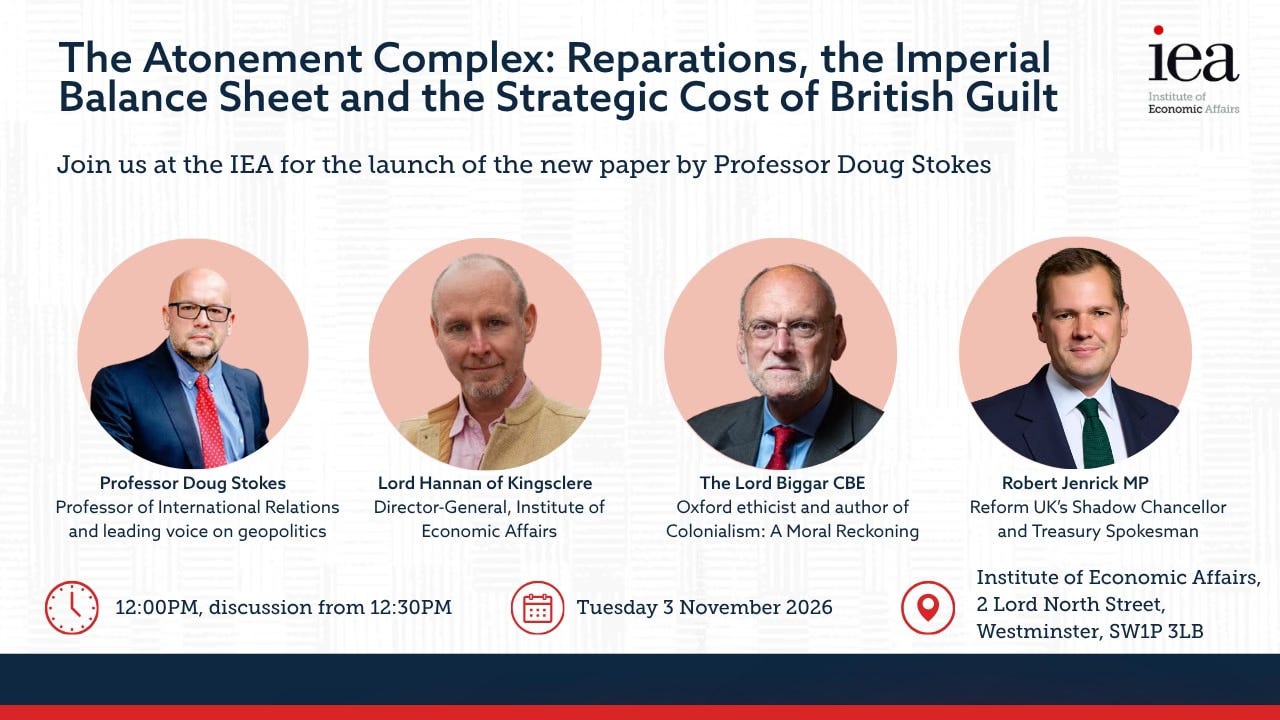
Speakers
Professor Doug Stokes, Professor of International Relations and Vice President for Institutional Development at Modul University Vienna. An Honorary Professor at the University of Exeter, he advises political and business leaders across the UK and Europe and writes regularly for The Times, The Telegraph, The Spectator and The Critic.
Lord Nigel Biggar, author of The New Dark Age: Why Liberals Must Win the Culture Wars. Emeritus Regius Professor of Moral Theology at the University of Oxford and a Conservative peer in the House of Lords, he is also the author of Colonialism: A Moral Reckoning and Reparations.
Robert Jenrick MP, Reform UK’s Treasury spokesman. MP for Newark since 2014, he previously served as Housing Secretary, Immigration Minister and Shadow Justice Secretary.
Lord Hannan of Kingsclere, Director General, Institute of Economic Affairs
Event details
Tuesday 3rd November 2026 at the Institute of Economic Affairs, 2 Lord North Street, London SW1P 3LB.
12:00-12:30: Doors open and welcome
12:30-13:30: Panel discussion
13:30-14:00: Post event reception; soft drinks provided