


In today’s newsletter:
Dominic Pino on how Scotland’s story demonstrates the cost of abandoning economic liberty
Which party policies would actually help the economy?
Do the Tories’ Inheritance Tax Plans Add Up? | IEA podcast episode
An introduction from Economic Affairs editor Maeve Halligan
Party conference season has finally drawn to a close. Between them, the parties have promised to scrap, cut, freeze or reform roughly every tax going, leaving only the small matter of who pays for it all.
The IEA’s Valentin Boboc this week scored each pledge on growth, incentives and the public finances, and found a few gold stars among the familiar price controls. Chris Snowdon and Kristian Niemietz took out the calculator on our weekly podcast to ask whether the inheritance tax sums add up.
Dominic Pino asked how the birthplace of Adam Smith came to run Europe’s largest deficit, and Matt Ridley wondered whether anything will still count as a luxury in a richer world. On current form, a balanced budget looks a safe bet.
Dominic Pino is an editorial writer at the Washington Post.
Free-market supporters are used to hearing about the horror stories of socialism from countries such as the Soviet Union, Cuba or North Korea. Property confiscation, prison colonies, famines and mass graves. It’s vitally important to keep telling the history of what happens when free markets and the rule of law are abandoned.
But as I was walking around Scotland recently, I thought of a different case against socialism, or at the very least in favour of free markets. Scotland doesn’t have bread lines or death camps, of course. It was certainly a nice place to visit, and by global standards, it is an incredibly pleasant place to live.
It just isn’t all it could be. When Scotland rejected its heritage as the birthplace of free-market ideas, it didn’t plunge into poverty, but it did yoke itself to mediocrity.
Samuel Gregg wrote for Law & Liberty about Scotland’s “intellectual triumph” during the Enlightenment. It’s a formidable record from an unexpected place.
It was an economic backwater in the late eighteenth century, ruled from afar since 1603. But Scotland had deep connections to European intellectual life and developed some of the greatest thinkers of the age. Francis Hutcheson, David Hume, Adam Smith, Thomas Reid, William Cullen, Lord Kames, Hugh Blair, Dugald Stewart, Adam Ferguson and others developed a rich, liberal tradition.
Their appreciation of liberty and rejection of top-down control were reflected in the economic thought of the time, best known from The Wealth of Nations. Smith wrote of the “system of natural liberty” where “every man, as long as he does not violate the laws of justice, is left perfectly free to pursue his own interest his own way, and to bring both his industry and capital into competition with those of any other man, or order of men”.
It wasn’t only the thinkers. Scotland produced many practical men as well. The other great event of 1776, alongside the Declaration of Independence and the publication of the Wealth of Nations, was James Watt’s invention of the steam engine.
Everyone who has used a paved road is indebted to John Loudon McAdam, whose surname gives us the back half of the word “tarmac”. William Rankine and Lord Kelvin laid the foundations for the modern science of thermodynamics at the University of Glasgow. James Clerk Maxwell opened our eyes to the electromagnetic spectrum. Life-saving medical technologies now seen as mundane, such as the hypodermic syringe and saline drip, were invented by Scots, Alexander Wood and Thomas Latta, respectively.
The astonishing record of achievement from a country that has never had a population larger than that of the present-day Madrid metropolitan area seems to have died off around the turn of the twentieth century. Alexander Fleming and Alexander Graham Bell made their advances outside Scotland, and since then, it’s hard to point to anything that lives up to the country’s previous reputation.
“Rather than showing the rest of the stagnant non-London British economy how the ideas her forefathers propounded can restore growth and increase prosperity, Scotland lags behind.”
It’s obvious, when visiting the Scottish National Portrait Gallery in Edinburgh, that Scotland has rejected its heritage. The stunningly beautiful building is filled with remarkable artwork that the museum is apparently ashamed to be displaying. The descriptions accompanying the artwork follow a predictable formula: one paragraph describing who the individual was, and a second describing an often-threadbare connection to slavery.
Even for someone who opposed slavery during his life, such as Adam Smith, the museum couldn’t display James Tassie’s medallion of his likeness without saying that Smith “appeared resigned to the continuing existence and even inevitability of extreme social and economic inequality” and promoted “the ethnocentric view that Western capitalist societies are superior to all others”.
Contemporary Scottish politics is consumed by quixotic nationalism that a majority of the country rejects. The Scottish National Party, which has controlled the devolved parliament since 2007, vacillates between over-the-top progressivism and pointless centre-left mush. Rather than showing the rest of the stagnant non-London British economy how the ideas her forefathers propounded can restore growth and increase prosperity, Scotland lags behind.
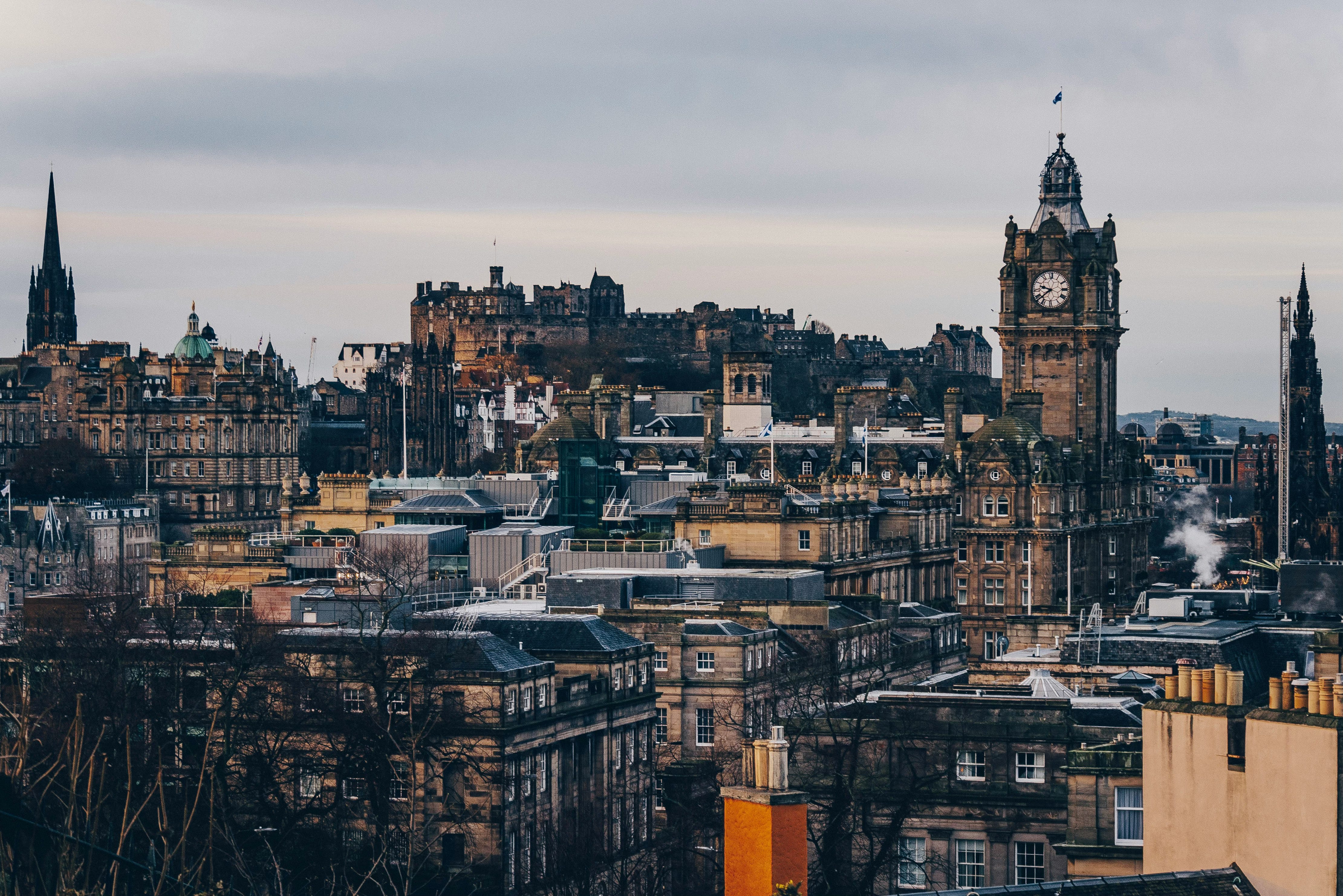
Scotland should be rich. North Sea energy can power high-tech industry to replace the old factories that closed. The ancient universities should be magnets for the world’s best talent. Edinburgh has centuries of banking history and remains a financial centre today. And Scotland has no problem attracting tourists like me to come and visit.
Instead, Scotland is a heavily indebted country inside a heavily indebted country. Its 2025 deficit of 11.6 per cent of GDPis larger than that of any other country in Europe and would be 14.3 per cent if not for North Sea oil. Scotland is pulling down the average economic output per person in the UK, trailing England by almost £3,000 per head.
And for the amount of tax Scots pay – 42.2 per cent of GDP, higher than most European countries and roughly two-thirds higher than in the US – they at the very least ought to have better roads.
Most critics of free markets today don’t want to go full Soviet, and it’s hard to imagine, say, John Swinney sending anyone to a gulag. But free marketeers shouldn’t need to reach for the worst atrocities to prove their point. Just look at Scotland. It’s not horrifying, but it is sad.
The best way to never miss out on IEA work, get access to exclusive content, and support our research and educational programmes is to become a paid IEA Insider.
Would exempting the family home from inheritance tax just push the wealthy into bigger houses? Chris Snowdon hosts the IEA Podcast with Kristian Niemietz and Daniel Freeman on Kemi Badenoch’s Conservative conference speech, from her inheritance tax pledge and what Spain’s wealth tax reveals about carve-outs for the family home, to scrapping the £100,000 childcare cliff edge and why relaxing staff ratios would do more, plus the latest riots in France and whether any level of public spending is ever enough, and how Wales’s Well-being of Future Generations Act has been used to block new roads. Watch on YouTube
This week on Economic Affairs
Party conference season: Which policies would actually help Britain's economy?

Valentin Boboc is a Senior Economist at the Institute of Economic Affairs


News and Views from the IEA
The Case for Freedom in an Illiberal World | IEA Interview
IEA Director General Daniel Hannan speaks to David Nott, President and CEO of Reason Foundation, about the philosophy behind Reason magazine and the case for individual liberty today. They discuss what distinguishes Reason's motto of "free minds and free markets", and why the magazine takes on difficult issues such as drug policy that other classical liberals often avoid. Watch on YouTube
We need to learn how to lower debt without losing public support. Dr Valentin Boboc, Chief Economist at the IEA, writes for CapX on what Britain can learn from Eastern Europe’s experience of austerity. He argues that, with debt interest now taking around £1 in every £12 the government spends, fiscal consolidation is unavoidable, and that Latvia and Estonia show it can be done without losing office.
“Most countries that experience debt problems struggle to implement lasting fiscal consolidation.”
The temperance lobby is making a comeback. Dr Christopher Snowdon, Head of Lifestyle Economics at the IEA, writes for The Critic on how the old temperance movement has rebranded and found a home at the World Health Organization. He argues that its campaigners now want a global anti-alcohol treaty modelled on tobacco control.
Cutting taxes on property is a welcome step in the right direction. Lord Hannan, Director General of the IEA, writes for the Daily Mail on why the Conservatives’ pledges on inheritance tax, stamp duty and the mansion tax would boost growth for everyone, not only homeowners. He argues that the real fix for Britain’s housing costs is to liberalise planning laws.
“The only question we should ask about any tax is whether it is efficient. Does it bring in a decent chunk of revenue without creating perverse incentives?”
Some say the modern world could be better. Others say it is rotten at the core. Dr Steve Davies, Senior Education Fellow at the IEA, opens a new 15-part essay series for Human Progress on those who reject modernity outright. In the first instalment, he argues that this deeper “revolt against modernity” is more widespread than the familiar reformist critiques, and that it increasingly needs a direct response.
The London Stock Exchange boss has urged the Chancellor to axe stamp duty on shares, This Is Money reports. Julian Jessop, Economics Fellow at the IEA, is quoted agreeing that the tax “acts as a brake on economic activity”, but argues that the Government should focus on improving the economy’s fundamentals.
Debt and profit are not, and have never been, opposites. Dr Valentin Boboc, Chief Economist at the IEA, writes for Econlib on why a company carrying large debts can still be profitable. He argues that what matters is what the borrowing paid for, and whether the firm has the cash flow to meet its commitments.


Education, Events and Opportunities
Upcoming:
The Atonement Complex by Professor Doug Stokes - Report Launch
03.11.2026
The campaign for slavery reparations has rarely had more momentum, yet its case has rarely been examined less. In The Atonement Complex, Professor Doug Stokes asks whether slavery made Britain rich, what the British public paid to end it, and how the £18.8 trillion bill was calculated. Join us for the launch of this new paper at a free event, open to all.
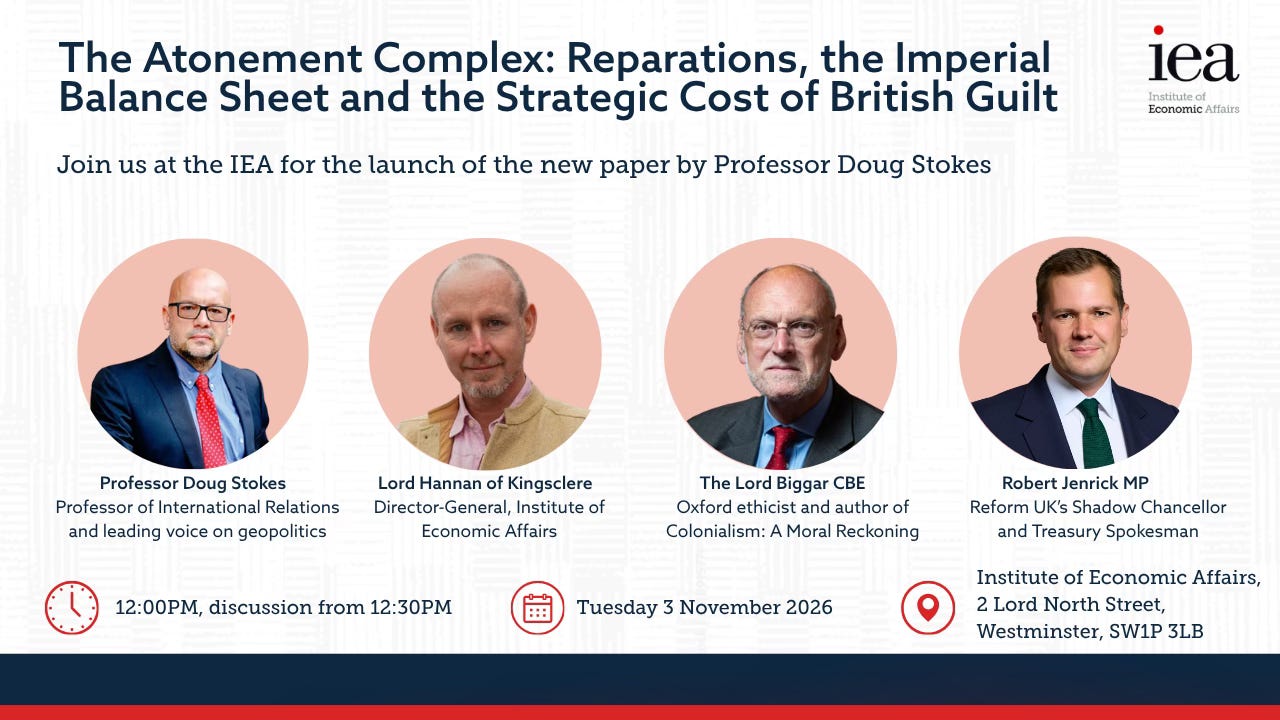
Speakers
Professor Doug Stokes, Professor of International Relations and Vice President for Institutional Development at Modul University Vienna. An Honorary Professor at the University of Exeter, he advises political and business leaders across the UK and Europe and writes regularly for The Times, The Telegraph, The Spectator and The Critic.
Lord Nigel Biggar, author of The New Dark Age: Why Liberals Must Win the Culture Wars. Emeritus Regius Professor of Moral Theology at the University of Oxford and a Conservative peer in the House of Lords, he is also the author of Colonialism: A Moral Reckoning and Reparations.
Robert Jenrick MP, Reform UK’s Treasury spokesman. MP for Newark since 2014, he previously served as Housing Secretary, Immigration Minister and Shadow Justice Secretary.
Lord Hannan of Kingsclere, Director General, Institute of Economic Affairs
Event details
Tuesday 3 November 2026 at the Institute of Economic Affairs, 2 Lord North Street, London SW1P 3LB.
12:00-12:30 Doors open and welcome
12:30-13:30 Panel discussion
13:30-14:00 Post event reception; refreshments provided
The Higher Education Delusion - Book Launch
11.11.2026
Britain’s universities are still billed as “world-leading”, yet the sector has rarely looked more troubled. Half of young people now go to university, but more than a third of institutions are in deficit, firsts have soared from 7% to 30% of degrees, and only around a third of recent students will ever repay their loans in full. In The Higher Education Delusion, edited by Professor Len Shackleton, ten contributors ask what has gone wrong, from the shrinking graduate premium and a student “loan” that works as a badly designed tax, to campus monoculture and the threat AI poses to the traditional university.
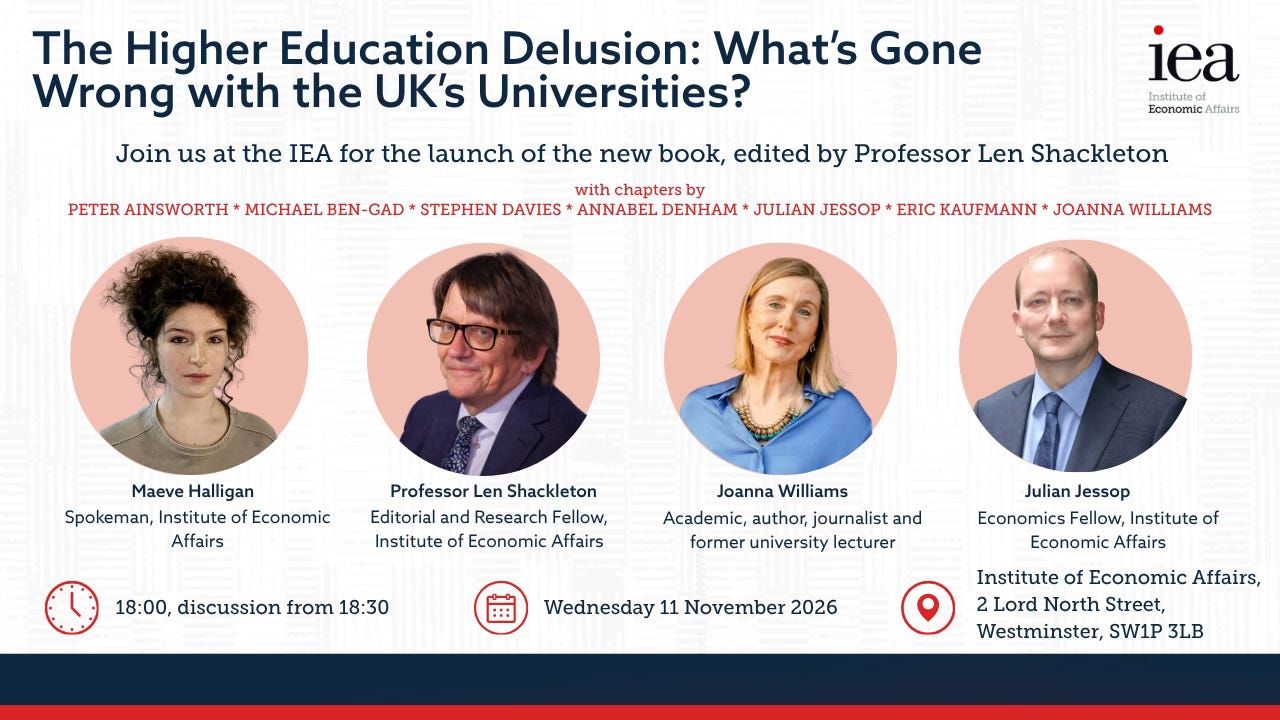
Speakers
Professor Len Shackleton - Professor of economics at the University of Buckingham and Editorial and Research Fellow at the Institute of Economic Affairs.
Julian Jessop - Economics Fellow at the Institute of Economic Affairs
Joanna Williams - Academic and commentator, and a former director of the Centre for the Study of Higher Education at the University of Kent. She is the author of How Woke Won, Women vs Feminism, Academic Freedom in an Age of Conformity and Consuming Higher Education.
Maeve Halligan - Spokesman for the Institute of Economic Affairs and editor of Economic Affairs, the IEA’s Substack. She comments on free speech, women’s rights and the political attitudes of young people, and has written for The Free Press.
More to be announced…
Event details
Wednesday 11 November 2026 at the Institute of Economic Affairs, 2 Lord North Street, London SW1P 3LB.
18:00-18:30 Doors open and welcome
18:30-20:00 Panel discussion
20:00-21:00 Post event reception; refreshments provided