


In today’s newsletter:
Britain's benefits, pay and planning rules blunt the incentive to move to more productive regions
The Capitalist Command Economy, a new discussion paper by Dr Christopher Snowdon
Rising claims of incapacity due to mental ill health reflect the incentives built into the benefits system, not a genuine surge in illness
An introduction from Economic Affairs editor Maeve Halligan
The autumn chill draws in and another week draws to a close at the IEA. The upcoming Budget looms as UK inflation rose to a five-month high, putting renewed pressure on a certain Everton supporter to come up with a credible game plan.
A march organised by Extinction Rebellion (remember them?) passed 2 Lord North Street this week, and Kristian Niemietz was inspired by the bellowing soap-dodgers to reflect on how “Thunbergism became the high-prestige opinion” back in the mad old days of 2019.
On the IEA’s weekly podcast, Chris Snowdon offered a resolute takedown of the Government’s decision to crowbar more lentils into UK pupils’ school dinners, in a flimsy bid to tackle health concerns. His position, in the tradition of Marie Antoinette, might fairly be summarised as “let them eat turkey twizzlers!” Needless to say that, unlike the former Dauphine, Chris does not suffer revolution-inducing levels of economic illiteracy.
Elsewhere in Economic Affairs, Daniel Hannan prescribed a steady job as the optimal solution for the mental health issues that a record number of people in the UK are now reporting.
Professor Len Shackleton is an Editorial and Research Fellow at the IEA. This article is based on a talk he gave this week to the Beloff Conference organised by the IEA and the Vinson Centre at the University of Buckingham.
Britain’s rotten overall productivity record has many causes. One neglected feature is the difference between geographical areas. Gross Value Added (GVA) per hour worked is 50% higher in London than in the North East. It’s over 25% higher in the South East than it is in Wales. There are similar variations within regions. Take the North West: GVA per hour is just under 50% higher in the centre of Manchester than it is in Blackpool.
Higher productivity in an area reflects factors such as investment by businesses and the government, infrastructure, agglomeration economies, skill levels of workers and so on. It is, broadly speaking, associated with higher wages. Historically, this has led to workers moving from low-productivity areas to areas where productivity and pay are higher. This was a necessary feature of the Industrial Revolution, with workers moving from rural areas to the new factories and mines or helping to build the canals and the railways which snaked across the country to speed transport of goods and people.
This was facilitated by the breakdown of old legal restrictions on moving around the country. The Tudor and Stuart Settlement Laws had made it difficult for a workman to enter a town or parish in which he was not born. This was to keep down the costs of Poor Relief and to protect local time-served craftsmen from cheaper competition.
Nowadays such restrictions have gone, and people can move from town to town and from region to region. Yet relatively few do so. Only 1–2% of those of working age move region each year, with perhaps 2–3% moving between local authority boundaries in the same region. These numbers are markedly smaller than in the United States – where internal migration across the vastness of the country far outstrips anything we see here – and they appear to have been falling in the last twenty years or so. A third of Brits spend most of their lives within a small radius of where they were brought up, and 75% never leave their broad home region apart from holidays.

Low internal migration locks many people in work which is below their potential. One indicator of this is the number who are ‘overqualified’ for their jobs (their highest qualification being above the modal qualification for the role). On this definition, 22.3% of those employed are overqualified in the North East, compared with 18.4% in the South East and 18.7% in the East of England.
Graduates are a particular concern. Around a third of all graduates are currently in non-graduate jobs, and this proportion has been rising. There are considerable variations in the proportions by region. Graduate ‘underemployment’ is markedly higher in Scotland, Wales and the North East than in London, the South East and the East of England. An interesting finding from the Resolution Foundation is that these variations are associated with remaining in the same region as the university from which you graduated.
Why don’t more people – the young in particular – get up and go in pursuit of higher-paid jobs? If they did, they’d have better long-term career prospects, productivity nationally would rise and the economy would grow faster. Some put reluctance to pack their bags down to culture and attitudes, with love for place and staying near family and friends being more important to many people than material factors. There are differences between ethnic groups which tend to support this hypothesis: people of White, Black African and Chinese heritage are markedly more likely to move between regions than those of Pakistani, Bangladeshi or Black Caribbean heritage.
This may be reasonable, perhaps even admirable. But in deciding between staying and going, the scales are often tipped by government policy which alters the balance of incentives.
For example, having national pay grades for public-sector jobs distorts local labour markets. Take teaching, where the U3 point on the scale (the maximum level on the Upper Pay Range) in the North East is 144% of the median earnings in the region. The same point in Outer London (even including the OL allowance) is just 113% of local median earnings. In relative terms, you are much better off – and much more likely to be able to own your own home – in the North East rather than moving.
You can see the same effect with statutory minimum wages. The National Living Wage is 77% of median earnings in the North East, but only 51% in London.
Regions with low-productivity have high benefit dependency. National rates for benefits mean the ‘replacement rate’ (what you get in benefits relative to what you could earn) is high in low-productivity regions. Those on benefits are often in social housing. In the North East, there are 108 social homes for every 1,000 people; in the South East there are just 48. Somebody moving to London for work is likely to have to rent privately. Rent takes 55% of median earnings in London, as against 30% in Yorkshire and the Humber. While this isn’t the direct result of government policy, high rents in some parts of the country are the consequence of planning restrictions which have cramped housebuilding for many years.
“It's time to redress the balance by thinking about ways in which we can facilitate market-led movements between and within regions.”
At a subregional level, similar planning restrictions have delayed or prevented investments which would have facilitated easier commuting – for example the long-delayed Lower Thames crossing which would have opened up job opportunities in Kent to Essex residents, and vice versa. And government spending choices have prioritised improvements to already well-endowed London, such as the Elizabeth line, over revamping railways across the North, which might facilitate commutes from Liverpool to Manchester or even Leeds. Much-hyped subsidies to Manchester buses contrast with very poor bus services in many rural areas.
Different policy decisions could significantly improve mobility between and within regions, leading to higher average productivity. Although between the wars government policy actively sought to encourage movements of labour between areas, since 1945 policy has almost exclusively focused on ‘taking work to the workers’. Tax reliefs and subsidies have been used to encourage private-sector businesses to relocate to depressed regions, while government offices have been moved – recently the ONS to Newport, the Treasury to Darlington and now Andy Burnham’s Number 10 North. The record of this type of policy has often been poor. Jobs have been moved around, at least for a time, but productivity differentials haven’t changed much. It’s time to redress the balance by thinking about ways in which we can facilitate market-led movements between and within regions.
The best way to never miss out on IEA work, get access to exclusive content, and support our research and educational programmes is to become a paid IEA Insider.
Scrap stamp duty, scrap inheritance tax? Daniel Hannan is joined on the IEA Podcast by Kristian Niemietz and Christopher Snowdon, for a round-up covering the Bank of England's rate hold, the case for scrapping inheritance tax and stamp duty, new school lunch rules, and the return of Just Stop Oil amid growing net zero backlash. YouTube
This week on Economic Affairs


News and Views from the IEA
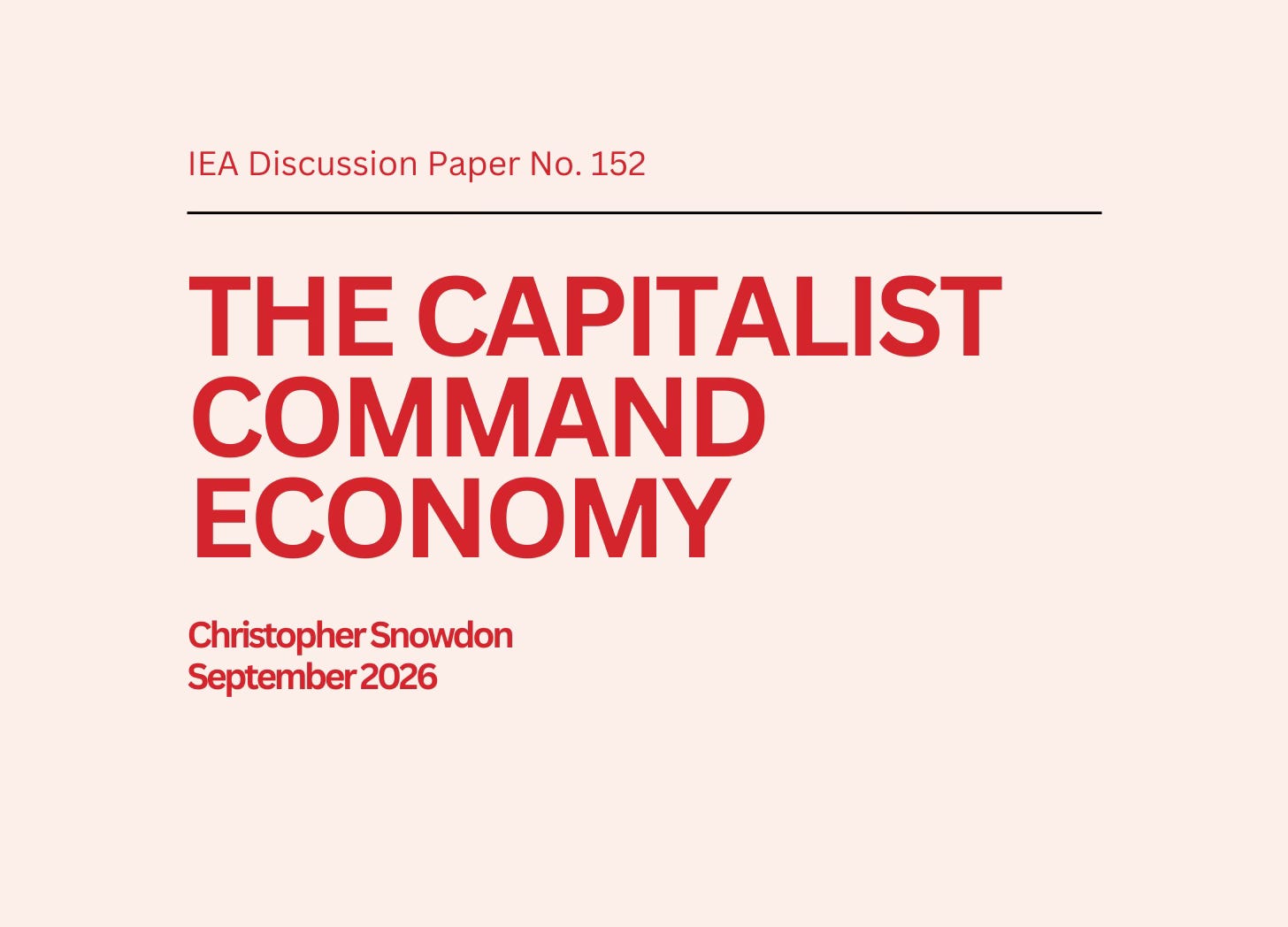
The Capitalist Command Economy
A new discussion paper by Dr Christopher Snowdon, Head of Lifestyle Economics at the IEA.
The private sector is increasingly directed by the state towards non-economic goals such as net zero, diversity and behavioural change.
This is neither socialism nor free markets: the Government doesn’t nationalise industries, but controls them so heavily they become de facto state agents.
Manufacturers now face fines of up to £15,000 per petrol car and £500 per heat pump sold below state quotas.
The minimum wage has risen from 50% to 67% of the average wage since 2010, now the fourth-highest in the OECD.
Britain suddenly looks precarious at home and friendless on the world stage. Daniel Hannan, Director-General of the IEA, writes for the Daily Mail on how forty years of elite contempt for British history have filtered out into the world and come back as hostility from allies and adversaries alike, and argues that the fix lies not in apology but in rebuilding old alliances such as Canzuk, mending ties with Washington and re-telling the story of what Britain actually did in the world.
"We are as alone as we were in 1940, but without the united resolve… No one respects a nation whose leaders struggle to celebrate its history. They’ll like us when we are strong again."
Britain's inheritance tax is among the harshest in the developed world, and free-market voices are calling for its abolition. Oliver Dean writes for ConservativeHome, quoting Paritosh Purohit, Junior Research Associate at the IEA, who argued in Economic Affairs this week that the tax is "arbitrary, distortionary and expensive to administer" and undermines Britain's competitiveness
Fried eggs are out, lentils are compulsory, and even a jam sachet cannot exceed 10g under Labour's new school-dinner rules. Christopher Snowdon writes for Sp!ked on how this latest instalment of Jamie Oliver's twenty-year campaign against school food reveals less about nutrition than about control, since a state that cannot yet police what adults eat is happy to start with children who cannot vote.
Wealth taxes are back in fashion, despite a long trail of European failures behind them. Kristian Niemietz, Editorial Director and Head of Political Economy at the IEA, writes for Quillette on why today’s campaigners’ “ultra-progressive” model would be even worse than the broad-based wealth taxes that Europe scrapped decades ago, since a narrow base means it cannot deliver the revenue or the fairness its supporters promise.
“One of the main reasons why wealth taxes are so popular is that their proponents vastly overstate the extent of wealth inequality."
Britain is quietly building a command economy, ordering private firms about without bothering to nationalise them. Christopher Snowdon, head of lifestyle economics at the IEA, writes for The Critic on the topics unpacked in his recent discussion paper The Capitalist Command Economy.


In this Institute of Economic Affairs briefing, IEA managing editor Daniel Freeman is joined by his colleague Dr Christopher Snowdon to discuss his new paper, The Capitalist Command Economy. They examine how the Government increasingly directs private companies to meet political targets, on heat pumps, electric vehicles, and food reformulation, while leaving them nominally in private hands.
Education, Events and Opportunities
The Beloff Conference
Over this past week, the IEA celebrated its long-term partnership with the Vinson Centre with our annual Beloff Conference. This year’s theme was Migration from an Interdisciplinary Perspective. Featuring speakers with backgrounds in history, political science, economics, and public policy, our attendees came from as far away as Brazil, Greece, and the Dominican Republic to discuss these ideas across three days of talks, panels, and deep conversation.
Kicking off with a Roundtable Discussion led by Dr. Steve Davies, our programme explored topics including Migration Patterns in Post-Communist Eastern Europe (Dr. Valentic Boboc), Representing Diaspora Communities (Rt. Hon. Steve Baker), Why People Migrate (Lord Syed Kamall), and the Cultural Perspectives of Migration (Prof. Eric Kaufmann), as well as a two-part comparative by Dr. Davies on migration in the Belle Epoque versus today.
The Beloff Conference is only one of many year-round events and programmes organized by the IEA/Vinson Centre partnership, including essay competitions, conferences, and speaker series. For those interested in getting involved in future events at the Vinson Centre, click here for more information!

What is your remedy, and the probable consequences?