


This is the second paper of a three-part series, published weekly.
Eben Wilson is a political economist, entrepreneur and industrialist, and former Director of TaxpayerScotland.
In Part One of this series I described how the use of individual Social Providence Accounts could provide a route to a sustainable social care funding mechanism. A Social Providence Account (SPA) is an accrued capital fund built from the partial hypothecation of National Insurance contributions, creating a transferable holding not subject to inheritance tax (IHT). Investment yields on accrued funds would be subject to an Equalisation Levy. In time, total holdings and levy redistributions would become very large, funding new choices in care.
This article explains how the choices in individual management and administration of accrued funds would be best organised.
The virtue of freedom from politicisation
Institutions matter for policy execution. The SPA Scheme carries incentives for cohorts that I have labelled as Accruers and Depleters: those building capital in their accounts and those spending it. It also creates a supported cohort in the form of the recipients of Equalisation Levy Funds. The fourth and fifth cohorts are the politicians with power to adjust policy and those who have power over disbursements. Under a National Care Service, these last two would be combined with undue control over the first three. Many others have already explained that this is not a good institutional format to best serve the first three cohorts.
It is important to consider how best to arrange the institutional form to manage pay-outs in the interests of both the over-65 Depleters and their families. They own the SPA funds. Freedom matters.
Under the SPA Scheme, the optimal approach is, first, to separate the fund-holding arrangements from the fund-handling arrangements and, second, to provide both within a competitive service structure.
The Accrual Model (described in Part One) produces holdings of nearly £1tn over time. For comparison, UK ISA holdings are already approaching that figure. Managing the holdings is therefore less novel than managing the flows.
At root, the administration of SPA fund holdings is akin to present ISA or pension arrangements, both of which have existing regulators. It would be naïve to believe that the SPA Scheme can be set up without some regulatory processes protecting accruals from fraud, process non-compliance or other wrongdoing. Given that holdings are mostly long-term by default, however, the bureaucratic intervention should be light, and subject to any deregulation obtained in those other markets.
Disbursements and Depleters – fund handling
The policy goal should be to allow families to make easy transfers and withdrawals by themselves, subject to proof of eligibility. Given that Accruers becoming Depleters are spending their own capital, without tax consequences for intra-family transfers, this would not usually be complex, while present arrangements with respect to power of attorney would apply.
For the SPA Scheme, the best approach here is to introduce administrative mutuals (entities owned by their SPA holders) who provide both a planning service to families and actual administration of services, including the introduction of new care providers with innovatory offers. This gives consumers and providers a strong shared incentive to work together, as in any market arrangement where perceived value and prices “design” service offers.
The SPA Scheme would be administered on a day-to-day basis by a set of competing service providers, separated from any investment role, but partnered with investment houses, acting as lead contractor “SPA Treasury Administrators” (STAs) for family support in any way they wish to present and promote best-practice service.
As always, the goal here is transparency in pricing and open competition. It is likely that this would provide a channel both for the administrator to innovate and for existing charities to provide add-on targeted support in specific areas either in association with mutuals or by being absorbed into them. The scope for creative destruction of failing services and subsequent service development here where pricing and service choice are liberalised is huge. In time, the days of public-money-seeking “sock puppet” charities would be over as well. They too would have to look at their “offer” and ensure that it integrated with the administrators’ goals and mutual members’ interests.
Ideally, free and open choice of provision would be legislated for, with the freedom to transfer between STAs. Again, the huge variability of “care” comes into play. Who is to say that sending a bereaved granny on a two-week holiday to Tenerife with an old school friend, paid for out of her SPA, is not better value than prescribing her antidepressants in order to get over the loss of her husband? Discovering freedoms that improve the effectiveness of care support is important. A social care mutual, properly constrained by the overarching parameters of the Scheme, yet liberated through a member-agreed constitution, could argue for best-practice use of such funding, voted for by its membership. Liberty matters with respect to moral agreement over sociable beneficence.
The above describes the disbursements of individuated accrued funds from escrow by Accruers who become Depleters. In time, a market-making solution could include passing the management of the Equalisation Levy Funds to the STAs. I do not explore the opportunities here; the variabilities in care needs are huge. What can be said is that if specialisation of services is the optimum way of offering enhanced productivity and quality service, a distributed group of funded players offering a range of priced services is far more likely to achieve this than a central state monolith.
Administering Depleters with depleted accounts
The first tranche of funding for any social care under the SPA Scheme will be an account holder’s own accrued fund. There will, especially in the early days of the Scheme, be many with depleted accounts, including the less well-off with minimal or no accrued funds. Clearly also, not all social care will be fundable through the Equalisation Levy Fund initially.
The policy dilemma here is a political one; its value elements and principles are:
The strength of commitment to the gradual longer-term transfer of social care funding to the SPA Scheme within its core framework.
The weight applied to the need for funding redistribution versus personal assurance.
The principled belief that strong incentives for self-reliance with a ceiling for personal obligation are required for long-term sustainability.
The principled belief that everyone should have security through known collective support alongside their personal and family obligations.
These, to economists, are trade-off parameters, the feedstock of governance decisions. The advantage within the SPA Scheme is that as long as the inflows and outflows of the Scheme as a whole are matched, while total accruals are also accumulating, changing the governing parameters affects only how long it takes to reach sustainability, not whether it is reached.
There are presently well-established capital limits for governing social care support. The SPA Scheme would operate alongside these with adjustments. The Equalisation Levy Funds would become the first drawdown support element. The present capital limits would then be adjusted as accrued funds grow within personal accounts.
Here is a comparison of today’s capital limits in England and how the SPA Scheme would operate initially.
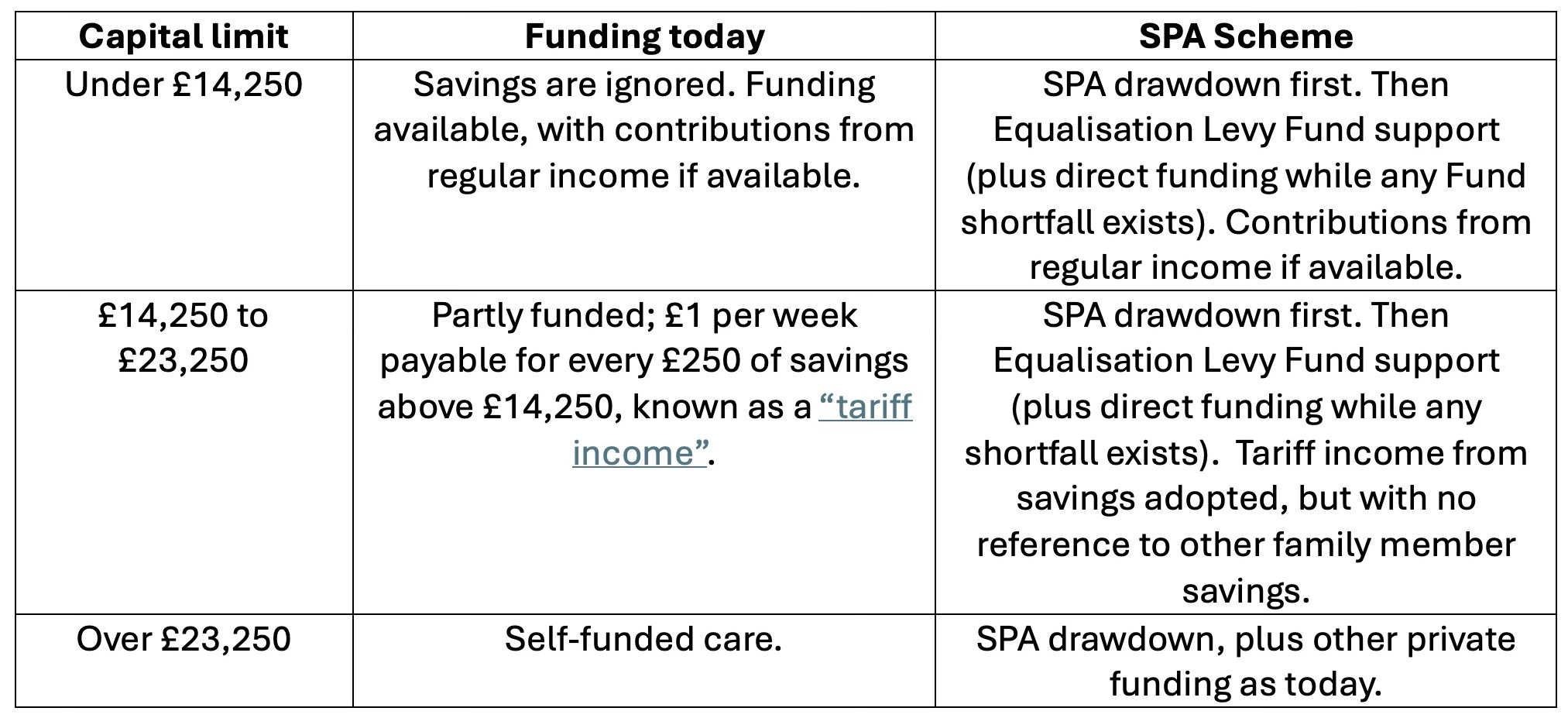
This regime requires no major legislative change; it merely aligns personal SPA holdings with the present capital limits as a separate source of funding. It also gives families an incentive to self-fund, and more choice in how they support their relatives, whether through home support from their STA mutual or a choice between local authority and private care homes.
From the point of view of the Government, it shows a gradual and increasing gain through the capitalisation of tomorrow’s care, a political win through growing success. For example, if the levy rate is kept at a constant 30%, the share of Accruer funds redistributed through the Equalisation Levy rises from around 4% in the first decade to almost 7% in the fourth, as SPA holdings approach £1tn.
From the point of view of care providers, it provides a funding flow to which they can adapt their investment plans, their service offer and its pricing.
It should be noted that it does not, initially, negate the need for long-term catastrophic care support, for example, dementia care with a long survival period, but the potential for a very large Equalisation Levy Fund flow ameliorates this funding pressure.
Again, the rates of accrual and redistribution are political decisions offering flexibilities; the Scheme’s core parameters provide the constant foundation offering sustainability, while aligning the interests of the players in the social care sector.
When Accruers become Depleters – the Worker/Pensioner ratio
Each year the Scheme loses Accruers who become potential Depleters at 65, but it also gains new (generally lower-income) Accruers at 16. The base of capital providers is retained if the working population is stable. But what happens when the ratio of workers to pensioners (now the ratio of Accruers to Depleters) changes?
This has been the major load on the present pay-as-you-go system used in pensions and, by lax dereliction of policy change, social care. The effect of the demographic ratio change is to add more load on redistributional policies; the state pension triple lock in particular has become a high load on the general tax burden.
The SPA Scheme ameliorates this load in several ways:
With a large number of individuals reaching 65 each year and potentially becoming Depleters with accrued funding available should it be needed, and still paying an Equalisation Levy annually, the Scheme’s “float” would be substantial and increasing rapidly.
To that can be added any funds transferred from the middle-aged generation to their ageing family members. As policy stands today, many of these funds which would have been subject to IHT will become non-taxable (although of course due to be largely spent).
Capitalised early-year Depleters who are fit and healthy are valuable. They still pay the Equalisation Levy on accrued yields.
Elderly SPA fund holders who die without needing social care will pass their funds on to their beneficiaries free of IHT; this increases Accruer fund total holdings and the Equalisation Levy proceeds. The purpose of the SPA Scheme is to escape from fixed-pie, essentially rationed, state funding to a “float-all-boats” social fund with a built-in equitable scheme.
One potential amelioration which might be considered is to bring in the SPA Scheme alongside any removal of the present state pension triple lock. According to the IFS, the saving from doing that is uncertain: the triple lock could add anywhere between £5bn and £45bn a year (in today’s terms) to state pension spending by 2050. If the cost proves to be at the higher end, the saving from removing it could offset the fund transfer flows to SPAs.
The SPA Scheme is designed not as a care-targeting system but as a care-funding engine that releases quality targeted care. The setting of the maximum holding, the rate of the Equalisation Levy and the allocation of other general taxation funding are tools to allow those who want to maximise care for the most unfortunate to achieve this goal.
Political choices matter for administrative stability
While Accruer fund holders become more highly capitalised, the gross “reserve float” in the Scheme becomes very large. Transparency of the Scheme’s inflows and outflows is important to constrain political meddling.
The SPA “engine” is intrinsically constrained by the political trade-off between a) the rate of mandatory thrift payments into the SPA Scheme, transparent in its promise of sustainable ownership of the costs of frailty in old age, and b) the rate of the Equalisation Levy redistribution that permits us to engage our need for beneficence again at a transparent cost.
The “spending” constraint is bounded by the cost of the “losses” to the Exchequer’s present-day spending plans through the transfer of today’s funds to tomorrow’s needs, ameliorated by the creation of increasing Levy Funds to support low earners.
The democratic policy objective is to reduce public social support spending to zero over a period longer than most parliamentarians’ voter-interest horizons.
As holdings accrue, it is likely that total social care spending will in fact increase due to the personal preference of SPA holders to support themselves or their relatives with the best possible care. SPA holdings are likely also to increase faster than mandated as wealthier families take advantage of the IHT exemption on SPA funds. The central state gains fiscally both from higher spending on social care organisations and from higher tax revenues from their activities.
What the Scheme is essentially doing is capitalising the social care industry, assuring not only that users can obtain an expanding service, but also that the operational capital to allow that expansion to take place is available.
All the above factors are drivers for longer-term administrative stability. We have to generate providence for all.
Politicians are encouraged by economic success. One is reminded of Einstein’s remark (apocryphally) about geometric progression being the eighth wonder of the world: “Those who understand it, earn it … those who don’t, pay it.” Our socialised and capital-restricted public services operate to a different algorithm: “Those who don’t understand it, deplete it … those who don’t pay for it, don’t get it.” The public have noticed and want change.
This is why any SPA Scheme implementation cannot immediately replace the present state-funded mess. It can only use the Equalisation Levy transfer flow to build sustainability, a redistribution that incentivises politicians, payers and recipients to stick with the accruals build-up in their own interests during the early years of the Scheme. Those accruals are tomorrow’s escape plan. A slow transition is mathematically required to build that escape.