



Dr. Kristian Niemitz is the Editorial Director and Head of Political Economy at the Institue of Economic Affairs
Britain has accidentally ended up with the kind of fragmented political landscape we would once have associated with proportional representation systems. This should, in one sense, make Andy Burnham’s life easier: at least, it gives him plenty of opponents on different sides that he can define himself against.
With that in mind, it seems like an odd choice that Burnham chose to define himself instead against an indirect predecessor who became Prime Minister 47 years before him, when he was still in primary school. Imagine having to explain this to a foreign visitor. Or imagine a French Prime Minister taking office declaring their intention to dismantle the legacy of Jacques Chirac, a German Chancellor taking office declaring their intention to dismantle the legacy of Helmut Kohl, or a Spanish Prime Minister taking office declaring their intention to dismantle the legacy of Felipe González.
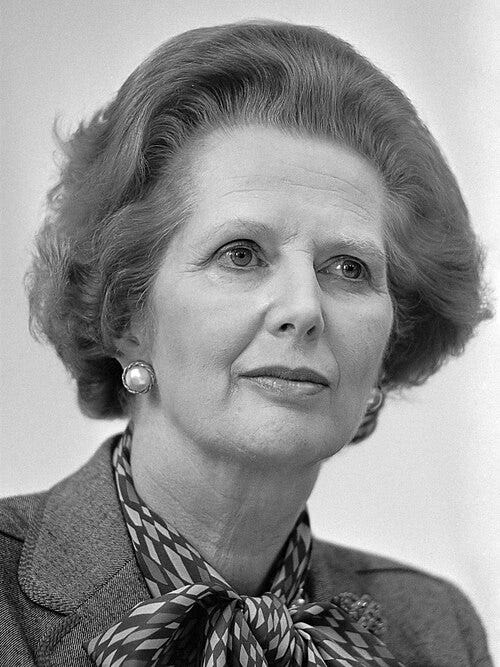
But while it would be hard to explain this to an uninitiated visitor, it would make perfect sense to an observer who is familiar with British social media, where posting a statement like “I still hate Thatcher” rarely fails to attract thousands of likes and retweets (or whatever the equivalents are called on other platforms). For large sections of the British Left, Thatcher was not simply a Prime Minister whose policies they disliked, in the way a French Leftist may have disliked the policies of Jacques Chirac, or a German Leftist may have disliked the policies of Helmut Kohl. To them, she was someone who completely altered the DNA of the British economy in a way which has no counterpart elsewhere (other than maybe Chile under Augusto Pinochet), and which has never been undone. They believe that we still live in a fundamentally Thatcherite economy, and that this makes Britain markedly different from other economies. So for them, pointing out how many years have passed since she left office is missing the point: it doesn’t matter whether she left office 36 years ago, 100 years ago or a 1000 years ago, as long as her legacy is still with us, she might as well still be running the country.
Is this actually true, though? Was Thatcherism really so unique, and was it really exceptionally durable?
Let’s start with the first question. If we define ‘Thatcherism’ as simply the package of policies that were being pursued in Britain during the Thatcher or the combined Thatcher-Major years, then no, Thatcherism was not unique. With differences in degree and composition, we can see similar policy trends in many other places.
Take Thatcher’s flagship privatisation programme. Britain got there earlier than most, but just a few years after Thatcher left office, the retreat of the state from its role as an active player in the economy became an OECD-wide trend. As the OECD points out:
“[B]y the middle of 1990s, privatisation had gained momentum in most OECD Member countries. In Europe activity accelerated, especially among those who had joined the Economic and Monetary Union (EMU), as they embarked on an ambitious economic reform programme in order to meet the requirements of the convergence criteria of the Maastricht Treaty. […] During this period OECD privatisation proceeds in each year averaged around 0.3 percent of the GDP.”
One would not normally associate France, Belgium, Sweden, Finland or Italy with ‘neoliberal fundamentalism’, but even these countries sold off a lot of their state-owned enterprises in the 1990s. In France, much of that happened under the left-wing government of Lionel Jospin.
The curtailing of the growth in government expenditure, the cutting back of industry subsidies, stricter control of the money supply, the trend towards a broader tax base with fewer exemptions and lower marginal rates – none of these policy trends were unique to Britain.
Note, I am not saying that the radicalism of the Thatcher government is overstated, and that they were really just a normal Western European government like any other. They were not. Britain’s Economic Freedom score increased by about two points on a ten-point scale, which is rare outside of post-socialist transition economies. However, Britain also started from a position of more heavy-handed state interventionism, so if Britain liberalised more than others, this is in part because there was simply more liberalising to be done.
As a policy package, Thatcherism was not unique. We can find similar trends in plenty of other economies as well, even if Britain applied them earlier and with greater vigour than most.
As for the question of whether we still live in ‘a Thatcherite economy’ – that depends on what we mean by that. What would it mean to ‘undo Thatcher’s legacy’? If only a full reversal of the Thatcher-era reforms counts, then no, that has not happened. British Airways and BT have not been renationalised, exchange rate controls have not been brought back, secondary picketing enjoys no special legal immunity, and the coalmines have not been reopened. But this is not a sensible way to classify an economic model, because the policy issues of our time are not identical to those of the 1980s. If ‘a Thatcherite economy’ means ‘a liberal market economy’, then in that sense, there has indeed been a partial reversal. Since the early 2000s, Britain’s Economic Freedom score has fallen from around 8.6 out of 10 to 7.9 today. That’s not communism, but the idea that Britain is a liberal outlier in a statist Europe is completely wrong.
Thatcherism was neither unique, nor was it, in a broader sense, particularly entrenched and long-lasting. So where do people get this idea from?
What made Thatcherism special, both compared to political trends in other countries at the time and compared to British politics since then, was that it was a much more self-conscious, self-aware ideological project. To give just one indication of this, an unusually large number of Thatcher-era politicians wrote political memoirs later, explaining what they were trying to achieve while in government. I somehow doubt that either Keir Starmer or Rishi Sunak will ever do that.
The Thatcherites were unusually open and vocal about what they were doing. Lionel Jospin, the former French Prime Minister, may have sold off state-owned enterprises as well, but the last thing he would have done is extol the virtues of privatisation. He would just do it, and be quiet about it.
In political folk memory, governments with a clear ideological orientation that we can easily name and describe loom larger than governments without such an orientation. It is not the case that there have been no meaningful policy changes since Thatcher, and that everything since then has just been ‘tinkering’. But the policy changes that have happened since then have not been part of an easily identifiable, overarching ideological project. We therefore notice them less, and overstate the extent of continuity since the last government which had such a project. And that was the Thatcher government.
The break from Thatcherism has already happened. It did not start with Andy Burnham: he just articulates it. But articulation matters. If we spend the next 100 years under governments that, step by step, take us further and further away from a liberal market economy, but without ever explicitly saying that that is what they are doing, then in 100 years’ time, people will still think that they live in a Thatcherite economy. Burnham is, at last, explicitly drawing a line under that period, and makes clear that he wants present-day Britain to be something very different. What Burnham’s alternative is remains to be seen, but at least, we will be able to judge it on its own merits, rather than continue to pretend that Britain is still governed by Margaret Thatcher’s ghost.

.jpg)
This article provides a great perspective, especially a wider European one, and an illustration that facts and circumstances can change faster than beliefs.
I now greatly admire Thatcher, though I loathed her and her government at the time. She had one attribute I wish all leaders had: you never had to guess her position or principles, and never expected her to chicken out.
A few words from her formidable press secretary Bernard Ingham in a documentary on her, have stuck with me: "She never wanted to be loved: God spare me from politicians who want to be loved". Burnham's future undoing, perhaps?
Thatcher dropped the minimum wage system under wages councils in 1993 - I know because I with Michael Forsyth drew up the report that encouraged this good free market approach!
Minimum wages were only restored by the BLair government in 1998....