


Hamish I. Marshall is a Canadian conservative strategist and pollster. He was national campaign manager for the Conservative Party of Canada in 2019 and is founder of the public affairs firm ONE Persuasion Inc.
Of all President Trump’s trade wars, the bitterest seems to be with Canada.
On the face of it, this makes little sense. Left-wing governments from London to Mexico City to Seoul have signed trade deals with Trump, but Canada’s supposedly business-friendly Prime Minister Mark Carney walked away from negotiations. Now, both countries are playing a back-and-forth game of tariffs, counter-tariffs and import bans.
Canada has more to lose than most countries. Three-quarters of its trade is with the United States, and the two economies are deeply integrated. By some measures, Canada and the US are more economically integrated than the UK and Ireland.
Everyone agrees that a trade war will hurt consumers, but when Carney walked out of negotiations on 21 August, he was hailed as a hero. His popularity has never been higher.
What is going on?
Canadian prime ministers, of all stripes, have never before been punished for signing trade deals with the US. Conservative Brian Mulroney won the 1988 election on a platform of free trade with the US. Liberal Justin Trudeau signed the updated version of NAFTA with Trump in 2018 without any backlash.
What’s changed is Trump’s rhetoric about Canada being the 51st state. It doesn’t matter whether he’s serious or joking; what matters is that he’s the first US president to talk about it publicly since James K. Polk was elected in 1844 on a platform of annexing territory that is now British Columbia.
It touches a nerve with Canadians because Canada exists precisely so as not to be the United States.
Millions of Canadians, including my wife and children, are descended from Loyalists who fled the American Revolution. The Underground Railroad delivered escaped slaves to southern Ontario. Confederation in 1867 created the Dominion of Canada explicitly to stand up to a stronger US after its Civil War. Today, Canadian identity is often framed in opposition to America. We’ve all heard the tropes: Canadians are nicer and more polite than Americans, and have better healthcare.
When Trump first brought up Canada as the 51st state in December 2024, it upended Canadian politics. The tired, decade-old Liberal government was given a shot in the arm.
Since the 1970s, the Liberal Party of Canada has made standing up to the United States (and especially Republican presidents) one of its core brand values. They opposed the Free Trade Agreement in 1988 and refused to join the Iraq War in 2003. It was natural that Canadians turned to the Liberals as the party with the most credibility on the issue.
Carney’s calm demeanour and ease on the world stage reassure Canadians when the American president is threatening us. Long-standing voter coalitions have flipped: older voters and the economically secure have moved to the Carney Liberals en masse, while young people more concerned about making ends meet are now voting Conservative.
Walking away from a trade deal was an easy choice to make politically. But it has painted Carney into a corner.
It is well known in Ottawa that Carney personally wants a trade deal of some sort, and he knows better than most the economic consequences of a trade war. However, his current popularity rests on standing up to Trump, and any conceivable trade deal will require some concessions. Any deal will imperil his political popularity.
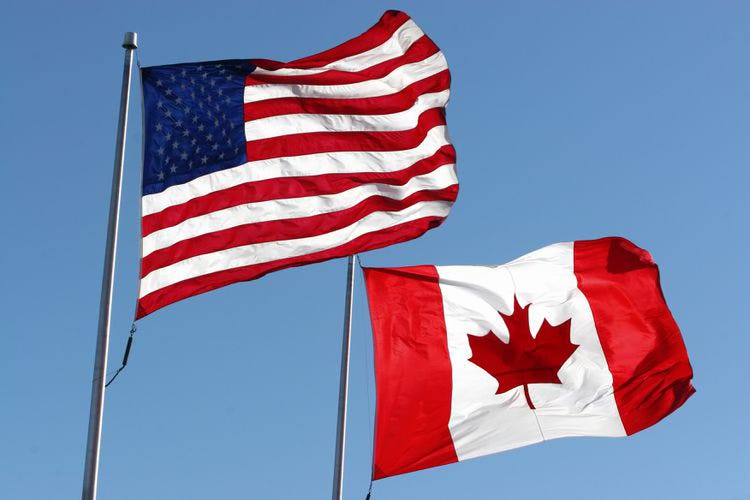
Carney’s solution is to say Canada should diversify its trade away from the US. Hence his seemingly inevitable presence at any gathering of more than about four European heads of government. On the surface, diversification makes sense, but in practice it is immensely difficult and slow.
More than 90% of Canadians live within 250km of the world’s biggest market. Trading with anyone else takes a lot more effort, time and money. It’s not just the size and proximity of the US, but how closely integrated the two economies have become. Car parts for a single vehicle may cross the border multiple times during the manufacturing and assembly process. It’s just as common for businesspeople in Toronto to go to meetings in New York as it is for them to go to Montreal or Calgary.
These new tariffs on everything from electronics to paper to home appliances will make life more expensive for Canadians who are already struggling with the cost of living. The Canadian economy, already tottering on the edge of recession, does not need another hammer blow.
For border communities that are part of the integrated manufacturing economy, the threat is much worse. Faced with tariffs and uncertainty, factories will start moving to the US, and those jobs will not return when the trade war ends. Meaningfully diversifying Canada’s trading relationships is a decades-long process at best.
In this contest between economics and identity, the pain of tariffs could yet overcome the desire to stand up to Trump’s irresponsible rhetoric, making a deal possible. Just don’t hold your breath.
Really? It makes NO economic sense? None at all?
What a bully Trump is! And unfortunately he has a mass following with, I suggest, able successors. Demoralising for the less well off of this world!!!