


Dr Steve Davies is Senior Education Fellow at the IEA.
Ever since what we may call its “reception” by the free-market side on this side of the Atlantic in the 1980s, the theory of public choice has had a strong influence on the way advocates for free markets and limited government think about their position and the tactics they should follow. It is a part of their mental world, as much as Hayek’s knowledge problem or the greater efficiency of markets in allocating resources.
Public choice is a massive intellectual achievement, but it also has serious problems as an analysis, and classical liberals should be very cautious about simply accepting it.
Public choice, as formulated by the Virginia School of political economy in the 1960s and 1970s, is the application of economic principles and analysis to the processes of government and politics. The Institute of Economic Affairs played a major part in disseminating the school’s ideas in Britain, publishing one of its classic works, The Vote Motive by Gordon Tullock, as early as 1976. Analysing the choices made by voters, politicians and bureaucrats through the lens of economics leads to strong conclusions, some of them discouraging for liberals of all kinds (and indeed for socialists and social democrats as well).
One of these is that the political process will systematically favour and benefit concentrated special interests over the general public good. This is for two reasons. The first is the phenomenon of concentrated benefits compared to widely dispersed costs. If a policy imposes costs on everybody but concentrates the benefits on a small group, the small group has a strong incentive to mobilise to demand and support that policy. For the population as a whole the cost at the individual level is often not enough to mobilise collective action.
The second is that it is much easier (less costly) to organise a small group of people who are much alike in important respects as compared to a much larger and heterogeneous body. The gloomy conclusion is that politics will normally work against the general interest and that this is very difficult to impossible to stop or reverse through democratic politics.
This argument persuades most economists and political scientists. This is because the argument is rigorous and supported by many, many real-world examples. Historians, though, are more sceptical. That is because there are quite a few major historical events that according to public choice should never have happened, or at least should have had a vanishingly low probability.
Yet these events did happen, and there are enough of them to perhaps cheer up those who would otherwise be depressed by reading public choice monographs. Examples include the movement to abolish slavery and the slave trade, campaigns for freedom of speech, and the emergence of organised labour, particularly so-called “general unions” in the later nineteenth century. For classical liberals the best example, and one with increasing current relevance, is the campaign to repeal the Corn Laws.
The Corn Laws were a classic example of a policy that harmed the general interest while benefiting a concentrated special interest. Building on earlier legislation, they were laws that prohibited the importation of any kind of grain unless the price of domestically produced grain went above a specified and very high level. The aim, explicitly, was to keep the price of grain higher than it would otherwise be so as to encourage domestic production. In the 1820s the simple prohibition was replaced by a sliding scale of duties determined by the domestic price level, but the effect, both actual and intended, was the same.
This harmed the interests of the bottom half of the income range in a very serious way because it raised the price of bread, their staple and primary food. It harmed the interests of the next 40 per cent of the range by generally reducing the performance of the British economy. It delivered big benefits to the top 10 per cent of income earners, above all the landowning class and all those who depended on rents for most of their income (which included most Anglican clergy).
The 10 per cent in question were the classic example of a concentrated interest that was also politically powerful. Landowners made up almost all of the upper chamber of Parliament and dominated the lower through their control of many of the constituencies (the “rotten” and “pocket” boroughs). They were as powerful and privileged as it was possible to be.
The case against the Corn Laws and in favour of free trade had been made from the later eighteenth century onwards and was classically stated by David Ricardo in 1821. However, the consensus of most economists had no effect on the politics (something economists today will recognise). Someone at the time thinking in the way public choice leads to would have concluded that the chance of completely abolishing the Corn Laws was too low to attempt it, and would have focused instead on reducing the effects and trying to slowly shift policy incrementally, mainly by lobbying and taking advantage of crises to bring about mitigating changes.
Instead, advocates for change formed a national organisation, the Anti-Corn Law League. This was formed in 1839 and grew out of a Manchester organisation formed the previous year. The initial meeting only had eight attendees, but the second brought on board two of the key figures, Richard Cobden and John Bright. Over the next seven years the League became a mass campaigning organisation – in 1834 it had 800 employees to organise its campaigns and the production and distribution of materials.
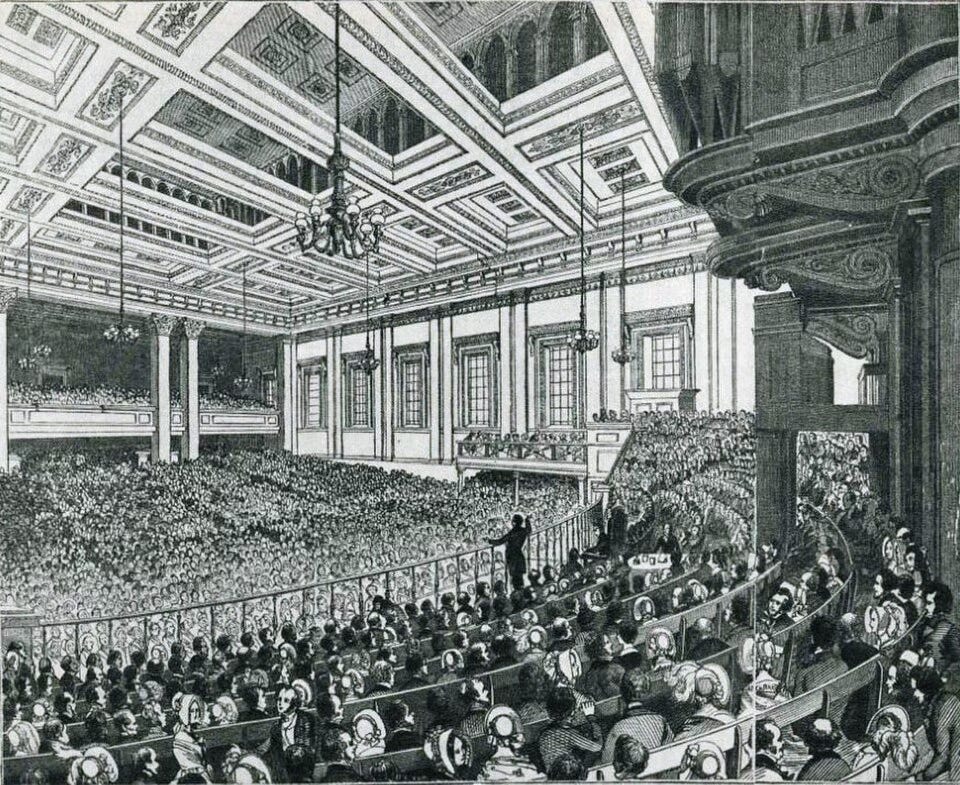
It copied the methods already pioneered by the campaigns for the abolition of slavery and for parliamentary reform but raised them to an even higher scale and level of development. The result was to organise and mobilise public opinion against the Corn Laws and also to persuade an increasing part of the elite intellectually of the need for change. First, the opposition Whig party went over to the League’s position in 1845, but the key step was the conversion of the Conservative Prime Minister, Robert Peel. In 1846 he split his own party by supporting repeal, and three years later the Corn Laws were gone.
This had extensive and massive consequences and meant a reorientation of British trade and fiscal policy, away from mercantilism and protection and towards free trade. There had been movement in that direction in the 1820s and the process was not complete until 1860, but 1846 was the decisive moment. It ushered in a policy of free trade and economic openness that would last until the early 1930s.
Several features of the successful campaign bear noticing because they are all things that orthodox public choice analysis would strongly discourage or discount. It did not focus on targeting elite opinion or influencing power networks; instead it looked to mobilise and form mass public opinion.
The arguments that were articulated and disseminated through mass meetings, pamphlets, literature and speeches were not primarily economic and aimed at policymakers. Instead, they were moral ones, and arguments about wider social and political principles. The argument for free trade in grain was always associated with and framed by wider ones about class power and the purpose of government.
Most notably, the League did not call for smaller or piecemeal changes, nor was it prepared to settle for that kind of measure. Instead, it always and consistently argued for the immediateand total repeal of the Corn Laws.
There were several points where the Whig party in particular tried to offer a compromise, such as a moderation of the sliding scale, but these were rejected. In the event, the repeal was put through over three years between 1846 and 1849, but the League remained in existence and prepared to reactivate at any suggestion of extending that period.
According to the view derived from public choice, none of this should have worked. The difficulty in organising a large and diverse constituency of people opposed to the Corn Laws should have made it impossible to create and sustain a national mass campaigning organisation, much less for it to succeed in mobilising and shaping public opinion – with multi-generational effects.
The elite should not have been responsive to this mass campaign as opposed to the (very real and organised) pressure from the vested interest. The high-probability outcome should have been a compromise and at most the start of a gradual process that would probably never have reached full completion. Yet that is not what happened.
As mentioned, this is only one of several such cases. The campaigns against colonial slavery and the slave trade are, if anything, an even more powerful example. What this kind of thing should do is twofold.
Firstly, the advocates of liberty should reconsider what kinds of arguments they use, the way they present their case and the methods of organisation that they employ. Ethical and moral arguments are sometimes more effective than ones founded on benefit, even when the latter are also true. There are ways of organising and mobilising large and diverse groups with only an apparently weak common interest if you focus on belief and methods of sociability and connection.
Secondly, and most importantly, liberals of all kinds (and people of other persuasions) should be more cautious about the powerful but simplifying arguments and analyses of economics and the often-unjustified pessimism they can lead to. We shall return to this topic in a later post.
One implication may be that public-choice theory identifies strong incentives without establishing political inevitabilities. What I find especially interesting about the Anti-Corn Law League is that it apparently overcame a severe collective-action disadvantage partly by reframing an economic question as a moral one. “Protection is inefficient” asks people to compare economic predictions; “why should political power make bread more expensive to benefit a privileged minority?” raises a question about justice. Perhaps reform movements become more powerful when dispersed costs can be translated into a general principle people believe should apply consistently, even when each person's individual economic stake is relatively small.
Entirely agree. It strikes me that today the argument for free trade is contained in term itself: I should be free to buy such goods as I choose, free allocate my labour as I choose, and free to disdain a government which constrains both.