



Erik Lidström holds a PhD in physics and is the author of Education Unchained, Representativ demokrati (in Swedish), and Evolution and Social Order.
The following is a short reflection on the labels we use in politics as well as an attempt to contribute a usable categorisation. Regarding political terminology, the general confusion is so deep that I believe it fair to say that most people could not name precisely which term fits their own worldview, let alone anyone else’s.
I will seek to define four labels and try to clarify what they stand for. If you do not like these particular ones, please feel free to substitute your own. What the labels are is, or at least should be, unimportant. What is important is that we understand what we mean when we use them. The subject of this post will be explored in more depth in my forthcoming book, Burke’s Republic.
The first category is classical, or true, liberalism. True liberalism, in my categorisation, is the worldview of David Hume, Adam Smith, the Founding Fathers, Friedrich Hayek, Alexis de Tocqueville and, today, Thomas Sowell. It is also that of Edmund Burke. Not the “holistic”, hand-waving Burke that Russell Kirk makes him out to be, driven mainly by religious and aesthetic concerns, but the real-life, razor-sharp politician and thinker. If you do not like the label true liberalism, or just liberalism, we could instead call it “Burkeism” or “Sowellism”.
True liberalism holds that man is born into society and can never leave it; an isolated, independent human being is a dead one. At the same time, true liberals cherish freedom, a state of affairs where the degree of coercion is reduced as far as possible. However, some coercion must remain to protect the freedom of all. Regarding what coercion remains, we should not be subject to the arbitrary will of others. We should be ruled by laws, not by men.
Libertarianism I will treat as based on a postulate of the inviolability of the individual. It holds that individuals enter into social arrangements voluntarily, that humans are (or should be) guided by Reason, and that all coercion is immoral. Murray Rothbard, Hans-Hermann Hoppe, Robert Nozick and David Friedman are exponents of this ideology, and libertarians often claim John Locke and the early Thomas Paine as forerunners.
Progressivism, also known as social liberalism or, in America, “liberalism”, shares the libertarian conviction that the individual is inviolable. For now, however, progressives say, as Rousseau did, that people must “be forced to be free”. First, the state must level the playing field, either at the outset or all through life. Then, within what remains of their freedom of action, progressives deem people to be free. John Stuart Mill and John Rawls are typical exponents.
Finally, we have conservatism, based on the idea that we should use tradition as the guide rope for social and economic policy.
Thomas Sowell, in his book A Conflict of Visions, demonstrated that we can categorise most ideologies as belonging to one of two distinct visions. The first of these is what Sowell calls the contsrained (or, elsewhere, tragic) vision. It is a systemic view of society combined with the idea that man has a nature and that this nature is not always a pretty sight. By systemic, we mean that all parts of society are interconnected. What I do today will influence those around me. What they do will influence me, as well as many others. Both true liberalism and conservatism belong to the constrained vision.
The second vision is the utopian or unconstrained vision, which holds that man is naturally good and virtuous. Importantly, this is not a belief that man is, in fact, always good now, only that he has the potential to be so, and would be if he weren’t corrupted by his station, society or some sinister enemies of society.
Thus, according to the unconstrained vision, if man is not virtuous already, he can be bettered by removing nefarious influences. Whereas those holding the constrained vision accept that man is selfish as part of his nature, those holding the unconstrained vision believe this selfishness can be removed. Those holding the constrained vision seek trade-offs, given the immutable nature of man, how slowly cultures change, if at all, and the systemic nature of society. In contrast, those with the unconstrained vision do not see society as a system. They therefore seek solutions. Both libertarians and progressives belong to the unconstrained vision.
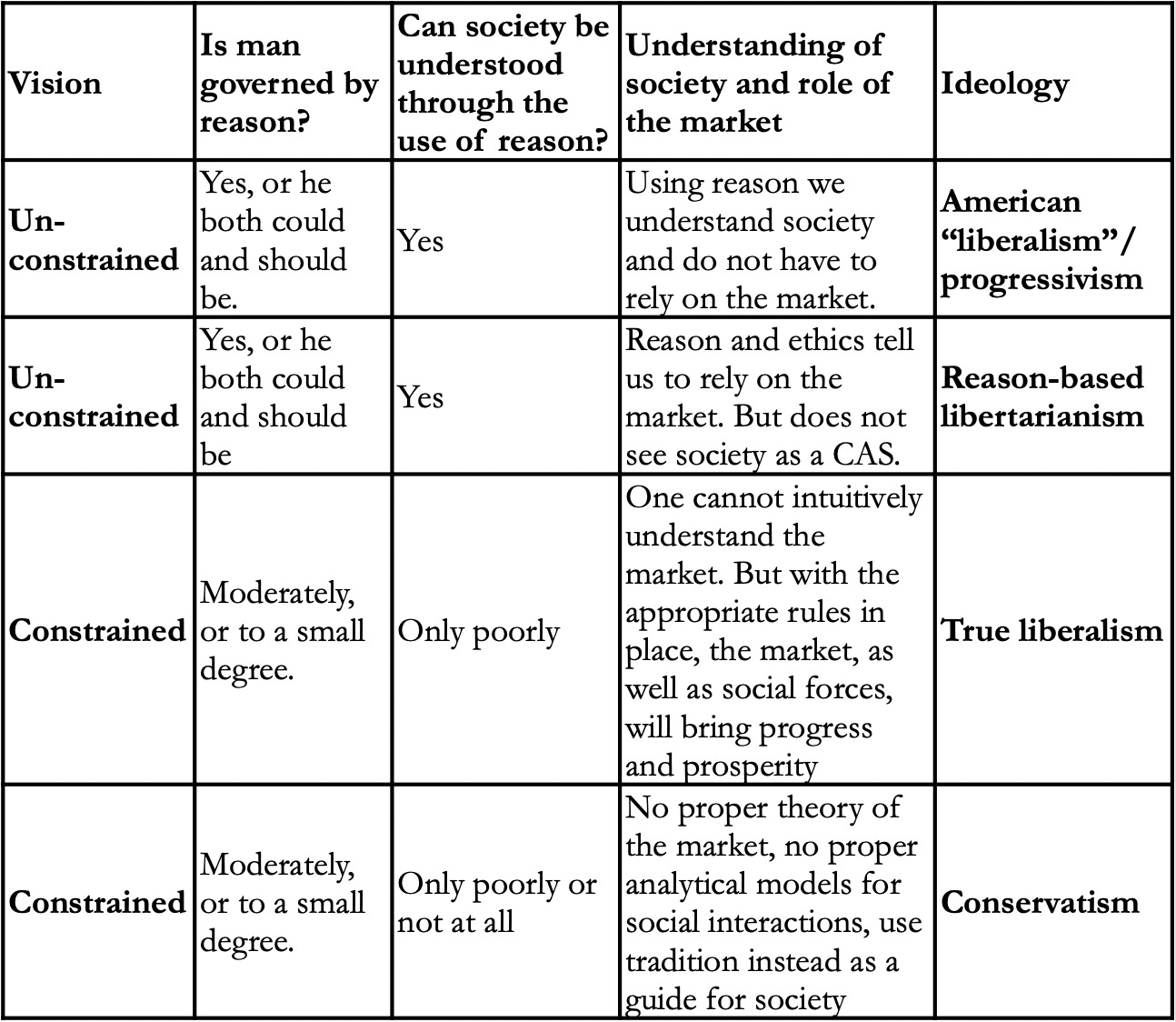
We may extend Sowell’s categories by making a second division into what then becomes four categories, based on what each assumes about the role of Reason and how each understands society.
Both true liberals and conservatives again see society as something extremely complex. However, true liberals use models to attempt to understand at least parts of society. For example, even though they have rarely used that terminology, true liberals see a market as a Complex Adaptive System (CAS). If, as David Hume pointed out, property is protected, we are free to buy and sell, and contracts are enforced, we may freely, and without fear, collaborate with everyone else. As a result, we get, as Hayek showed, an extended order of collaboration that spans the globe. Conservatives, on the other hand, are more sceptical of such models. They therefore use tradition as a guide instead. Michael Oakeshott, in his essay Rationalism in Politics, explicitly rejects Hayek’s attempts at an analytical understanding of parts of society. Even George Will’s wide-ranging book The Conservative Sensibility does not engage with Sowell’s work.
Consequently, conservatives commonly want to prescribe outcomes, while true liberals want to institute laws and rules for society that may produce such outcomes, and much else. History gives true liberals an example. Until 1947, Britain and Sweden both broadly recognised the right to fixed property: landowners generally did not need planning permission to build on their own land and could build in whatever way they chose. The result was stunningly beautiful buildings. Conservatives, instead, tend to want government to prescribe certain architectural styles.
Libertarianism is again based on a postulate of the inviolability of the individual. Members of a common sub-category, which I call Reason-based libertarians, hold both an ethical conviction and, they believe, a Reason that tells them that there should be free markets since the market is a natural outgrowth of the inviolability of the individual. However, they lack the systemic understanding of society that true liberals have. If they had such an understanding, they would have to abandon much of their belief in Reason. The market operates mainly through processes of trial and error, not through reasoned forethought.
Progressives, on the other hand, ironically also believe both in the postulate of the inviolability of the individual and in the power of Reason. For now, however, they tell themselves that it falls to an elite (themselves, or “the Anointed” in Sowell’s words) to guide the rest of us to salvation. Their supposed Reason also tells them that they do not need to make use of “the chaos” of the market. Instead, they believe they can use their insights to bend both the economy and society at large to their will.
The table below summarises the four categories.
Thanks for this, it was a good read, and thank you for rescuing Burke from Kirk’s version of him. The Edmund Burke you describe has become one of my political touchstones. I’d politely point out though that Georgian London wasn’t built by people doing as they pleased. The Building Acts of the 1700s set building standards, mainly for fire safety, and in 1774 sorted houses into rates with set specifications. That’s a big reason London’s terraces look so uniform, and in Bath and Brighton the conditions in building leases did a similar job. If you think about it, that actually supports your argument, as these were rules rather than prescribed outcomes. But that same pre-1947 freedom also gave us back-to-backs and interwar ribbon development, which is one of the reasons the 1947 Act came in. In other words, I’d be careful about judging the whole system by the bits of it that were worth keeping.
Els Llibertaris, mal anomenats, son els Creadors del Sistema Anarquiste-Lliberal, no necesseriament creuen en el Mercat Lliure, el Sistema de mercat Lliure es una enganyifa dels Mateix Sistema Capitalista, el
qual per la mateixa aparicio ha de dsapareixer, per ell mateix La Economia de Lliure mercat que segueiixen els pensadors clasics no te prou principi reglat es un desordre dins de un Ordre,mal entes lamillor manera que la Humanitat avançi sense clases de cap tipus es pot produir quan el Llibertaris ben entes te i estableix les seves propies regles de inici.