



Valentin Boboc is a Senior Economist at the IEA
Public ownership of water and energy repeatedly returns as a robust theme in British politics, consistently attracting polling support as a standalone issue. Nevertheless, any government attempting nationalisation while honouring the fiscal rules John Healey inherited this week from Rachel Reeves would face a tax bill that no peacetime chancellor since Denis Healey has been willing to impose under the IMF programme.
The cost of nationalisation falls into two parts: buying the businesses and running them afterwards. The second is usually the larger of the two over time, and the part most often left out of the political prospectus. We made some calculations to estimate the impact.
Water
As far as water is concerned, Defra’s 2025 paper puts the buyout at approximately £100 billion, anchored in the regulatory capital value that Ofwat assigns to England and Wales. Higher estimates exist, including the Social Market Foundation’s 2018 work for four water companies, which used the established ‘RCV times 1.3’ rule and would today put the figure closer to £140 billion, but we aim to keep our assumptions conservative and err on the side of things being cheaper than expected.
Ofwat’s PR24 Final Determination allows the water industry a total expenditure of c. £104 billion over 2025-2030 on operations and capital maintenance. To account for this, bills are programmed to rise 36 per cent in real terms by 2030.
A nationalised industry will face severe political pressure to remove some of those increases from household bills and place them on the Exchequer instead. This will, of course, mean that households still pay the difference, but they will do so through taxation. Even if the Exchequer agrees to a partial solution and only chooses to absorb 30 per cent of bill increases across household and business customers, this will cost roughly £2 billion a year in cash terms by 2030.
Energy
Concerning energy, the picture is more complex than water, because the industry breaks into three parts that would each need to be bought.
First, the retail businesses are the ones that send the bill, the household-facing arms of suppliers such as British Gas. The TUC estimated the cost of taking the main retailers into public ownership at £2.85 billion in 2022.
Second, the network businesses are the wires and pipes that carry electricity and gas across the country. Unite’s 2023 report puts the equity book value of the 23 network companies at £33.8 billion.
The third part is generation, the power stations and wind farms that produce electricity in the first place, of which EDF’s nuclear fleet is the largest single component. A full buy-out of generation would cost £40 to £60 billion at fair value, though a partial model that takes only the strategically important plants could be significantly cheaper.
Adding the three together, a reasonably low estimate for taking energy into public ownership is about £50 billion, covering full retail and network ownership and a partial stake in energy generation. A more ambitious version that buys out energy generation in full could cost significantly more.
Running costs include the £58 billion grid investment programme that the system operator sets out in its Beyond 2030 blueprint, plus existing Contracts for Difference obligations of around £2 billion a year, plus operating subsidies. We settled on a figure of about £10 billion a year as a reasonable ongoing claim.

The total package costs out as follows.
Financing
To stay within fiscal rules, the £150 billion buyout must be gilt-financed. At an average issuance yield of 5.3 per cent across the curve, with the 30-year gilt currently trading near 5.7 per cent, interest alone is £8 billion yearly, assuming gilt markets remain stable.
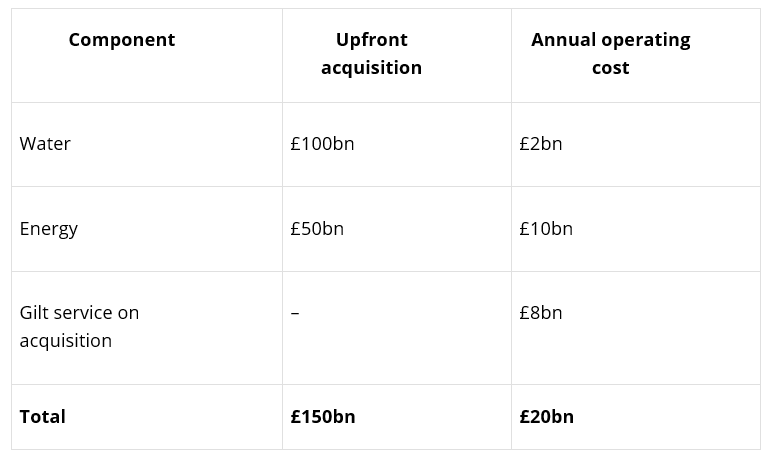
Over the first parliament alone, the package would cost roughly £250 billion: £150 billion for the buy-out, £60 billion in running subsidies, and £40 billion in gilt service.
Fiscal room and rules
So far, so good, but the Treasury does not have any spare cash at the moment. Public sector net debt sat at 93.8 per cent of GDP at the end of March 2026, up from 93.2 per cent a year earlier. The Government is already struggling to contain public sector borrowing, which reached £24.3 billion this April, up £4.9 billion from a year earlier and higher than previously expected.
The £150 billion of gilt issuance also sits awkwardly with the second fiscal rule. That rule requires Public Sector Net Financial Liabilities, a measure of government debt that nets the state’s financial assets against its borrowing, to fall as a share of GDP by year five. Keeping the ratio falling requires either nominal growth outpacing the new issuance, offsetting financial assets being acquired, or savings being found elsewhere.
To fund the annual day-to-day expenditure, the Government would need to find, on the most conservative reading, around £20 billion a year of new tax revenue. To give a sense of scale, that is roughly what the Exchequer now pays out in debt interest every two months.
So where does the £20 billion come from? Suppose a government chose income tax, the broadest base available. Using HMRC’s June 2025 ready reckoner, a penny on the basic rate raises £8.2 billion a year in a steady state. Funding £20 billion of new spending, therefore, requires roughly 2.4 pence on the basic rate, taking it from 20p to 22.4p. If the running cost runs closer to £30 billion, as several of the assumptions above could quite reasonably push it, the requirement is around 3.7 pence.
For a worker on £39,000, broadly the UK median full-time wage (ONS ASHE 2025), a 2.4 pence rise in the basic rate adds about £630 to her annual income tax bill. A 3.7 pence rise adds about £980. Both figures exceed the two pence Healey added in 1975, and neither is small.
So perhaps the answer is to look elsewhere. The reflex may be to reach for wealth taxes. The trouble with this answer, as Kristian Niemietz points out in Fool’s Gold: The case against the wealth tax, and suggestions for alternatives, is that Britain is already an outlier in how heavily it taxes wealth:
‘[T]he UK raises more revenue from taxes in that category [wealth and wealth-related taxes] than other OECD countries. Despite not having a wealth tax, the UK is, on this measure, ahead of Spain, Switzerland and Norway, which do have one’ (p. 24).
In other words, we are already unusually reliant on these taxes. Adding more would make us an even greater outlier. Maybe all these other OECD economies are missing one neat trick, and we are the only ones who get it right, but somehow, I doubt it.
The case for taking the utilities into public ownership rests on the claim that the public would gain something the current arrangement does not deliver, such as lower bills, reinvested profits, or better service. Each of those claims is contestable, but even on the most favourable reading, the case must confront the costs.
A government can have public ownership of the utilities, or it can have fiscal rules and tax restraint. It cannot have both. New spending must come from somewhere, and the only honest answers are higher income taxes, higher VAT or a stack of wealth-adjacent taxes that already make Britain an OECD outlier.
What we’re reading
Manchester, so much to answer for…For The Critic, Shimeon Lee has argued that the fiscal realities behind Andy Burnham’s “Manchesterism” have largely been ignored. The unanswered question facing “Manchesterism” is not whether voters like what it promises, but who ultimately pays for it. Taxpayers will bear the cost of Burnham’s agenda, rather than some external source of funding — particularly the central government funds on which Burnham relied as Manchester’s mayor.
Healey 2.0. Andrew Lilico has been in the Telegraph making the case that John Healey, our new Prime Minister, faces economic challenges remarkably similar to those confronted by Denis Healey in the 1970s. Just as Denis Healey struggled to reconcile Labour’s spending ambitions with fiscal reality, so too will his namesake today find himself forced into politically painful tax rises or spending restraint. Competence cannot overcome the unaffordability of the rest of Labour’s agenda.
Slava Ukraini. Over at National Review, Robert Loewen has suggested that Ukraine’s greatest strength since Russia’s invasion has not been advanced weaponry or foreign aid, but the remarkable willingness of ordinary people to resist aggression. Ukraine exists within a broader historic and geographic tradition of ordinary citizens fighting against seemingly overwhelming odds through courage, sacrifice and patriotism. The country’s continued willingness to fight ultimately relies on its people.
Checking your socials. Meanwhile, at The Spectator, Ross Clark has argued that a reported proposal for a 10 per cent “social care levy” on all estates, replacing inheritance tax to fund a National Care Service, would prove problematic. Those with modest wealth but little need for care could end up paying more than they receive, whereas the wealthiest households could see their tax burden substantially reduced. Burnham would, unexpectedly, be launching a tax cut for the rich.
Cautionary tale. Noah Smith has warned Americans that the United Kingdom has become a perfect example of what not to do, suffering from a series of policy failures that have left the country poorer and economically stagnant. He blames restrictive planning rules, an over-reliance on the financial sector and persistently high energy prices, among a cornucopia of other problems. He suggests that America should avoid repeating Britain’s mistakes by focusing on economic growth and openness.
A most interesting analysis. As a side note and with reference to debt and net financial assets, I wonder if the government in deriving a net figure, is taking proper account of depreciation of state capital assets. I have in mind as an example road infrastructure and the pothole saga. To get back to a steady state condition for roads requires an investment of £20bn probably more.