


Matthew Lesh is a Public Policy Fellow at the Institute of Economic Affairs and a Director at Freshwater Strategy
I have at least one thing in common with Boris Yeltsin, the first president of the Russian Federation. When I’m travelling, one of my favourite activities is visiting a local supermarket. In 1989, when still a communist, Yeltsin made an impromptu stop at Randall’s supermarket in the suburbs of Houston.
“When I saw those shelves crammed with hundreds, thousands of cans, cartons and goods of every possible sort, for the first time I felt quite frankly sick with despair for the Soviet people,” Yeltsin wrote in his memoir. “That such a potentially super-rich country as ours has been brought to a state of such poverty! It is terrible to think of it.”
It is often said this visit helped puncture any remaining faith he had in the Soviet system, hastening the collapse of communism.
Yeltsin was right to be awe-struck. Supermarkets are nothing short of a modern miracle. A large Tesco Superstore carries around 40,000 product lines, sourced from over 20,000 British farmers and 70 countries, available year-round. They involve the coordination of literally millions of people and operate almost seamlessly. Supermarkets represent a level of everyday access to food that was literally unimaginable for almost all of human history. They have also only gotten better over time: in 1957, households spent on average one-third of their budget on food; today, it’s closer to 15 per cent.

Yet in Britain today the supermarket is cast not as a marvel but as a villain, blamed for the very prices it has spent a century driving down.
Building on our IEA project on attitudes to economic growth, we tested the public views on supermarket prices in our latest City AM / Freshwater Strategy Poll this month.
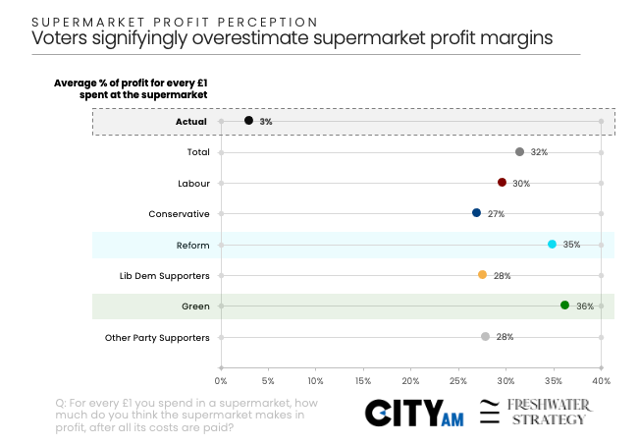
To start, an astonishingly high proportion agree, at 70 per cent, that supermarkets are making excessive profits, with just 12 per cent disagreeing. When asked to name the profit margin, the public say supermarkets are making 32 pence for every £1 that shoppers spend. In reality, their margins are around just 3 pence per £1 spent, compared with the all-industry net margin benchmark of roughly 8.5 pence. Some make even lower margins, with Tesco at just 2.4 per cent and Lidl GB’s at 1.3 per cent last year. Repeated CMA investigations have found no competition issues in the sector.
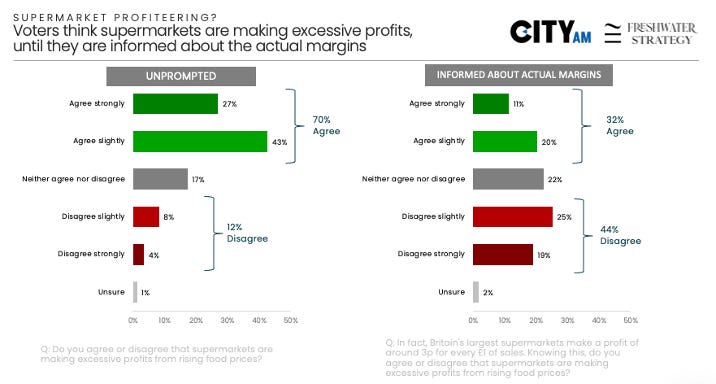
However, when you inform voters about the profits supermarkets make, public opinion shifts dramatically. The level of agreement that supermarkets are profiteering drops to 32 per cent, while disagreement rises to 44 per cent. That represents a fall from +58 to -12 in net agreement that supermarkets are profiteering. This represents an unusually large shift in public opinion from providing just a single piece of additional information; usually, these effect sizes are much smaller.
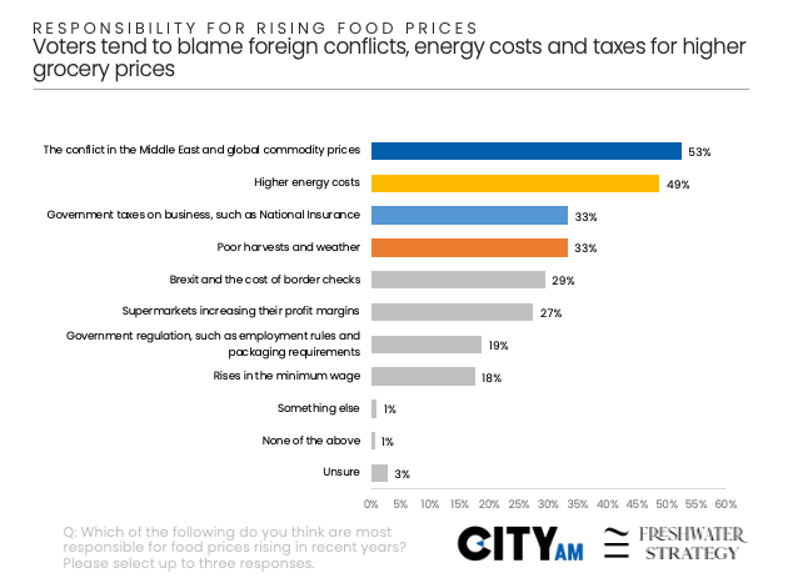
Interestingly, despite instinctively believing that supermarkets are making excessive profits, the public is closer to reality when actually given a choice about what they blame for higher prices. Their most-cited reason, when asked to pick a top 3, is foreign conflicts, followed by energy prices and government taxes on business, and then poor harvests. Profiteering is the 6th most commonly cited reason.
Indeed, the real driver of higher grocery prices is not greed; it’s policy! A mixture of post-Covid inflation, driven by expansionary fiscal and monetary policy, and the Russian invasion of Ukraine. This has been worsened in the last few years by costly policy decisions. The October 2024 Budget alone added over £5 billion to retailers’ costs through higher taxes and the minimum wage hike, not to mention the packaging levy (thought to cost a further £2 billion), extended employment regulation and so-called ‘equal pay’ claims that are forcing equalisation between retail and warehouse workers.
The trouble is that when the public are misinformed, they become more susceptible to bad policy ideas. Astonishingly, according to a separate poll, 70 per cent of Britons back price caps on essential groceries. If prices are set below market levels, a Soviet-style policy now being adopted in Scotland would undoubtedly be a disaster, forcing shops to either remove certain goods from shelves or shut down altogether.
It is easy to conclude that public arguments around prices, profits and business have already lost. That the narrative is set, the villains are cast, and there is no point engaging. In fact, our data finds that just one verifiable fact reverses a two-to-one majority
That should reframe how think tanks, businesses, and industry bodies understand the problem and respond to it. Public opinion on the economy is far from fixed; but it is largely uninformed. Those are very different problems with very different solutions. A fixed opinion can only be worked around. An uninformed one can be corrected with more information. This is no easy task, but it does closely align with Hayek’s advice to Antony Fisher prior to establishing the Institute of Economic Affairs: to fix politics and policy, we must first fix what people believe to be true.
Very good. Also, supermarkets were the unsung hero's of the Covid pandemic. They continued to function throughout and provide for NHS workers. Did we clap the wrong lot?
The next time the CMA investigates the sector it needs to acquaint itself with two-sided market theory. The supermarket petrol price investigation a couple of years back was lacking in this department.
Your poll size? Could not see the figures; perhaps my eyesight.
Thank you for this: it causes me to raise what I believe is a serious issue. I try to keep myself informed (which is why I'm here) but this is helped immensely by being retired and having the time to make a positive effort to explore, time that folk busy with jobs and family do not have. Such knowledge and wisdom I have accumulated in the last few years owes very little to mainstream news media and nothing to social media, to which I give a very wide berth. Though a wealth of information is now easy to find, I fear many people lack scepticism or curiosity to seek it out.
One vital example: how many people know that the UK has the highest industrial electricity costs in the world, or have any inkling as to why? How many appreciate how important is energy to an economy and that the UK's declining per capita energy use is perhaps an alarm signal rather than a cause to celebrate? It should be a national debating point, if not a scandal.
My advice to the young (alongside that of Oscar Wilde) would be: always be conscious of ignorance, and keep the impulse to do something about it, while retaining the ability to doubt.