Britain’s weak recovery from the 2008-09 financial crisis was caused by post-crisis banking regulation, not fiscal austerity or an inevitable feature of deep recessions, according to a new briefing from the Institute of Economic Affairs.
The briefing, by Tyler Goodspeed, formerly Chairman of the White House Council of Economic Advisers, sets out the case that Britain’s slow recovery was a policy choice rather than a historical inevitability.
Goodspeed finds:
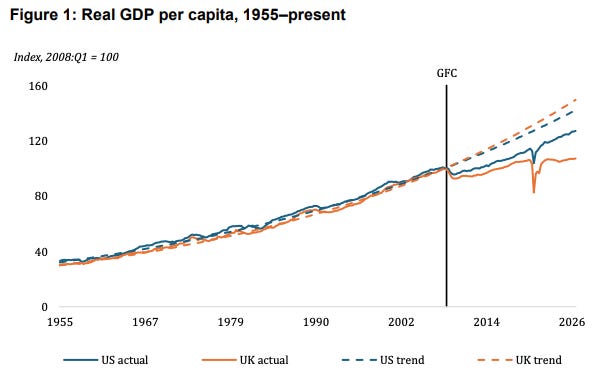
The UK is now around 40 per cent poorer per person than the US, having been on course for near economic parity as recently as 2007. If it were a US state, the UK would be the poorest in the union, ranked below Mississippi.
Britain has not always been outpaced by the US. Between 1955 and 2008, the UK experienced an annual trend rate of real growth per person of 2.3 per cent, slightly faster than the US at 2.1 per cent.
After the Global Financial Crisis, the US suffered a drop in the level of economic activity but then essentially returned to trend growth. In contrast, the UK experienced both a sharp drop in the level of economic activity and a decline in the subsequent rate of economic growth.
Austerity cannot explain the UK’s underperformance since the US pursued a similar policy over the same period.
The real cause was post-2009 banking regulation, which required banks to substitute perceived low-risk lending to governments for lending to business.
The effects of regulation fell disproportionately on the UK’s bank-dependent economy, and undermined lending to small and medium-sized businesses, inhibiting their ability to grow. The US was less affected due to its greater reliance on non-bank credit and the abundance of small banks subject to fewer regulatory requirements.
Whereas US lending to non-financial businesses recovered by mid-2013, in the UK bank lending remains 15 per cent below its early 2008 level.