



Matthew Lesh is a Public Policy Fellow at the Institute of Economic Affairs and a Director at Freshwater Strategy
In the run-up to the 1997 election, the Tories campaigned viciously against the minimum wage, having earlier warned it could cost up to two million jobs. The debate was lost, but it was not without impact. A concern about rising unemployment drove the Blair government to adopt a piecemeal approach to introducing the minimum wage.
This took the form of the Low Pay Commission, a tripartite body of business representatives, trade unionists and independent economists. Their remit was to recommend a rate that would help the low paid with a minimum possible impact on employment, rather than a figure arbitrarily plucked by ministers. The result was deliberately cautious: the first minimum wage, introduced in April 1999, was £3.60 an hour for adults and a £3.00 development rate for 18–21-year-olds, well under half of median hourly earnings.
In a case of surprising quango success, it appeared to work. Unemployment kept falling, and the Tories’ warnings were duly filed away as scaremongering. The minimum wage became accepted and popular. The Conservatives, in opposition, came to accept, and then in government embrace, the policy. The public also came to widely accept the idea. By January 2014, a YouGov/Sunday Times poll found that two-thirds (66%) supported a “substantial increase” in the minimum wage, while just one-fifth (19%) opposed.

Today, the situation has dramatically shifted. Not only has the minimum wage begun to bite, but there are some signs that public opinion has also become more sceptical.
The shift began in George Osborne’s 2015 budget when, keen to steal Labour’s clothes, he rebranded the minimum wage as the ‘National Living Wage’ and set a political target of 60 per cent of median earnings by 2020. In 2019, Sajid Javid increased it to two-thirds of median earnings and, not to be outdone, in 2024, Rachael Reeves decided to begin phase out lower rates for younger workers. It has now reached £12.71 for those aged 21 and over, around two-thirds of the median hourly earnings and among the highest in the developed world.
The result is the return of basic economics, with a vengeance. Since Labour’s 2024 budget paired another above-inflation increase with a rise in employer national insurance, Britain has lost around 170,000 payroll jobs, more than half of them in hospitality, the sector with the highest concentration of minimum wage workers. The Low Pay Commission itself now describes a “low hire, low fire” labour market, with employers cutting hours, and the number of young people not in education, employment or training passed a million this year for the first time since 2013.
As the reality of the minimum wage has come to bite, so has public scepticism risen. According to the City AM / Freshwater Strategy Poll, a majority (55 per cent) now believe that above-inflation increases in the minimum wage are unaffordable at this time, compared to less than one-fifth (17 per cent) who disagree.
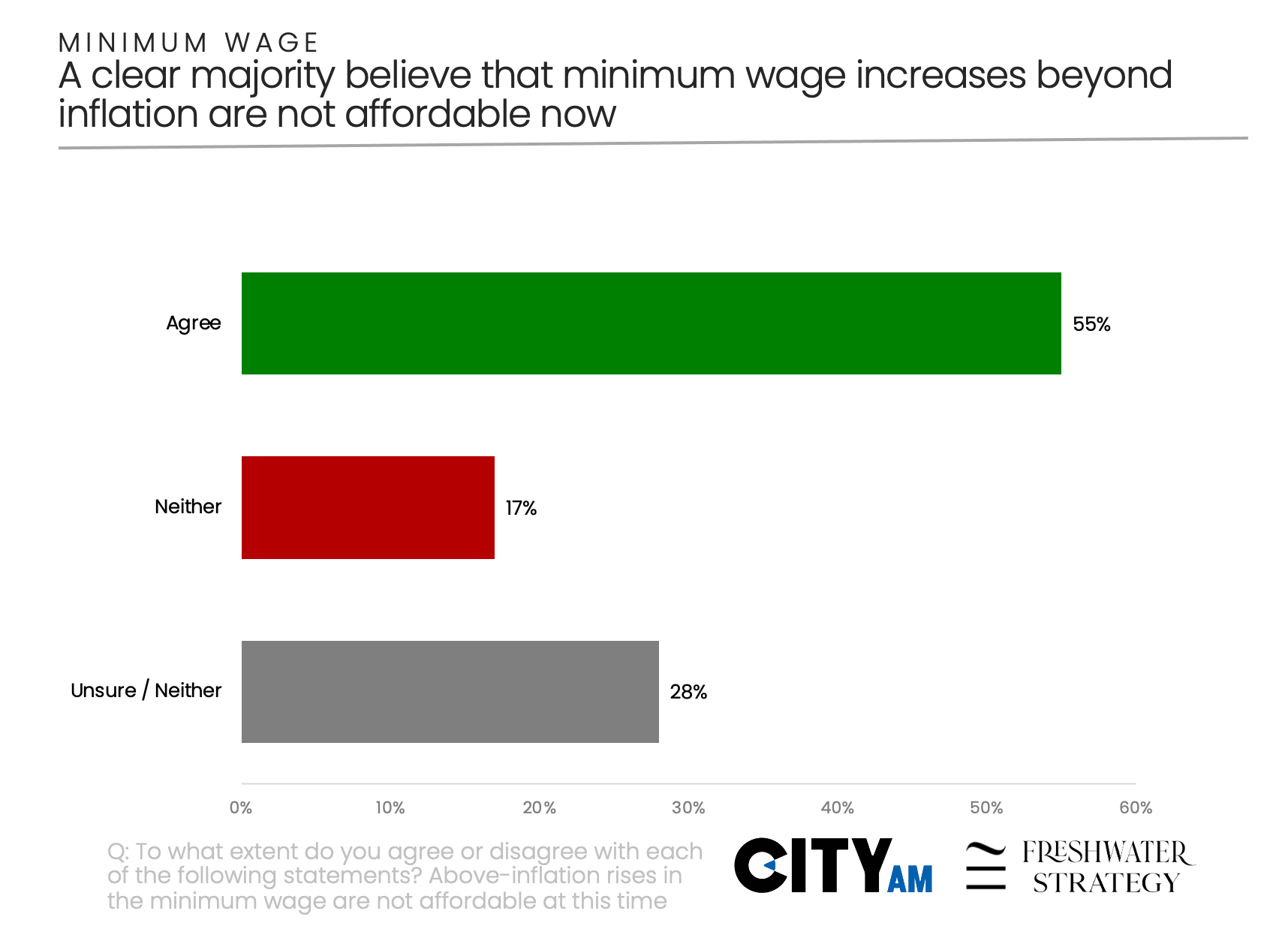
This squares with a YouGov exercise in 2021, which found that while 67 per cent said £9 an hour was too low, a suggestion of £13, close to where we are today, was considered too high by 46 per cent, compared with 34 per cent who thought it sounded about right.
The minimum wage is having all sorts of deleterious effects on the employment market. To start, around two-thirds of the benefit goes to households in the middle and upper half of the income distribution, with the losers being those at the bottom who are locked out of work – the very people who most need to get onto the jobs ladder, build skills and earn more down the track.
There’s also growing evidence of pay compression. That is, the gap between an entry-level job and a supervisor, a trained care worker, or a qualified apprentice shrinks. That erodes the incentive to take on responsibility, train, or progress, and it flattens the ladder rather than lifting people up it. This can only be bad news for Britian’s productivity malaise.
Undoing past minimum wage increases will be challenging, but there might be a few good options. The first is to pause and revert to the Blair-era Low Pay Commission model, reintroducing more age categories and carefully weighing increases against employment impacts. Another option, if governments insist on keeping an arbitrary target, would be to regionalise the minimum wage. According to research from the Centre for Cities, the national rate is 53% of local median pay in Reading and 82% in Doncaster. A national wage doesn’t make much sense in a differentiated economy.
This may have looked like political madness not too long ago, but with public opinion softening on the topic, now is the time for a more rational reconsideration of the minimum wage.
I believe UK NMW now 20% higher than France or Germany - madness
In all honesty Mathew as good as your piece was and it’s a very good piece, it’s barking up the wrong tree.
It’s a coming mistake to keep suggesting cuts when what is needed is growth to achieve surpluses.
NMW or NLW are both minimum figures. For survival in the worst of economic droughts. Surely the maximum wages are more the problem if you argument us to be accepted?
But let’s not argue too much as cuts will never achieve growth.
Tax take is insufficient. Because of turnover of money within our economy is insufficient.
Our turnover is insufficient because money itself is NOT BEING SPENT. Or at heart it’s not being spent in sufficient weight or in sufficient time.
We know that, because our tax take is insufficient to cover the costs of Government. So it has its own “check”.
The problem out economy and every other economy since money began is insufficient cash flow! It’s always been a cash flow problem.
The one certainty in any monetary system is that money cures all ills!
And as we know problems are a result of a lack of money! It really is that simple.
But the real problem with assessment is that it’s always in a two dimensional bookkeeping, accounting way! That like you here, we assess hood or bad by a profit and loss account.
That’s unrealistic when running an economy.
Firstly just ax you have done you loom at the cost of a minimum wage without any thought to the citizens for which money is for their use. That has not much to do with affordability and more to do with need.
We all need money. You do, I do and they do. So to cut the flow of money to the majority is not just unfair it’s undemocratic. We all need a minimum. I believe the amount like a state pension is nowhere near the real needs of our citizens. We should be getting paid more. So much more. Not less.
And cuts just won’t cut it!
The truth of the matter is we need to
Think in four dimensions not two.
We need money to revolve freely in rotation revolving around us all. Money must be thought of holistically and literally in the round.
Money isn’t just money in snd money out! Or if you are an MMTer money out and money in! Oh no. It’s got to come back again perpetually and in time for all our needs.
Without sufficient flow. Insufficient tax is taken and the result is a need to borrow. And guess who we borrow from? The very people who keep our money out of reach by NOT SPENDING.
Whereas if money were flowing in sufficient weight and speed the. We get sufficient it more than sufficient tax takes. This obtaining a surplus.
So it’s not rocket science. Money comes from the same place it’s always come from! From someone else SPENDING their money.
The problem is since the seventies Banks have controlled money and not governments.
They give money and withhold flow. And never SPEND money. So it’s not time restricted.
Instead they produce money instead of government free flowing money, we get indebted money instead it’s place. Yes, we get debt capital plus interest to be repaid in place of money freely moving. Forever rotating its debt ridden and nothing free about it.
It’s got so bad our government is deep in debt too.
What should have occurred is a state control of money making it move. Instead of allowing it to be unmoved. Unspent. Idle and hoarded.