



Ballots and Balance Sheets is a fortnightly series, published on Tuesdays, scoring election candidates worldwide on their free-market credentials.
Dr Apostolos Pistolas is a political analyst, compliance expert and former lecturer in political marketing who combines a PhD in voting behaviour with financial sector expertise. He tweets at @appistol
Spain votes on 29 November in an election nobody planned for. Pedro Sánchez dissolved parliament on 5 October, nine months early, after Congress threw out two emergency housing decrees that would have suspended evictions of vulnerable tenants until 2030, capped rent rises at 2 per cent and tightened the rules on short-term lets. The Partido Popular (PP), Vox and the Catalan nationalists of Junts voted them down.
The question for free-marketeers is therefore unusually concrete: would a government led by Alberto Núñez Feijóo’s PP and dependent on Santiago Abascal’s Vox reverse eight years of creeping intervention, or simply swap one set of interventions for another?
The polls make the scenario plausible. Politico’s poll of polls puts the PP on about 32 per cent, the Spanish Socialist Workers’ Party (PSOE) on 26 per cent and Vox on 19 per cent. GAD3 and Sigma Dos both project a combined PP–Vox total of roughly 200 seats, comfortably above the 176 needed for a majority.
Scorecard:
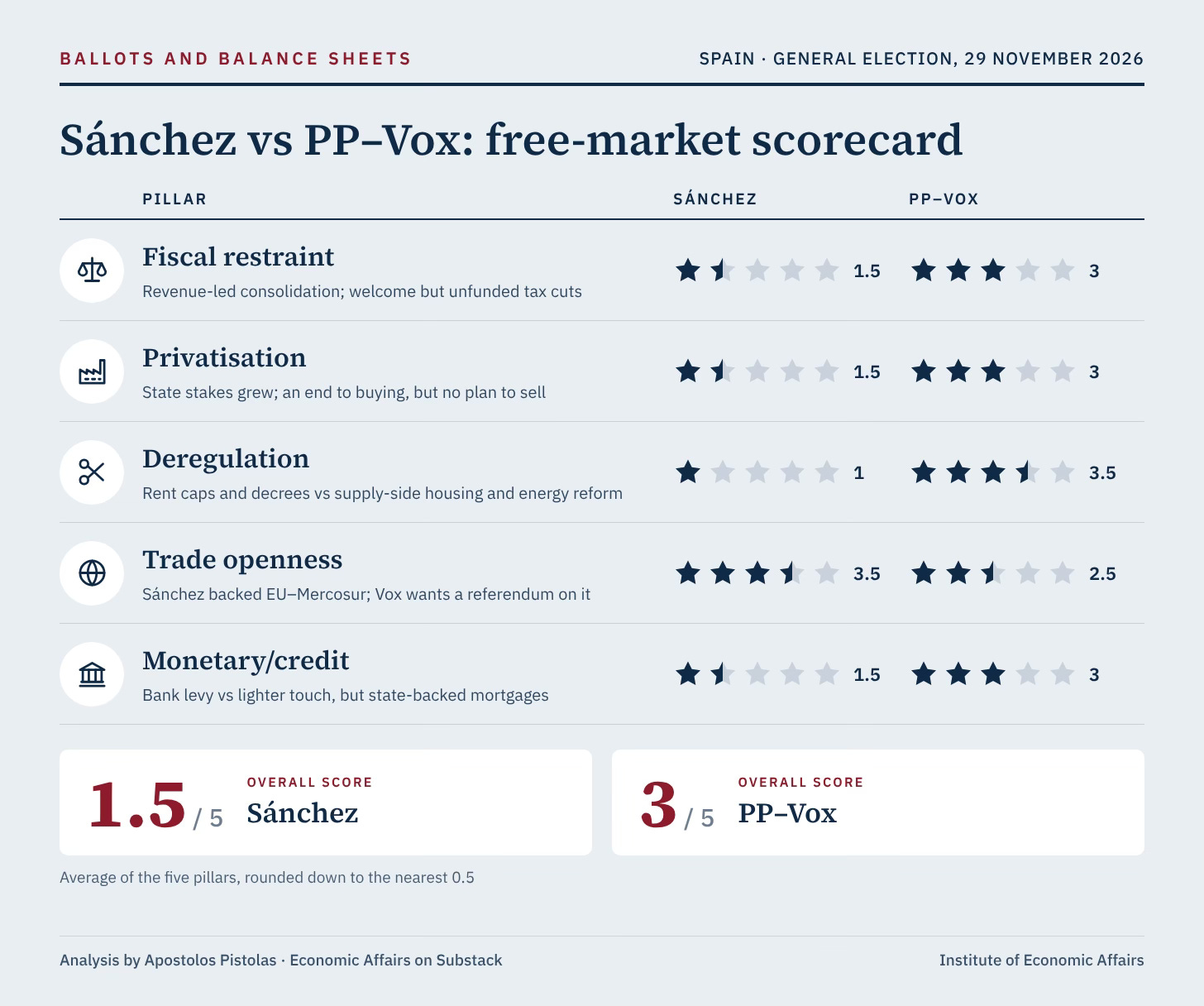
On pure free-market credentials, a PP–Vox government rates 3 stars overall, against 1.5 stars for the outgoing Sánchez coalition.
Each of the five pillars is scored out of 5; the overall score is their average, rounded down to the nearest 0.5.
Score Breakdown:

Spain’s headline numbers look respectable: a deficit of around 2.4 per cent of GDP this year, debt of around 99 per centand growth of 2.3 per cent after 2.8 per cent in 2025. But the consolidation has been revenue-led. Frozen brackets and inflation have done the heavy lifting, and the government has not passed a new budget since 2023.
The PP promises to index income-tax brackets to inflation, give relief to young workers in their first four years of employment and cut income tax in its first year; Feijóo says he will resign if he fails. Vox goes much further: a €22,000 tax-free allowance, just two income-tax rates of 15 and 25 per cent and VAT cut from 21 to 18 per cent.
The direction is right; the arithmetic is not. Vox puts the cost of its income-tax plan alone at around €46bn – although the finance ministry’s estimate is €85bn – and its promise to fund it partly by reviewing €52bn of subsidies remains unspecified. Neither party will touch pension indexation, the largest driver of spending.

Under Sánchez, the state holding company Sociedad Estatal de Participaciones Industriales (SEPI) bought 10 per cent of Telefónica, holds a large stake in the defence group Indra and used its weight to replace Telefónica’s chief executive with Indra’s government-backed chairman. Both the PP and Vox criticised the move. Neither, however, has promised to sell the stakes, and Vox’s call for an industrial policy to reinforce national production suggests it is comfortable with state direction so long as it is patriotic. Expect an end to new acquisitions, not a privatisation programme.

This is where the contrast is sharpest. The minimum wage has risen by more than 60 per cent since 2018, the government tried to legislate a 37.5-hour week before Congress rejected it, and housing policy has layered rent caps and eviction moratoria onto a market short of several hundred thousand homes. Landlords have responded by shifting to seasonal and short-term lets, which the government then sought to regulate too.
The PP’s answer – a million new homes, faster release of buildable land and legal certainty for owners – goes to the root of the problem, which is supply. Vox’s housing plan is also supply-side: liberalise land, shorten planning timelines and let owners recover property quickly for non-payment. Add the PP’s pledges to abolish the 7 per cent tax on electricity generation (currently suspended) and extend the life of nuclear reactors by 10 years, and this pillar earns the coalition its best score. The half-star deduction is for Vox’s “national priority” in social housing and benefits, which rations supply rather than expanding it.

Here the right is weaker than the left. The Sánchez government backed the EU–Mercosur agreement, which has applied provisionally since 1 May this year. Abascal called it “a crime against the countryside and food sovereignty” and wants a national referendum on it. The PP supports Mercosur, but would govern with Vox’s votes, and farmers are a core constituency for both. A trade-sceptic junior partner could slow Spain’s backing for future EU deals. This is the clearest free-market shortfall relative to the incumbent.

Spain has no monetary policy of its own inside the euro, so this pillar turns on credit and banking. The bank levy, introduced in 2022 as a temporary windfall tax, was replaced in 2024 by a new tax lasting three years, at rates of 1 to 7 per cent on net interest income and fees. The government also imposed conditions on BBVA’s bid for Sabadell, barring integration for three years. The bid, which ultimately failed, had already been cleared by the European Central Bank (ECB) and the competition authority had cleared it, prompting the European Commission to open infringement proceedings.
The PP opposed the levy and criticised the intervention; a PP economy ministry would likely let the levy lapse and use merger powers sparingly. Vox’s populist instincts towards big banks make it a less reliable ally. The right is not immune to directed credit either: the PP and its regional leaders want public guarantees for 100 per cent mortgages for under-40s, the kind of state-backed lending this pillar penalises.
Overall score: Sánchez 1.5 | PP-Vox 3
A 3-star rating reflects a genuine pro-market turn on taxes, housing and energy, tempered by unfunded fiscal promises, no appetite for privatisation and a protectionist junior partner. On these five measures, it is a clear improvement on current policy, not a liberal revolution.
Broader economic implications
Spain enters the election as the fastest-growing large economy in the eurozone. The risk for a PP–Vox government is that it inherits strong headline numbers and spends the fiscal room on tax cuts before reforming spending. With debt close to 100 per cent of GDP and EU fiscal rules back in force, the margin for error is thin. Vox’s “remigration” agenda also sits awkwardly with a labour market whose recent growth has leaned heavily on foreign-born workers.

What to watch
The first budget. Whether a PP government presents one with spending offsets, or simply cuts taxes and hopes for growth, will define its fiscal credibility.
The coalition deal on trade and agriculture. Any concession to Vox on Mercosur or future EU agreements would be a red flag.
Housing legislation in the first 100 days. Repealing rent controls and speeding up land release would signal seriousness; layering on “national priority” rules would signal the opposite.
A PP–Vox victory would move Spain towards the market on the issues voters care most about, tax and housing, and away from it on the one Vox cares about most: protecting domestic producers. That would still leave Spain’s policy mix more market-friendly than today’s. But the improvement depends on Feijóo keeping control of the economic portfolios, and on resisting the temptation to pay for Vox’s support with the protectionism the right claims to oppose.