


Valentin Boboc is a Senior Economist at the Institute of Economic Affairs
From tax cuts and housing reform to rent controls and nationalisation, Britain’s political parties have set out competing economic priorities. But which proposals would improve growth, competition and consumer choice — and which risk making existing problems worse?
Party conference season has produced a wide range of economic announcements, from changes to inheritance tax and welfare to proposals for housing, energy, healthcare and public ownership.
Some would reduce barriers to investment and improve economic incentives. Others risk increasing costs, distorting markets or placing further pressure on already stretched public finances.
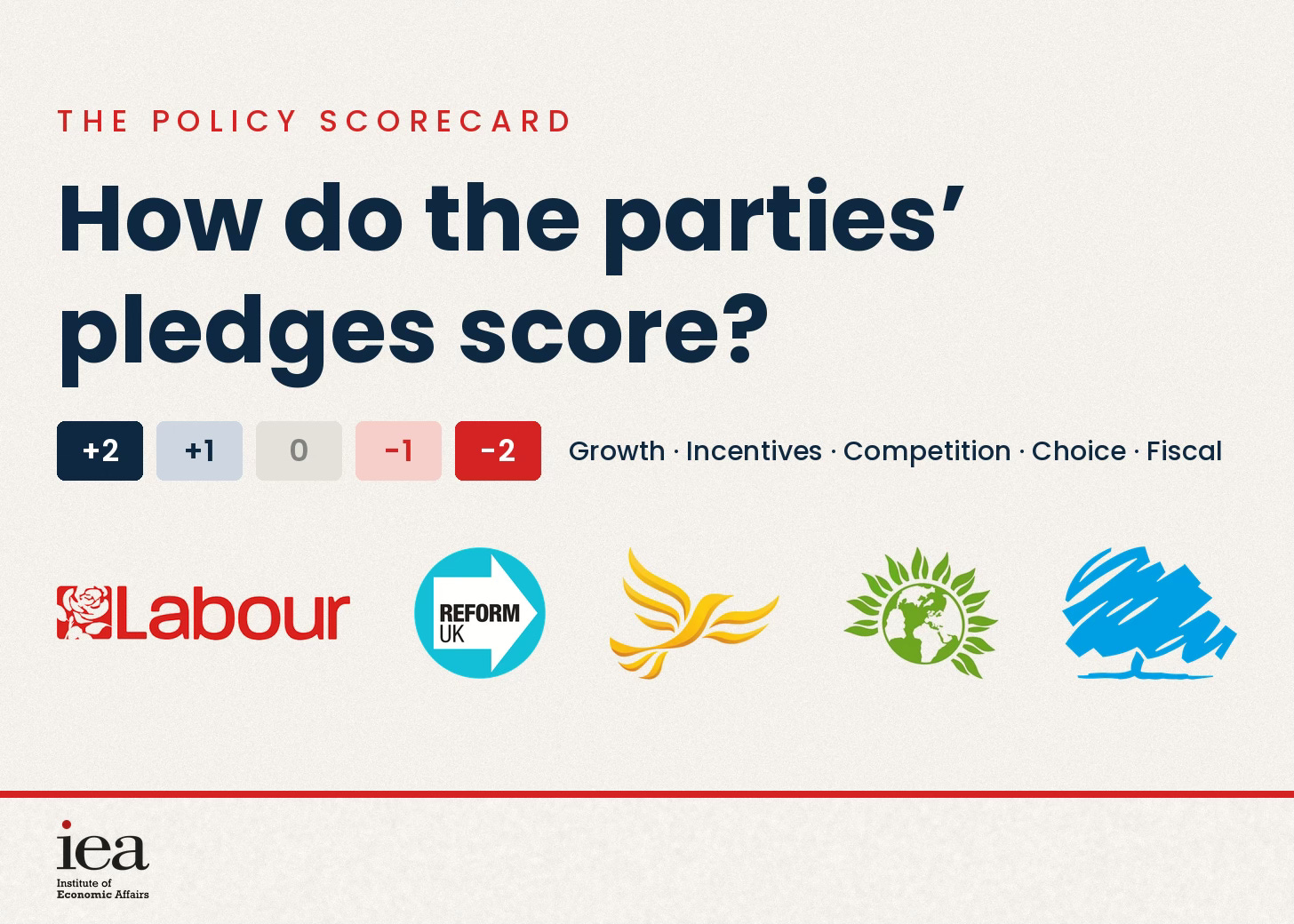
We have assessed a selection of the main proposals from Labour, the Conservatives, Reform UK, the Liberal Democrats and the Green Party against five criteria:
Growth: Would the proposal support economic activity and investment?
Incentives: Would it encourage productive behaviour?
Competition: Would it improve competition or restrict it?
Consumer choice: Would individuals have more or fewer options?
Fiscal position: Would it improve or worsen the public finances?
The results reveal some encouraging proposals across the political spectrum, alongside several familiar mistakes.
Tax and public finances
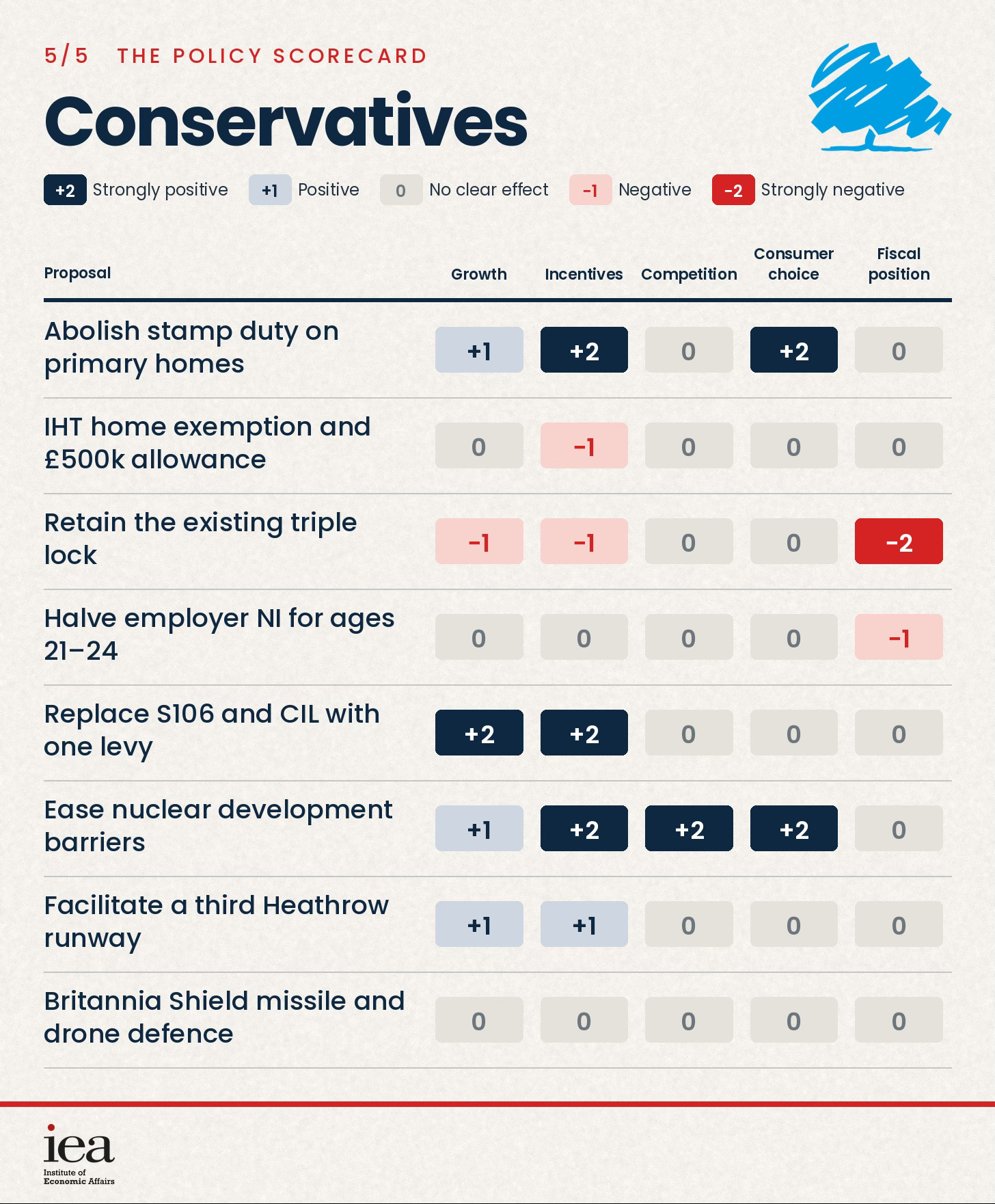
One of the more welcome proposals came from the Conservatives, who announced plans to abolish stamp duty on primary homes.
Abolishing stamp duty on primary homes would make the housing market more efficient by making it easier for people to move.
But exempting main residences from inheritance tax when passed to direct descendants would merely exacerbate the bias in the UK towards property as a means to store wealth.
This in turn would encourage people to use their main residence to shelter wealth from tax at the expense of other investment and, if the supply of housing is constrained, could simply drive up prices.
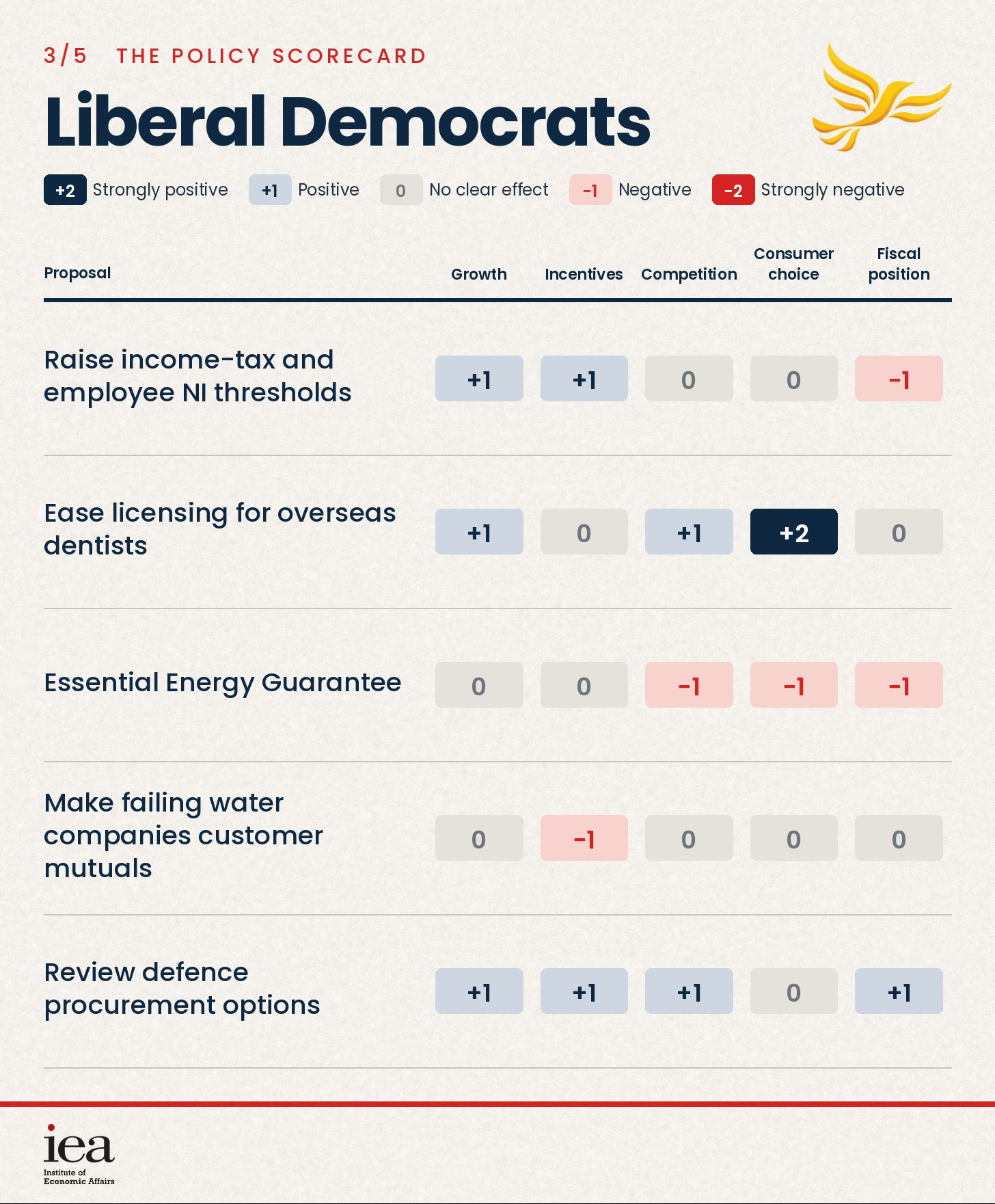
The Liberal Democrats proposed increasing income-tax and employee National Insurance thresholds. This would cut revenues but also reduce fiscal drag, creating positive incentives for the labour market.
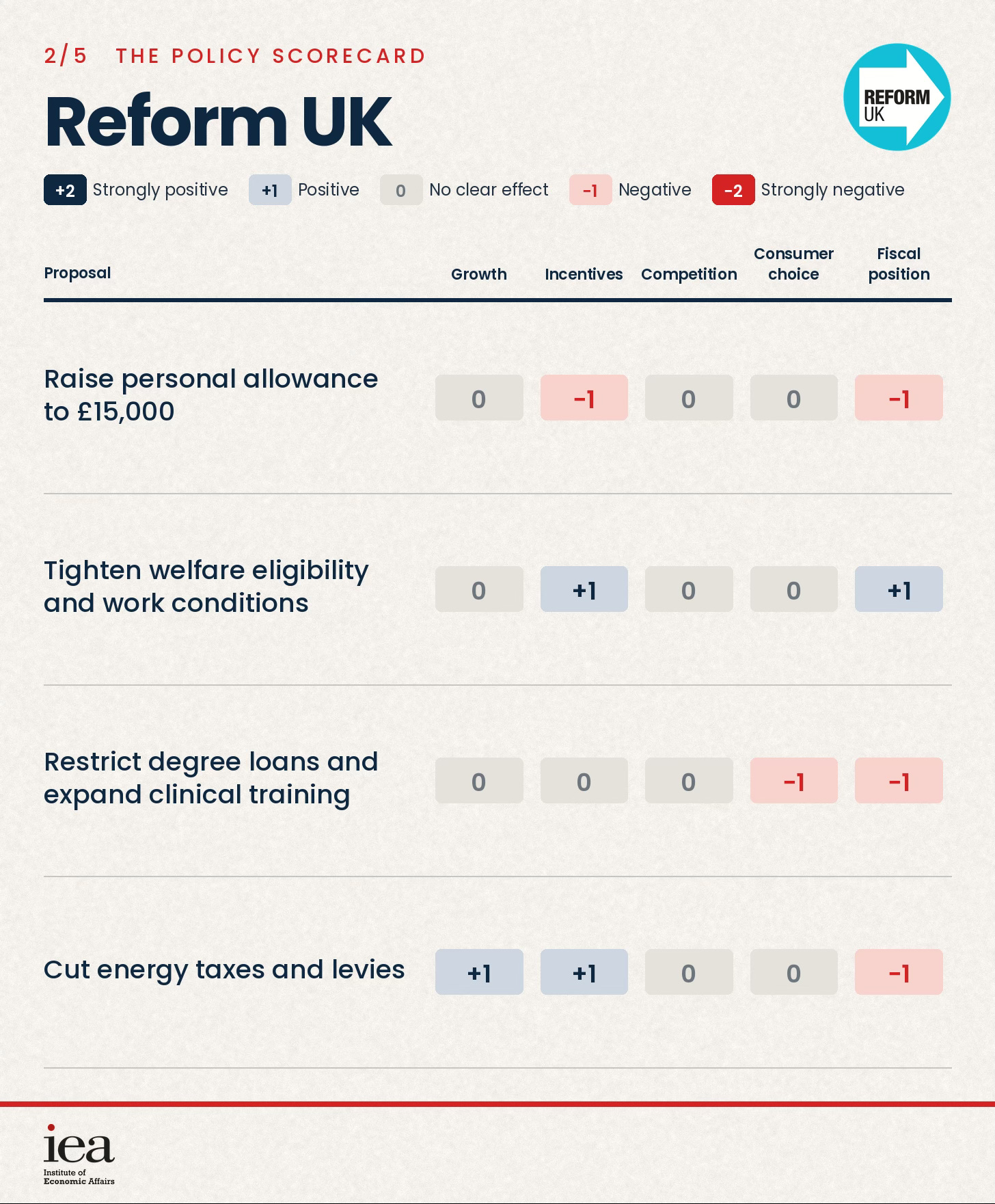
Reform UK’s proposal to increase the personal allowance to £15,000 is less straightforward. British taxation already relies on a very narrow base. Removing even more people from the incidence of tax creates poor incentives.
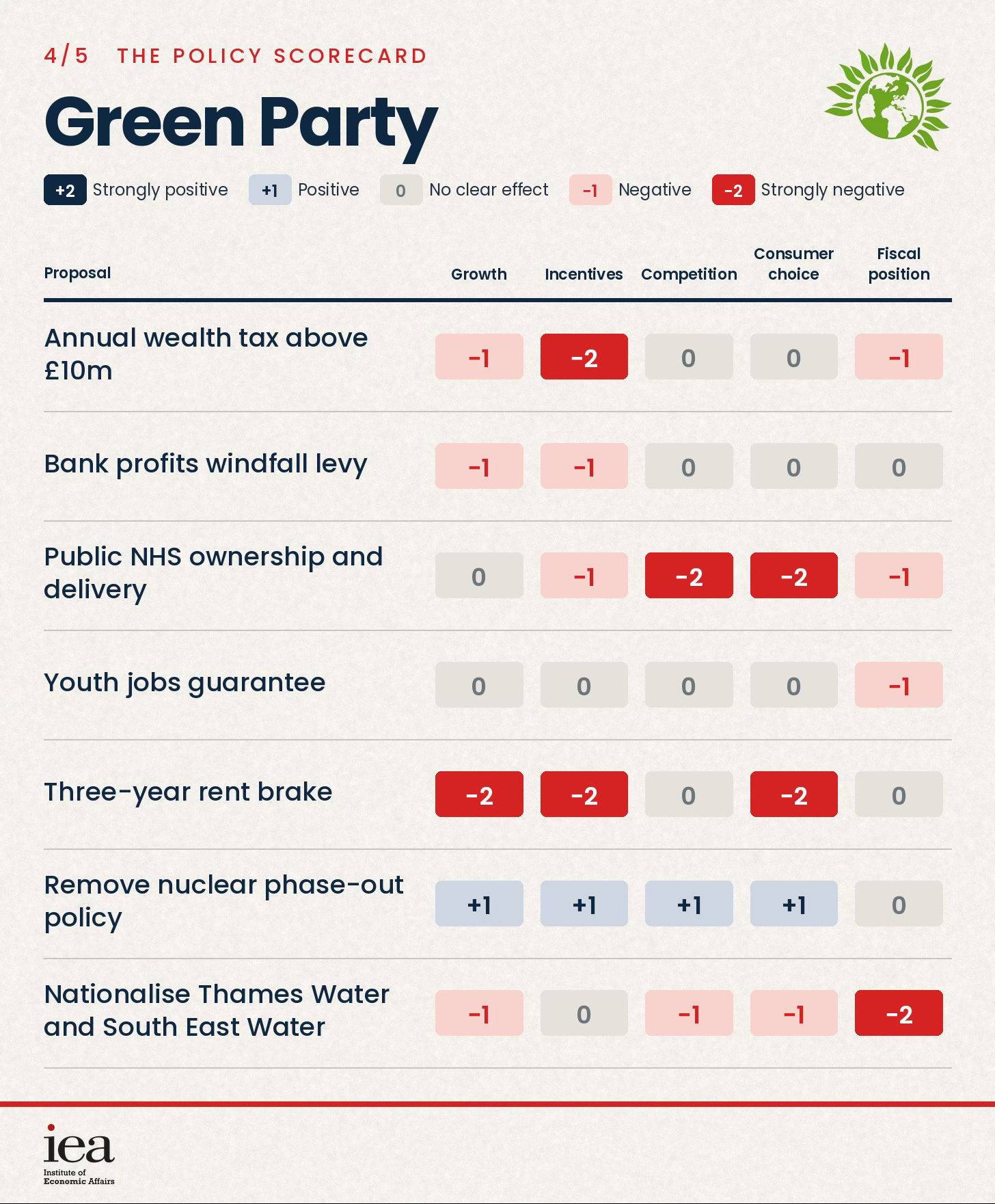
The Greens proposed an annual wealth tax on assets above £10 million and a bank profits windfall levy.
A wealth tax would discourage investment and create valuation and avoidance problems. An unpredictable sector tax is also problematic: temporary receipts cannot reliably fund recurring commitments.
Health and social care
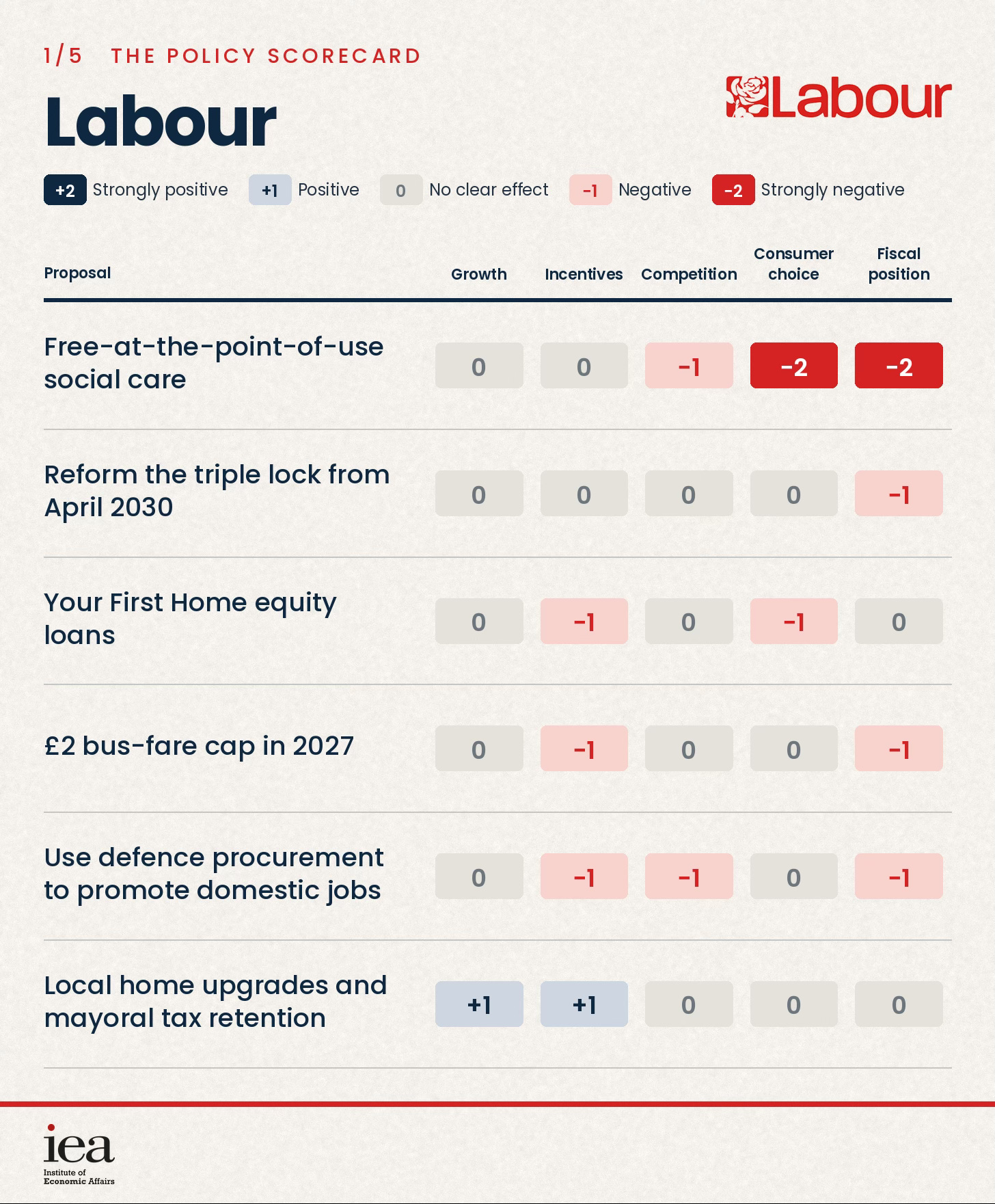
Labour proposed a National Care Service with free personal care for older people in the next Parliament.
However, the proposal is currently uncosted, and it remains unclear how the additional spending would be funded.
The Liberal Democrats’ proposals to improve access to dentistry offer a more promising approach in one respect.
Removing certain occupational licensing barriers could improve capacity by removing administrative barriers to qualified dentists from overseas already in England practising here.
Insisting that those services will be funded and delivered with public funds serves only to exclude the possibility of using independent sector capacity and competition to improve the system while also increasing the fiscal burden.
The Greens’ commitment to public ownership and provision of NHS services would similarly restrict competition and patient choice, while acquisition and transition costs remain unquantified.
Welfare and pensions
Labour proposed changing the triple lock to a different formula from April 2030, although it will still be a triple lock with a 2.5 per cent floor.
It is not clear how much this will save, but it will help restrain the growth in State pension expenditure, which is currently rising very fast.
It is hard to see whether the promised social care spending can be funded from these savings.
The Conservatives, meanwhile, committed to retaining the existing triple lock. This does not address a major uncapped spending commitment which is causing immense fiscal pressures.
Reform UK’s proposals to tighten welfare eligibility and work conditions could improve incentives and reduce fiscal pressures.
Education and employment
The Conservatives’ employer National Insurance reduction for workers aged 21–24 lowers hiring costs and could help inexperienced workers, though the age boundary risks displacement.
The Greens’ youth jobs guarantee lasting up to two years offers places without a complete national costing or convincing evidence of additional, lasting employment.
Both should be judged by employment and earnings after support ends.
Reform UK’s proposals to restrict degree loans and expand clinical training also raise questions.
Blunt restrictions on student choice may not necessarily offset the more expensive degrees which require clinical training. The current loan system is likely unfit for purpose when it comes to creating better incentives.
Housing and planning
The Conservatives would replace Section 106 agreements and the Community Infrastructure Levy with a single infrastructure levy.
This could help to remove negotiations and the risk of delay, providing that the levies are set at a level that allows development to remain viable whilst still raising enough for infrastructure.
Labour’s proposed equity loans for first-time buyers are less convincing.
These would likely inflate prices throughout much of the country where housing supply is constrained. Uncosted equity loans also expose buyers to financing and asset risks.
The Greens would introduce a rent brake for a period of three years, limiting rent increases to the lowest of inflation, wage growth and 2 per cent.
The benefit of this would go to incumbent tenants.
The long-term effects would be likely to include a reduction in the number of rental houses, a reduction in the quality of maintenance of rental housing and a reduction in labour and tenant mobility.
Energy and transport
One good measure to increase electricity supply would be to ease development of nuclear power and generally to facilitate investment in generating new supply by scrapping regulatory barriers and setting technology-neutral investment rules.
Reducing other policy costs imposed on energy consumption would also be helpful in tackling the cost of living and the cost of doing business.
The Conservatives’ proposals to ease nuclear development barriers would help expand reliable energy generation and competition in the energy sector.
Reform UK’s proposals to cut energy taxes and levies would mechanically reduce revenues, but would reduce the policy costs which currently affect the cost of living and the cost of doing business.
The Greens’ decision to remove the mandatory civilian nuclear phase-out is also welcome. It avoids premature closure and preserves energy options.
The Liberal Democrats’ Essential Energy Guarantee, however, would weaken price signals and distort the market. The fiscal costs do not seem to be justified.
Water and public utilities
The Greens proposed bringing Thames Water and South East Water into public ownership.
Public ownership risks making prices, staffing and investment more responsive to political pressures than to service quality and long-term costs.
Ministers would face pressure to suppress bills, while essential investment would compete with schools, hospitals and other spending priorities.
Access to taxpayer support could also weaken incentives to control costs and address poor performance.
Even a zero acquisition price would leave substantial operating and infrastructure costs to finance.
The Liberal Democrats’ proposal to convert failing water companies into customer-owned mutuals also raises questions. Customer-owners would become liable for outstanding company debt, and it is unclear how this dynamic would improve incentives for other utility providers.
Defence
Some proposals correctly pointed out that the key to efficient defence spending is fixing procurement rules.
Other proposals revolved around using defence procurement to promote job creation or domestic industries.
The problem with the latter is that it subordinates military capability to industrial policy.
The Liberal Democrats’ proposals to review defence procurement options could improve competition and value for money.
The policy scorecard
We scored selected announcements against their likely effects on growth, incentives, competition, consumer choice and the fiscal position.
Scores range from -2 (strongly negative) to +2 (strongly positive), with zero indicating no clear or material effect.
The scores are assessments of individual proposals, not forecasts of their economic impact or comprehensive costings of the parties’ programmes.
The missing ingredient: Devolution
It would have been good to see more on devolution in the announcements.
Devolving the collection of taxes to local areas, allowing them to keep more of the money they collect and to set their own tax rates, would match local spending power with local raising of revenues, creating the right incentives to foster growth.
This was an opportunity to do much more which has been largely missed.
Conclusion
There are worthwhile proposals across the political spectrum, particularly those which reduce barriers to investment, improve competition and strengthen incentives.
But many of the announcements rely on greater public spending, tax preferences, price controls or changes in ownership without adequately addressing the underlying problems.
The important question is not simply how much governments promise to spend, but whether their policies create the conditions for investment, competition and sustainable economic growth.
On that test, party conference season has offered some promising reforms, but also too many missed opportunities.
"This in turn would encourage people to use their main residence to shelter wealth from tax at the expense of other investment..."
How exactly? You already own your primary residence so how would you shelter wealth using something you already own...?