


Matthew Bowles is the Senior Policy Researcher at the Prosperity Institute
There was something wonderfully British about the Chiswick affair. A dispute over outdoor seating at three riverside pubs – the Bulls Head, the City Barge and the Bell and Crown – began as a mundane licensing agreement. Hounslow Council had discovered that furniture, which had occupied the Thames towpath for decades, lacked the necessary permissions under the Highway Act, and forced the pubs to remove it. After local protests, the council paused enforcement whilst the pubs applied for the appropriate licenses.
The story was pushed into the public eye by the tweets of local resident Alastair Hilton, a photographer with a well-known X account. He specifically blamed Rick Rowe, a local Green councillor for a vendetta against the outdoor seating which was near his home.
Then the police arrived. After receiving a complaint from an elected official concerning alleged malicious communications and public-order issues, Metropolitan Police officers spoke to Hilton at the Bell and Crown. According to video footage later viewed by millions online, officers warned him about new legislation relating to protests outside the homes of public office holders and suggested that some of his social-media posts could be construed as harassment. Hilton was not arrested, was not under investigation and the Met subsequently confirmed that no offence had been identified.
If this were an isolated incident, it would be little more than a curious local story. But it joins a growing collection of episodes that have left many Britons with an uneasy sense that lawful speech increasingly attracts official attention. Last year, Graham Linehan, creator of Father Ted, was met by armed police at Heathrow Airport and arrested over social media posts. Universities have spent years embroiled in rows over disinvited speakers and cancelled events. Meanwhile, the machinery of non-crime hate incident recording has created the peculiar possibility that a citizen might find himself on a police database despite never having committed a criminal offence.
None of this means Britain has become an authoritarian state. People are not routinely imprisoned for criticising the Prime Minister, newspapers remain free to investigate those in power and free elections are able to topple governments. However, there has been a gradual erosion of the legal and cultural norms that once favoured open debate and a growing willingness of both the state and major institutions to police expression that would previously have been left to public argument.
The Prosperity Institute’s latest report, “Reversing Britain’s Free Speech Recession” by barrister Jon Holbrook, argues that this cultural shift didn’t emerge overnight. The legal ground was prepared decades ago.
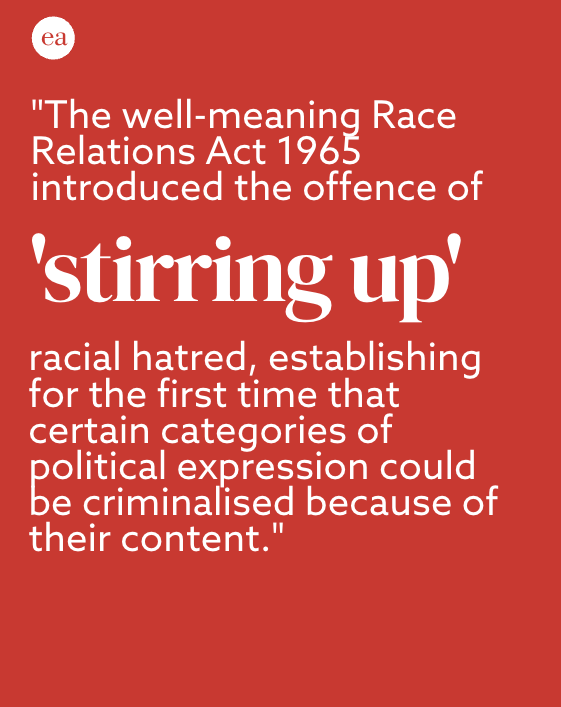
The well-meaning Race Relations Act 1965 introduced the offence of “stirring up”racial hatred, establishing for the first time that certain categories of political expression could be criminalised because of their content. The Public Order Act 1986 lowered the threshold further by criminalising words that were “likely to cause harassment, alarm, or distress”, replacing the older focus on provoking a breach of the peace.
Reasonable people can debate whether these laws were justified, or whether they were justified at the time and then later expanded too far. But the overall point is difficult to ignore. Over the last sixty years the state has become progressively more comfortable regulating speech, whilst the arrival of social media has made speech vastly more accessible and visible. Every citizen essentially possesses a printing press in his or her back pocket. Instead of treating this as an opportunity for wider democratic debate, governments of all stripes have shied away from the challenge and treated it as a problem that ought to be constantly managed.
That shift has had consequences beyond criminal law. Once Parliament establishes the principle that the state has the ability to police certain opinions, then a wider culture of speech regulation will follow. Employers become more cautious; universities and public bodies become risk averse. The question, “Will this cause trouble?”, is asked more and more frequently.

What then should be done?
The recovery of institutional restraint is essential. Over multiple decades, the boundaries of speech have tightened, with regulation broadening in ways that would have once seemed remarkable. Laws aimed at preventing racial hatred, public disorder and harmful communications were introduced with understandable intentions. However, the cumulative effect has been to make the state increasingly comfortable policing expression that falls far short of calls for violence or any direct threats to the individual.
This of course does not mean that every speech restriction should disappear. A free society must have the power to punish genuine threats and incitement to violence. The difficulty that faces Britain currently is that we have gradually accumulated a patchwork of offences and regulatory powers whose scope is at best uncertain to those expected to obey them.
Some reforms therefore seem long overdue. Section 5 of the Public Order Act 1986, which criminalises speech merely because it may cause harassment, alarm or distress is ground zero and must be repealed.
Tackling the myriad of speech sent via both electronic and traditional mediums is also a must. The Malicious Communications Act 1988, the Communications Act 2003 and the recently contentious Online Safety Act 2023, should be repealed and replaced with just one offence of communication that punished intentionally menacing and targeted speech.
When it comes to civil claims, Holbrook advocates for removing the religion and belief protection out of the Equality Act, delivering free speech from the contentious realm of anti-discrimination law and replacing it with a simple tort of unlawful interference with free speech. A new costs regime would also deter spurious allegations and protect those who seek to defend their right to speak freely.
Britain ultimately is not an unfree country, despite frequent attempts to portray it as such. But free speech is not something to be suddenly lost in a single dramatic moment. Instead, it is eroded in a thousand small interventions.
The road to recovery begins with Parliament narrowing or repealing laws that have drifted far beyond their original purpose. Only then can we relearn our older liberal habit of meeting opinions we dislike with criticism, ridicule or persuasion rather than a demand that somebody in authority make them stop.