



Ballots and Balance Sheets is a fortnightly series, published on Tuesdays, scoring election candidates worldwide on their free-market credentials.
Dr Apostolos Pistolas is a political analyst, compliance expert and former lecturer in political marketing who combines a PhD in voting behaviour with financial sector expertise. He tweets at @appistol
With Luiz Inácio Lula da Silva (Lula) re-elected to a historic fourth term, the central economic question is no longer whether markets hoped for a sharper fiscal turn. It is whether a continued Partido dos Trabalhadores (PT) government will treat the existing fiscal framework as a genuine constraint or as a flexible envelope around an expanding state-led model. Markets have already signalled discomfort: equity futures and the real weakened on the result, reflecting the gap between the first-round pricing of a Flávio Bolsonaro tesouraço (“a sharp fiscal squeeze”) and the continuity now confirmed.
Scorecard:
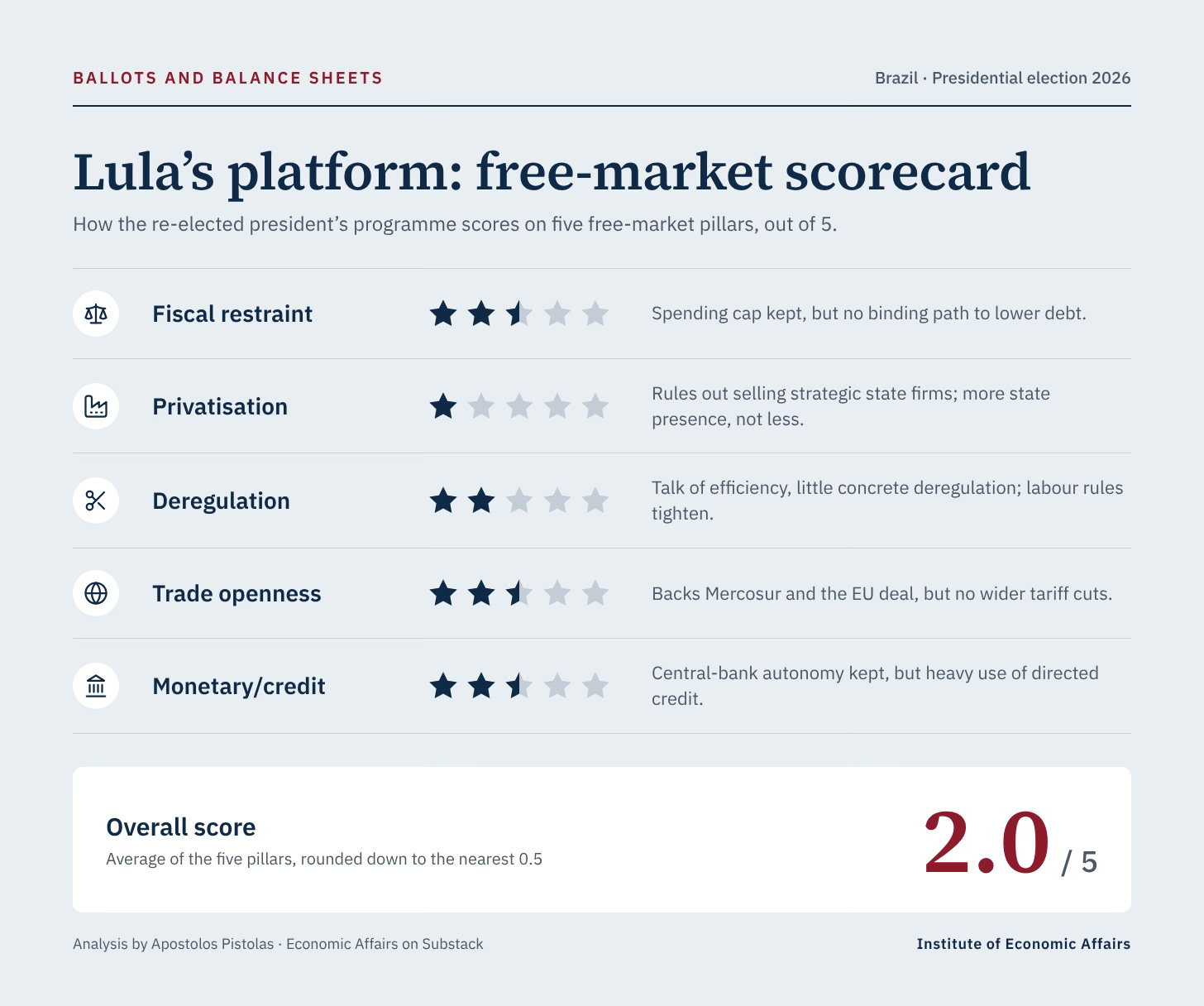
On pure free-market credentials, a second consecutive Lula term currently rates about 2.0 stars overall.
Score Breakdown:

The platform commits to keeping the fiscal framework, which caps real spending growth and aims for gradual primary improvement through growth and revenue. That is better than an open-ended expansion, yet the document offers no binding debt-reduction path, leaves large mandatory outlays (pensions, social transfers) largely untouched, and treats higher progressive taxation as the main adjustment tool. Implementation has already been tested by parliamentary amendments and revenue shortfalls; the political incentive to loosen the framework further is high.

The government programme explicitly rejects privatisation of strategic state-owned enterprises (SOEs), such as Petrobras, Correios and others, and frames public banks and state investment as active instruments of re-industrialisation and sovereignty. Concessions and public-private partnerships (PPPs) are tolerated in infrastructure, but the direction is more state presence, not less. This is the clearest free-market shortfall relative to Flávio Bolsonaro’s platform.

Efficiency language appears (“quality of public spending”, transparency platforms), yet concrete deregulation is thin. The agenda prioritises labour-market tightening (40-hour week without wage cuts, real minimum-wage increases) and industrial-policy tools (local-content preferences, directed credit, selective tax breaks). Administrative reform is secondary to capacity-building of the state.

On trade, Mercosur remains the preferred vehicle; the EU deal is cited positively, and selective openness exists. Broader unilateral tariff reduction or a decisive pivot towards deeper OECD-style integration is absent. Industrial policy and “neo-industrialisation” sit in tension with freer trade.

Formal central-bank autonomy is preserved, which is a meaningful institutional gain from earlier decades. However, the platform leans on public banks, directed credit and “the largest credit policy the country has known” to support consumption and specific sectors. Fiscal credibility remains the binding constraint on how far rates can fall without re-anchoring inflation expectations.
Overall score: 2 stars
A 2-star rating reflects continuity of a mixed, state-heavy model rather than a decisive shift towards markets. The difference between 1.5 and 3 stars will be decided by whether the fiscal framework is enforced or repeatedly relaxed, and by how far industrial-policy and credit interventions expand.
Broader economic implications
Lula’s victory most directly entrenches the size and composition of the state. Gross debt already sits near 83 per cent of GDP. The binding constraint on lower interest rates and stronger private investment remains fiscal credibility. Maintaining the existing framework may prevent an immediate jump in risk premia, yet without deeper spending reform the room for the central bank to ease remains limited. Markets will watch the 2027 budget guidelines and any attempt to create new exceptions or revenue earmarks.
On the real economy, public investment via the Novo PAC and industrial incentives will continue, alongside real wage gains and expanded social transfers. These can support short-term demand, but they also raise unit labour costs and crowd out private capital if not matched by productivity gains. Formal employment costs stay high; labour rigidities will limit, rather than expand, the shift into formal employment. Private investment will depend on regulatory predictability in energy, mining and infrastructure concessions, areas where the programme signals continuity rather than a clear opening.
However, the elephant in the room for the Brazilian President is the composition of Congress. Lula’s re-election puts him back in the Planalto, but the Congress that sits with him is not the one he would have chosen. The right holds roughly 303 of the 513 seats in the Chamber of Deputies and around 49 of the 81 seats in the Senate. Flávio Bolsonaro’s PL is the largest single party in both houses, with 121 deputies and 28 senators. The left, even counting the full PT-led federation and its usual allies, remains a clear minority.
The arrangement is still multiparty and the Centrão will extract its usual price, yet the balance of power has shifted. A president who wants to expand spending, reverse privatisations or tighten labour and environmental rules will need to buy support from a Congress whose median member is further to the right than in Lula’s previous terms. That does not guarantee free-market reforms, but it does raise the cost of the alternative and leaves open a narrow window for fiscal discipline or targeted liberalisations if the government decides the price of obstruction is higher than the price of compromise.

What to watch
Three things will show whether the new Congress actually constrains Lula or merely raises the price of his agenda.
First, the 2027 budget and any accompanying fiscal framework. The right’s numbers make a clean return to unconstrained spending harder, but the Centrão’s appetite for amendments and earmarks is unchanged. If primary spending still grows faster than the economy and the debt path steepens, the congressional majority will have proved accomodating rather than effective.
Second, any attempt to reverse or slow the privatisations and concessions already in motion (Eletrobras residual issues, ports, highways, sanitation). A determined government can still use regulatory agencies and state banks to claw back influence. Clear reversals or heavy re-regulation would signal that the congressional right is unwilling or unable to defend the private-sector space it claims to support.
Third, Supreme Court appointments and the handling of key regulatory bodies. The Senate’s right-wing majority can slow or reshape nominations, but only if it stays disciplined. Early votes on fiscal, labour or energy measures will reveal whether the PL and its allies treat free-market constraints as a priority or simply as leverage for other political goals.
None of these tests will be settled in the first hundred days. They will be settled in the ordinary business of budgets, concessions and appointments over the next two years. For now, the free-market outlook is not transformed by the presidential result. It remains constrained by a platform that scores poorly on private-sector space and only modestly on the other pillars, and by a Congress that can raise the cost of leftward moves without necessarily delivering the opposite.
Two stars feels generous once you line up Petrobras and Correios staying off the table, a 40-hour week with no wage cut, and "the largest credit policy the country has known" running through public banks. Brazil has seen this movie before, and the Dilma years ended in a deep recession after directed credit and fiscal workarounds piled up. The fiscal framework looks like the one real guardrail left, so the detail about parliamentary amendments and revenue shortfalls already testing it is worth watching closely. A right-leaning Congress could slow the state-led push, though Brasília's coalition bargaining has a long habit of buying votes with spending. The way the real and equity futures reacted on the night suggests markets are already pricing in some slippage.