


Rochelle Blakeman is an independent writer
Do you remember being told as a child that eating carrots would help you to see in the dark? Or that if you pulled a funny face, it would stay that way if the wind changed direction? As a social species, we often trust the information we hear repeatedly from authorities without question. Much of the time, this instinct promotes our survival: don’t cross the road without looking both ways, don’t eat those poisonous berries. But as we grow older, we realise that some of these imperatives were mere myths.
I remember this phenomenon whenever I hear about the North being left behind.
Successive generations of politicians have lamented variations of this theme, all promising similar schemes and plans to level the playing field. From Tony Blair’s “the Northern way” to George Osborne’s “Northern Powerhouse” and Boris Johnson’s infamous “levelling-up” agenda, acknowledging and promising to redress the perceived North-South divide is almost a rite of passage for British politicians.
Andy Burnham, our latest Prime Minister and a proud, born- and-bred Northerner, has taken this tendency to new heights. The former Mayor of Manchester is so attached to his home that his Number 10 North, part of a plan for devolution to “re-wire” Britain and deliver “good growth in every postcode”, would be a work of parody if it wasn’t so earnest. Whilst Burnham portrays this as unique and visionary, many of his predecessors have sung from the same hymn sheet. The narrative is so ubiquitous in politics that it is barely noticed. It is not given as much scrutiny as it deserves.
I am not denying that there is any truth to the North-South divide. If London was its own country, it would be one of the world’s richest nations. In 2023, the capital city had a total economic output of £618 billion, accounting for 22.3 per cent of the UK’s GDP. Meanwhile, the decline of industry, lower educational attainment, lower average life expectancy and a general feeling of malaise define many assessments of the North and the Midlands.
However, speaking as someone who grew up in the North, I believe the assumption that all fortune must be in the South’s favour is too simplistic. One comparative advantage of the North, for example, is the affordable and growing housing market.
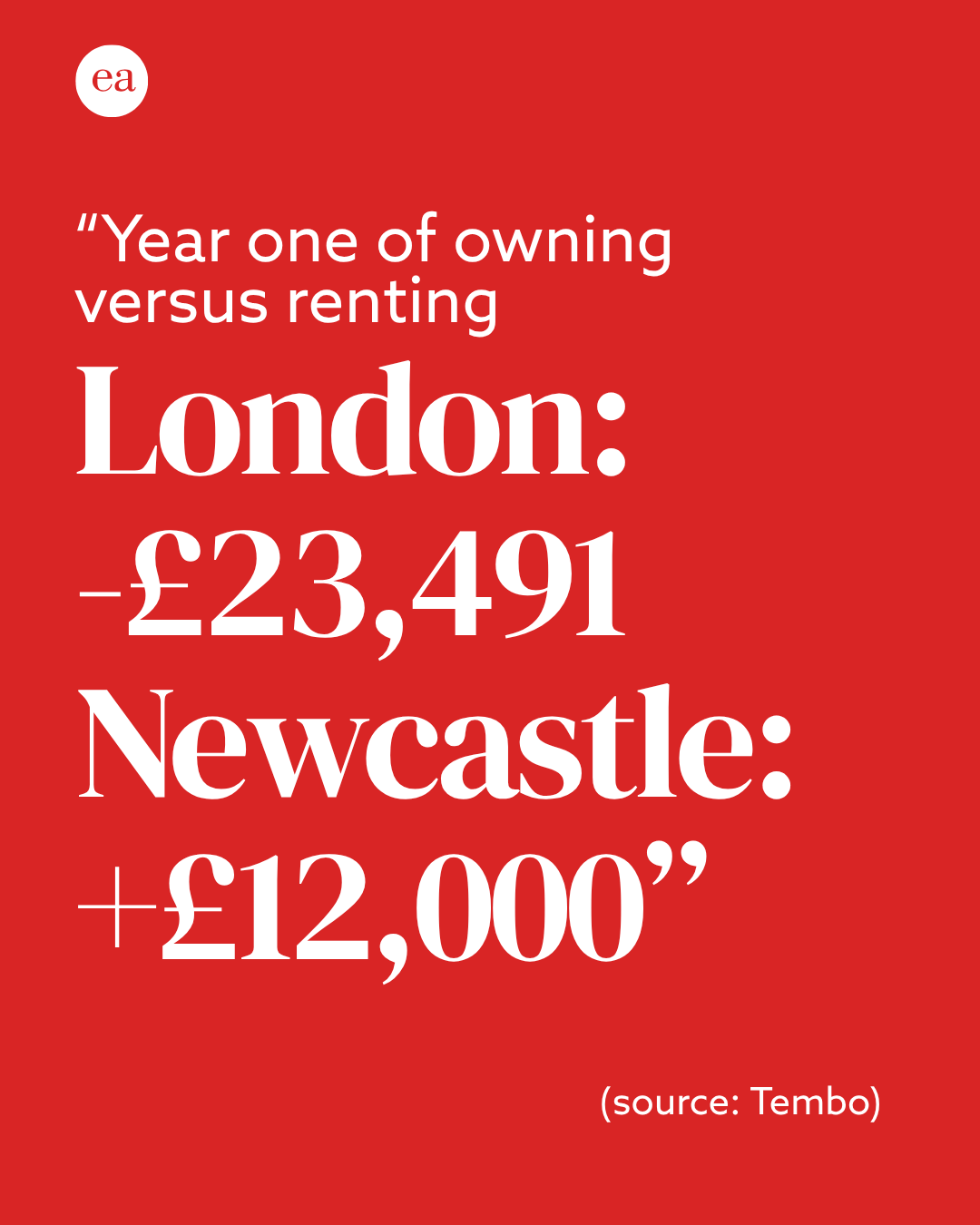
The North-East had the cheapest average house prices in England in July at £196,895. The neighbouring North-West saw an average of £275,168 and Yorkshire and the Humber £259,730. By comparison, the average house price in London was £676,248. Analysis by mortgage broker Tembo shows that first-time property owners in London could be left £23,491 worse off after one year of home ownership than if they had continued renting. In Newcastle, by contrast, buyers can see an overall financial gain of more than £12,000 in their first year of homeownership.

The implications of this on quality of life are significant. High mortgage rates, the need for large deposits and the average London home costing 10 to 12 times the average earnings lead many Londoners to delay property and family aspirations. Whilst this is a sacrifice many are willing to make, for others the pull to home ownership and its associated stability may make parts of the North and the Midlands look more attractive in this regard.
Some may protest that lower overall wages and fewer job opportunities in Northern regions neutralise this advantage. To which I would point out the many thriving and growing places of industry, innovation, and renewal above the river Trent.
Leeds in Yorkshire has become the largest legal hub outside of London. Cheshire, famed for footballer affluence, sees a growing Science Corridor, home to over 7,000 businesses. The Advanced Manufacturing Research Centre (AMRC) in Sheffield, transformed from a former colliery 25 years ago, attracts global names such as Boeing and McLaren.
Wealth, jobs and opportunities in the UK do not follow a simple North-South regional divide, but could be said to grow where investment, innovation and intelligent business ideas are able to flourish.
Why, then, do some politicians continue to play on the simplistic, self-defeating idea that it is grim up north and golden down south? As Ed Davey rather astutely put it on a visit to Torbay, Devon: “Avanti Andy needs to realise Britain doesn’t start at Euston and terminate at Manchester Piccadilly”.
Burnham thinks he appears as a refreshing outsider to the Westminster bubble. But his conception of the world beyond London is quite an urban bubble in itself. Rural and coastal communities in the South-West barely cross his radar.
Readers of this publication can make a strong case that free-market and fiscally sound policies are the recipe for betterment across Britain, not just London. Burnham’s embrace of localism might make him popular with London-bashing strands of the electorate, but fundamentally, I am not optimistic that his devolution plans will improve life anywhere, let alone up North.
Whilst Burnham promises various tax cuts, his vision for the country will inevitably require more government spending. His plans to increase public ownership of water, energy and housing all point towards a burgeoning public sector. Within his first few days of office, the UK’s debt interest has climbed, with 10-year gilt yields jumping from 4.7 per cent to more than 5 per cent.
Perhaps the silver lining is that as the fiscal impossibilities of Burnham’s plans come to light, it might never be clearer that an over-bloated state is not the way to economic growth. Life isn’t that bad up North after all. It is a place with much potential. Don’t let politicians with saviour complexes get in its way!