


Archie Bartlett is a recent graduate of the University of Hull, received first-class honours in History and Politics and recently completed an internship at the Institute of Economic Affairs.
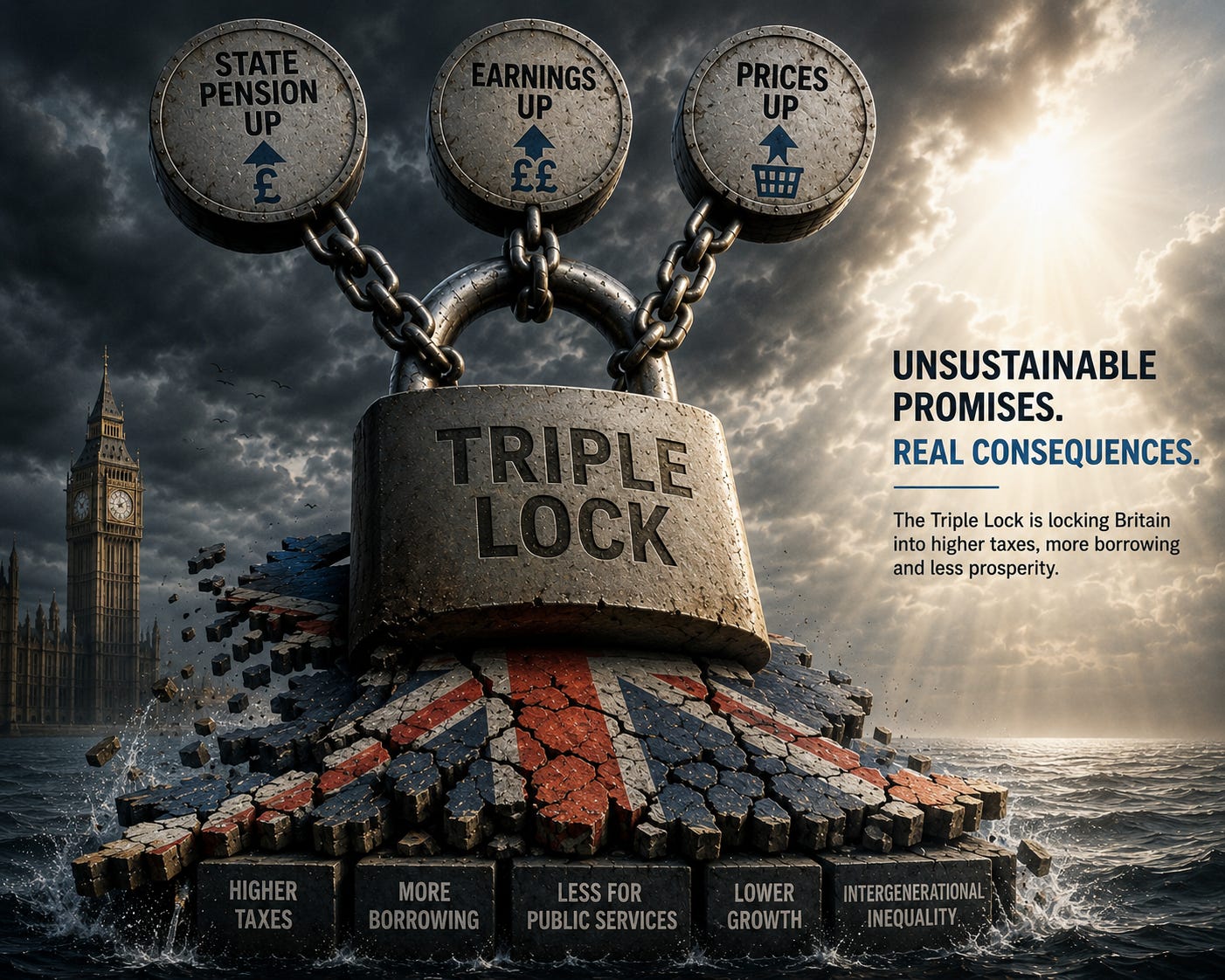
The coalition government announced in 2010 that the triple lock would take effect in the 2011/12 financial year. The triple lock means the state pension increases by 2.5% per year, or by inflation or average earnings growth, whichever is highest. It was introduced to ensure that the state pension would increase in real terms over time. While the triple lock has virtuous intentions, its affordability has raised questions about its sustainability.
The triple lock has proved more expensive than expected, according to the Office for Budget Responsibility (OBR). In the 2025/26 tax year, the Government spent £146.1 billion on the state pension, more than on education and defence. The National Audit Office have said that the triple lock has cost three times as much as expected. The OBR has gone further, stating that the triple lock could put government finances on an ‘unsustainable path’.
In the 2025/26 tax year, the UK government spent £333.7 billion on the social security system, with around 55% of that spending going to pensioners. In the tax year of 2025/26 (from April 2025 to April 2026), the UK government collected £330 billion in income tax. While the total tax volume was £938.8 billion, government spending was £1.232 trillion, resulting in a spending deficit. The government gets most of its revenue from National Insurance, Income Tax, and VAT. Social protection (which also includes other benefits) accounted for £384 billion (30%) of government spending, and health accounted for £242 billion (19%).
All political parties are committed to the triple lock, yet individuals on both the left and the right of the political spectrum have argued for its repeal. The Institute for Fiscal Studies estimates that spending on the state pension will rise by £80 billion in today’s terms by 2070, and over half of this increase will be due to the triple lock. But under a more precarious political environment, the triple lock could cost an extra 1.5% of national income - or £44 billion in 2025-26 terms- on top of this. This highlights how the triple lock is unaffordable; reforming the pension system seems politically impossible.
Abrogating the triple lock remains controversial because most voters are older; the British Electoral Study found that 65.4% of 18-24-year-olds voted, compared to 88.6% of those over 66. Politicians from all parties are reluctant to commit to repealing or reforming it for fear of alienating those over 66, who have the largest turnout in elections. Recent political figures, such as Tony Blair, have said it is “outdated and unaffordable”, and Jeremy Hunt (former Chancellor of the Exchequer) has called it “immoral”. The criticisms of the triple lock have come from people who have previously served in government or from backbench parliamentarians. Right now, no one in the government or the opposition is willing to criticise the triple lock, as it will be unpalatable to voters aged over 66.
Many people believe that paying National Insurance goes into an individual’s pension pot, but in fact, the opposite is true. Understanding how pensions are funded remains obscure to the British public. The state pension is funded through a pay-as-you-go scheme, which relies on young taxpayers to fund it. Currently, 13.2 million people in the UK receive a state pension, and this number is increasing each year due to an ageing population.
With an ageing population in the UK and the rest of the developed world, working-age people are paying more National Insurance than they otherwise would to fund current pensioners. The pension system is revealed to be a Ponzi scheme because the money is not invested or set aside for any particular individual. The system has been reliant on new taxpayers, but age demographics have changed. We are seeing fewer young people and an increase in the number of people over the state pension age, making the pension system increasingly unaffordable.
Many critics of the triple lock have seen this as an injustice to young people, as many younger people have not seen their wages increase, while the triple lock on state pensions will increase. The triple lock has led to intergenerational unfairness: an annual transfer from young to old of up to £20 billion, compared with simply indexing payments to price increases. This has meant a generational wealth transfer from working-age people to pensioners, as it places an unsustainable tax burden on working-age citizens to fund above-inflation payments to all older adults. This has widened the intergenerational wealth gap and exacerbated living standards for working-aged people.
In the early 2000s, pensioners had roughly the same income as working-age families with children. In 2025, it was estimated that pensioners are £5,000 richer than working-age families with children, and the gap could rise to £7,000 by the end of the decade if the triple lock is maintained. This can be seen as unfair to working-age people because it means that pensioners are taking more out of the welfare state than they have put in. If the triple lock continues to increase, working-age people will have to pay the difference between what pensioners have paid in and the actual cost of maintaining it.
Britain cannot sustain the triple lock if British politicians are serious about not bankrupting the country. The triple lock has proved more expensive than anticipated and is siphoning wealth from younger generations. While pensioners are seeing an increase in real earnings from the triple lock, many working-age people will see their standard of living decline, eventually bankrupting Britain.