



Matthew Lesh is a Public Policy Fellow at the Institute of Economic Affairs and a Director at Freshwater Strategy
Andy Burnham is, at least to date, proving to be a more moderate prime minister than anticipated. Not too long ago, he promised to end ‘40 years of neoliberalism’. On his first full day in office, he cut VAT on electricity bills to zero, saving households £45 annually. On his second, he capped bus fares, a Rishi Sunak policy. Hardly earth shattering stuff.
In the subsequent weeks, Burnham has proven hesitant to significantly diverge from his predecessor. He talked about a council house building revolution, but has adopted a largely unchanged Starmer-era allocation for ‘affordable’ housing. The proposed ‘National Care Service’ for social care appears nowhere in sight. The Prime Minister has also accepted many key premises of the right, including the need to be “relentless” on small boats, to maintain the nuclear deterrent, and, expected in an announcement soon, to allow more drilling in the North Sea.
For all the social media razzle dazzle, the soaring rhetoric, and a ‘vibe shift’ among the public, there’s not yet much practical policy shift. “Apart from him playing the guitar, where’s the change of direction?” one Starmerite quipped to The Times this weekend.
There could, and undoubtedly are, several explanations for the lack of radicalism in early Burnham.
The first is that I’m writing this thesis down too soon and will soon look like a fool. He has barely had any time at the top. Moving the machinery of state takes time. There is little doubt that Burnham will go further to the left in the forthcoming Budget and ‘10 year plan’. We are, as one former senior civil servant recently told me, experiencing a ‘Gordon Brown-style government’ – to the left of Blair and Starmer (albeit not quite Corbynism).
The second explanation is that the facts of the world could explain the hesitancy. Or, in other words, reality has a fiscally responsible tinge. Burnham is constrained by the growing pile of debt (now thought to be over £3 trillion), the crippling cost of interest, and record-high taxes, which mean there’s not much more that can be squeezed from the private sector. For example, the Prime Minister would undoubtedly love to nationalise the water companies. This would also potentially be quite popular, at least superficially. But unless he wants to turn the country into a banana republic by confiscating private property, this comes with a price tag of at least £100 billion, which would have to be raised, borrowed or cut from elsewhere.

But one perhaps underacknowledged point in the debate is that the public aren’t necessarily on board with a radical jump to the left. Burnham, who has a much keener political instinct than his predecessor, is in fact reflecting, or at least triangulating towards where the public now sits, by avoiding going too far to the left and adopting some right wing positions. Perhaps he understands that victory for Labour in 2024 reflected a failure of the Tories more so than an endorsement of a left wing agenda, which when subsequently introduced (in the form of broken promises on taxes and more red tape) hasn’t won over the public.
A few months ago we asked a series of questions in our Freshwater Strategy / City AM Poll to see where the public stands on the key, contested issues of the day. The impetus at the time was Blair’s essay, which we should remember was rejected by Burnham and Starmer. But appears to have ended up providing some guidance.
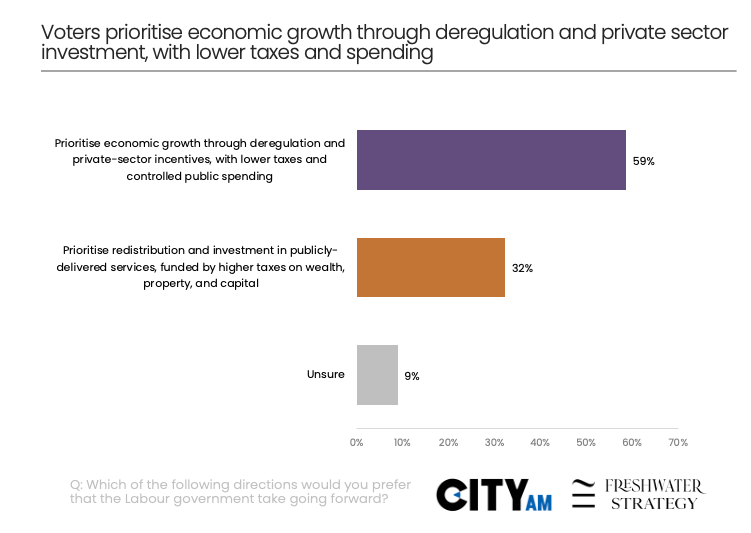
To start, voters want the government to prioritise economic growth, deregulation and lower taxes and controlled spending (59 per cent) over redistribution and investment in public services (32 per cent) – including a majority of Labour voters (55 per cent v 40 per cent).
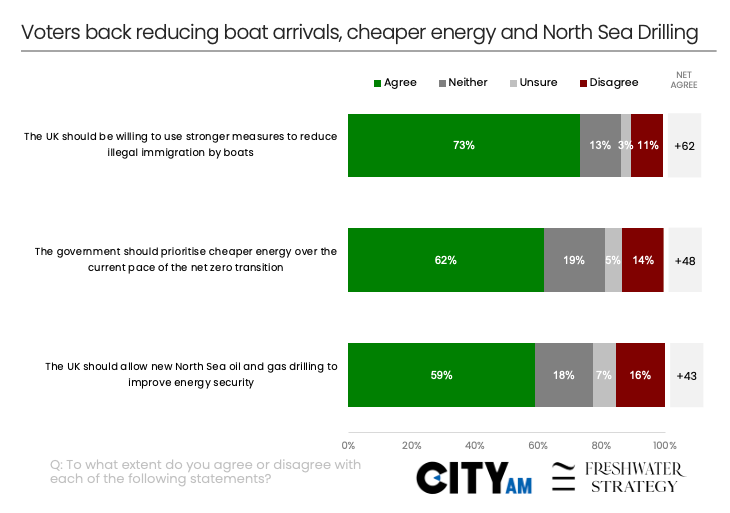
When it comes to many policy issues, notably those where Burnham is taking a rightward turn, even if uncomfortably, there are strong majorities for his shifts, including reducing illegal immigration by boat (NET +62), cheaper energy over net zero (NET +48), and allowing new North Sea oil and gas (+43).
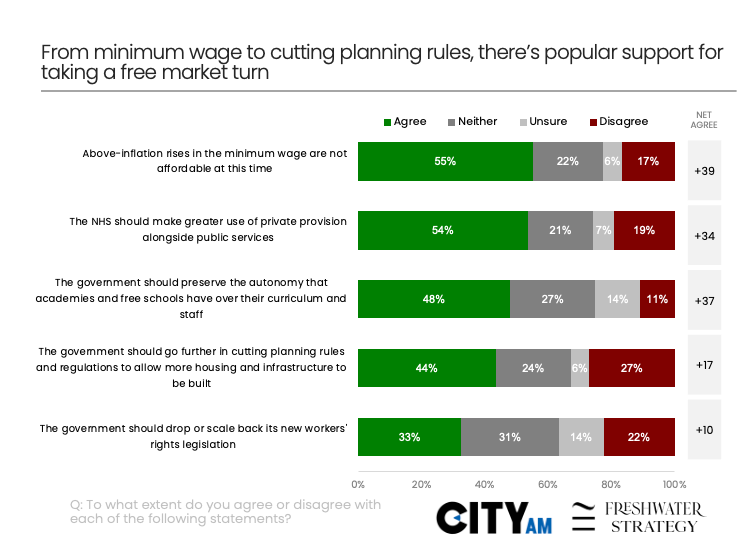
On other issues, from not increasing the minimum wage beyond inflation (+39) through to allowing private provision in the NHS (+34) and cutting planning rules to allow more housing (+17) there is also broad public support – even if we’re yet to see that fully reflected in government policy.
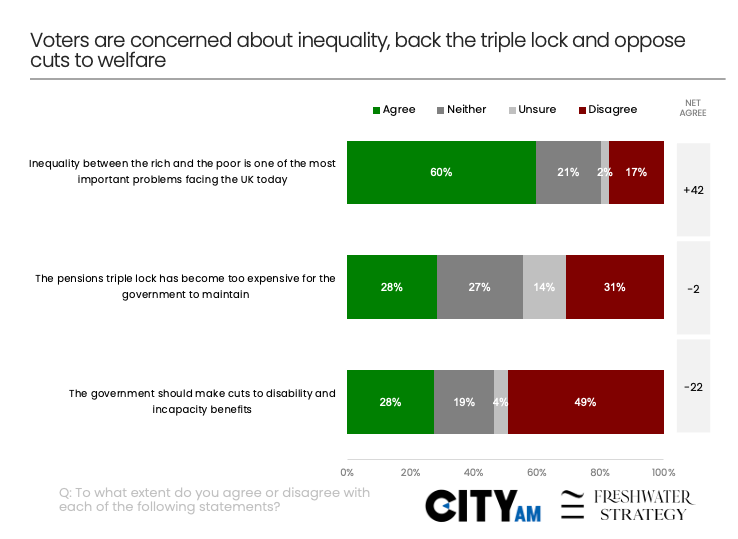
In this business, it’s important to be honest. The public is far from radical free marketers, certainly not on issues such as concern about inequality, continued support for the pension triple lock, and cuts to disability and incapacity benefits.
This could all rapidly shift. We should understand the public’s views on issues like tax-and-spend to reflect a somewhat thermostatic reaction – that is, opinion often shifts in the opposite direction of government policy. During the Tory era, when the perception was that the government was cutting taxes and spending, the public wanted more. Now Labour have come in and put up taxes, the public wants less.
There’s also a lot more to come over the coming months, and a risk that if Labour is not left wing enough, Burnham’s left flank will see through the rhetoric and the Green Party could once again surge, shifting the political calculation. Triangulation often fails, particularly in our emerging multiparty system, with political entrepreneurs from both sides exploiting moderation to call for more radical change. It is also likely to fail in policy terms, lacking the change that’s actually necessary to make Britian prosperous. For now, however, we are getting something a tad unexpected: another centrist in Number 10.