


In today’s newsletter:
Better off out?
Nationalisation doesn’t come cheap
Booming black markets
On Monday, the IEA will launch its new substack, Economic Affairs. With original daily content and a round-up of stories about the state of free markets in the world it will be the only site classical liberals need to read.
We will be running regular columns from some of the titans of the free-market movement, including Matt Ridley and John Redwood, as well as introducing a number of stellar new contributors.
Economic Affairs will be edited by Will Atkinson, one of our finest young writers, formerly of ConservativeHome, a Spectator leader writer and regular Telegraph contributor.
These are challenging times for supporters of limited government. The government has gone from spending one pound in every three at the start of this century to closer to one in two. Debt has risen to 100 per cent of GDP. Taxes are higher than at any moment since the post-1945 demobilisation. Yet most voters think that our problems come from “neoliberalism”, and support spending even more, especially in the budgets that are already growing the fastest: healthcare and social security.
We need to go back to first principles. We need to explain, to a country that has forgotten, why governments run things badly, why only the private sector generates growth, why we cannot return to prosperity without low spending, sound money, light regulation and free trade.
Economic Affairs will be the place, not just to hear these arguments restated, but to find out how they are landing, to learn about the state of classical liberalism in Britain and the world. Please make it part of your daily reading menu.
by Lord Hannan
Director General
The best way to never miss out on IEA work, get access to exclusive content, and support our research and educational programmes is to become a paid IEA Insider.
IEA Podcast: Director of Communications Callum Price is joined by Editorial Director Kristian Niemietz and Director General Lord Hannan to discuss whether Britain is ungovernable, Brexit ten years on, and ask if air conditioning is right wing now? IEA YouTube
How to make Brexit a success
Dr Kristian Niemietz on how to make the most of Brexit, ten years after the referendum:
“Free-marketeers, whether they were on the Leave side or on the Remain side, have always argued that Brexit was only ever going to be a success if it led to genuine economic liberalisations, especially on trade and regulation. A Brexit followed by liberalisations would be an economic success. A Brexit not followed by liberalisations would not be.
“Free-market Brexiteers thought that Brexit was likely to be followed by liberalisations. Free-market Remainers thought that a liberalising Brexit was possible, but unlikely.
“Ten years on, it is fair that there have been some liberalisations, but they have been too timid to cancel out the disruptions caused by Brexit (and the years of Brexit uncertainty). The UK has signed up to some additional trade deals that it could not have concluded as an EU member. There have also been some mild deregulation measures, such as on gene editing, which would not have happened in the EU.
“These are welcome steps, but their impact has been small in magnitude. If we want to see bigger effects, we need to roll out reforms of that style across the board. Free trade and light-touch regulation are the way to make Brexit a (belated) success.”
News and Views
“A good economist sees beyond the visible and the secondary consequences”, Daniel Hannan warns steel protectionism could harm 2.8m construction, 452k agriculture, 183k automotive workers reliant on imports, YouTube
Why my friends talk about leaving Britain, IEA polling on perception of UK prosperity covered in The Times
“Recently, the Institute for Economic Affairs asked 3,000 people to rank our GDP per capita against American states. On average, respondents thought we were as well-off as the seventh American state. It turns out that we’re poorer than all of them.”
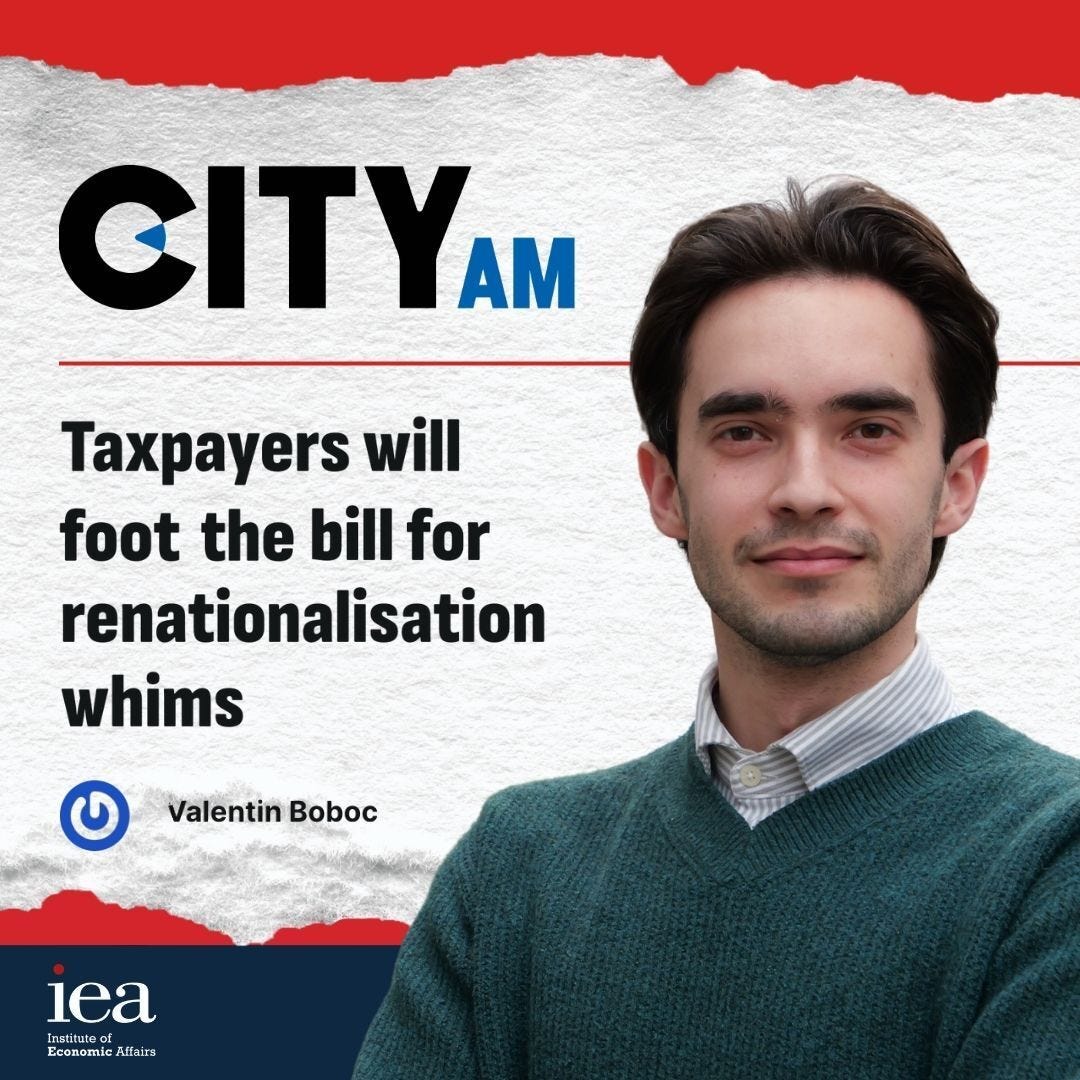
Renationalisation doesn’t come cheap, Senior Economist Dr Valentin Boboc on why the case for nationalisation doesn’t stack up, CityAM
Classics Revisited: Better Off Out?

30 years ago, two IEA authors published the first attempt at a cost-benefit analysis of Britain’s membership of the EU. 10 years after the Brexit vote, the book still works as a ‘Brexit Primer’
“I don’t trust the Government to distinguish misinformation from correct information”, Chris Snowdon on GB News

Tax Rises Built a Black Market. Is Britain Next? Chris Snowdon talks to former Australian Border Forcer official Rohan Pike about the negative consequences of a tobacco crackdown in Australia, IEA YouTube
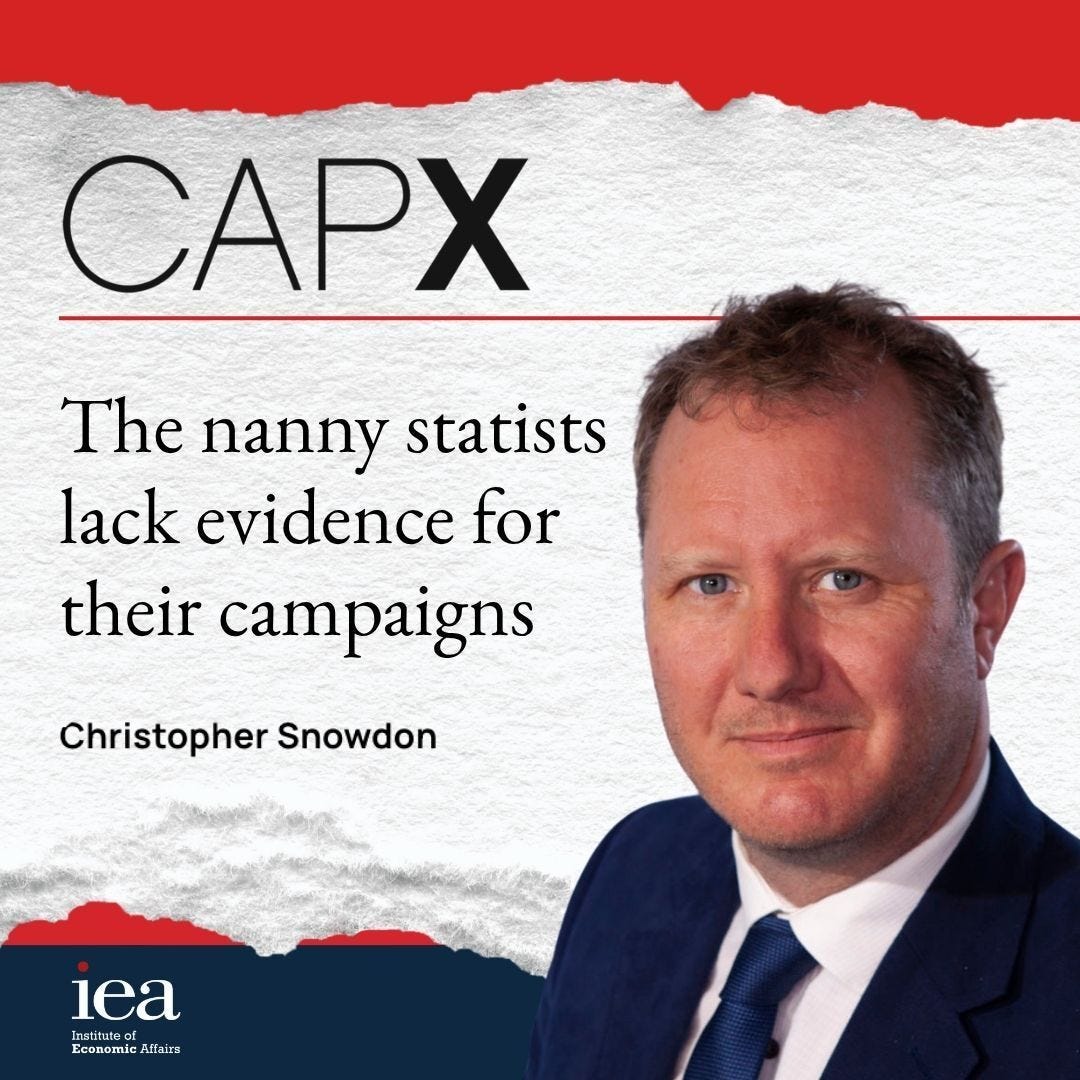
The nanny statists lack evidence for their campaigns, Chris Snowdon on the myth of evidence-based policymaking, CapX
The cost of Net Zero, IEA research on what our environmental commitments are costing us, The Express
“The Institute of Economic Affairs calculates that his net zero madness could top a staggering £9 trillion. British companies are buckling under the weight of some of the world’s most expensive energy costs. They’re either shifting operations overseas or shutting down.”
Events and Opportunities
Applications are open for our 2026 Beloff Conference
We are delighted to invite applications for our 2026 Beloff Conference, a three-day residential programme taking place at the Vinson Centre, University of Buckingham from 14–16 September 2026.
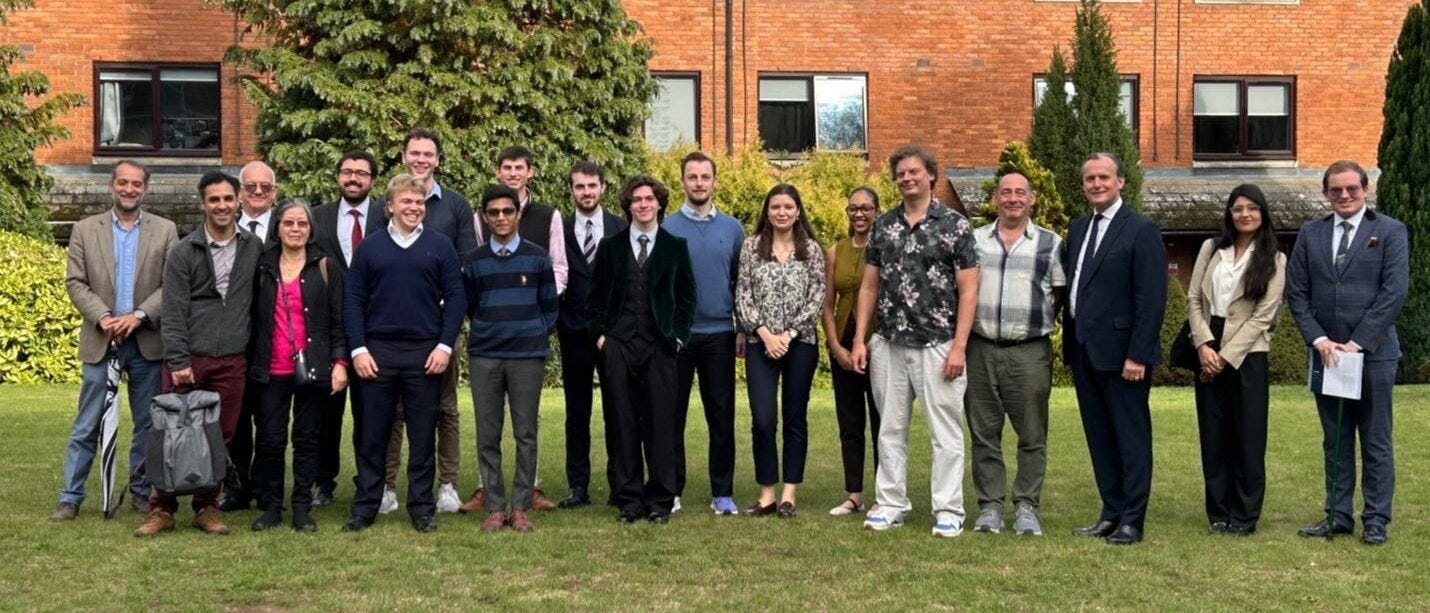
Designed for postgraduate students and final-year undergraduates with an interest in economics, public policy, and classical liberalism, the Beloff Conference brings together some of the brightest young minds for an intensive programme of discussion, debate, and learning.
This year’s programme will explore the topic of Migration. Through an interdisciplinary lens, participants will explore the economic, historical, philosophical, and geopolitical dimensions of migration, engaging with questions surrounding welfare systems, borders, displacement, diasporas, and international relations.
Speakers will include:
Professor Jonathan Portes (Professor of Economics and Public Policy at King’s College London)
Professor Syed Kamall (Professor of Politics and International Relations at St Mary’s University London and Member of the House of Lords)
Professor Eric Kauffman (Professor of Politics at the University of Buckingham and writer)
and many more!
The conference is entirely free to attend, with accommodation and meals provided. Places are highly competitive, with only 15 participants selected.
If you’re looking to deepen your understanding of one of the defining policy issues of our time while engaging with leading academics and fellow students, make sure you apply!
Conference: 14–16 September 2026
Application deadline: 7 August 2026 (23:59)
As a student I subscribed in the to the IEA's Journal of Economic Affairs. In around 1984 it was relaunched in magazine format as "Economic Affairs". I remember FA Hayek proposing to launch a non-government currency called the Standard.
I’ve just listened to your rebrand and got as far as “the private sector gives us growth”. And stopped.
Your assertion that the only way to obtain growth is by private sector profits is totally missing the point! And it tells me you can’t see further than the profit.
Any private sector company would earn a penny if their turnover was nil! Or their turnover was insufficient. Or they set up ‘shop’ and had no customers or consumers or patrons.
This short sighted view of profit over money and flow is exactly what’s got us in this mess.
I’m all for s small state bring less friction less intervention. But it can’t be small or nothing we need would get done.
I’m all for earning as much as we or you can but unless you accept the realisation that customers and consumers have to have money and the willingness to SPEND that money before turnover can be established your blinkering your view and the truth of the matter in hand!
My Lord, you have to accept that the SPENDING of the government’s £1.5 trillion pounds each year just has to have an impact on the profits and turnover of the private sector!? Surely you can see that??
If it essentially for that amount of yearly Spending by government the private sector wouldn’t have any new money to maintain itself let alone grow!??
I keep telling you in my reply’s that it’s not entrepreneurial brilliance that gives growth. It’s much more simple! It’s the velocity and autonomous flow of money itself that gives us the money to turnover and profit from!
You’re putting the elaborate golden coach before the knackered horse! No wonder you can’t see an answer!
No wonder all you can think of is a smaller state, cuts and balancing the insufficient tax funds to a spending amount! You just don’t get it do you!!??
You can’t get growth from cuts! You can’t get growth from a smaller government SPENDING. And a free market is only going to run if money is in the hands of customers who will spend it!
You are blind to the fact that money is key, lots of money, lots of new money has to be SPENT faster and in a smaller time period than now to grow at all!
Honestly no wonder you never reply to my messages if this is the highest form of thought you can achieve!?
I wanted to engage with you all as I’m a free marketeer and I’m all for less friction. But unless you can see more money had to flow faster and in more weight throughout our hands both private and public sectors then I’m sorry but you’re wasting everyone’s time! Including your own.
No wonder you can’t give the answers to get us out of trouble! If you can’t see the problem that’s causing it just the problems you see on face value then you’re not the thinkers I assumed you were.
Look, of course government SPENDING of £1.5 trillion a year has an impact! And if you lower that then you’re lowering growth even further.
Now, new money isn’t all new money! Most can be existing money that’s not being SPENT by those who have it! And those who have it might not be just in the private sector!!!!!
An awful lot of existing money, not SPENT is in the hands of those in the public sector. In pension funds and wealth funds and banks. But so too is the money UNSPENT in the hands of the private sector not being SPENT in our daily economic productive economy that pays taxes!
That economy is devoid of the money of both private and public sectors where money sits UNSPENT idle unused and hoarded. In banks and wealth funds pension funds and tax havens here and abroad.
So my ‘new’ money isn’t new at all! Just new because it’s not being SPENT in our productive economy.
For goodness sake will you stop with this stupidity.
Our economy is devoid of vast sums not being SPENT. Where to obtain growth we need more money bring SPENT not missing in action!
Come on, start engaging in my effort to get you to see a way out of this mess!
We’re not short of money. We’re just not using enough of it to turnover sufficient amounts to pay sufficient tax for government to have surpluses not deficits!
It’s not rocket science. It’s piggyback economics. You can only get out what you put in. But if we are in a system that allows money to be withheld and not SPENT and the system doesn’t even tax unspent money then, you will never see a path out of this biblical size hole we are digging ourselves in.
For any economy to work at its optimum it needs all its money bring SPENT not an insufficient amount. And I’m not just talking about public Spending oh no! I’m talking about private sector too. All money has to be constantly rotating non stop exchanging of money for work effort for their to be growth!
To say it’s just the private sector that gets growth tells me you haven’t a clue.