


Dr George Maher F.I.A. is an actuary and a classicist. He is the author of Pugnare – Economic Success and Failure, which uses the Roman Empire as a parable for our times.
Thirty years ago Lloyd’s of London, a three-hundred-year-old British institution, was on the brink of collapse. Had people not acted then as they did that market would now no longer exist, the City of London would be much diminished and the world a poorer place.
Lloyd’s of London emerged in the late seventeenth century - as did the Bank of England and banks such as Hoare and Co. A new commercial spirit animated the place after the Glorious Revolution, and as Britian became increasingly prosperous. Rich landowners needed an outlet for capital generated by their ever more productive rural estates. These and other wealthy individuals joined together in syndicates to risk their capital on the insurance of shipping ventures. If the ship sank they paid and if not the profit was the premium they had collected. It was an opportunity for entrepreneurial talent, for those who delighted in assessing risks, negotiating terms and prices and waiting to see what might happen. Exit mechanisms were devised. An investor (called a ‘Name’) who wanted to leave could sell his remaining risks on ships whose voyages were not complete.
A market which helped British maritime trade to flourish in the nineteenth century contined to innovate in the twentieth century. When the motor car and air transport began to be widely used, insurance for those novel risks was invented. There is a type of person who enjoys solving a new problem, and profiting from the solution. They were to be found at Lloyd’s, then and now. Reputation matters and is built. In 1906 large parts of San Francisco were destroyed by earthquake. North America insurers, competitors of Lloyd’s, were reluctant to pay but Cuthbert Heath, the Lloyd’s underwriter, telegraphed his agent in California: “pay all policyholders in full, irrespective of the terms of their policies”. Lloyd’s of London paid.
Things started to change from about the 1970’s and increasingly into the 1980’s. A new generation had entered Congress, a generation motivated to fix the environmental damage caused by US industrial expansion. Legislation was enacted which required companies to clean up sites for whose pollution they were now to be held liable. As the cost of removing waste and restoring sites increased some companies went bankrupt and all sought to claim on their insurance policies. Class actions and novel legal theories as to how claims should be allocated began to push costs towards Lloyd’s, and onto policies which had been issued well before the legislation was enacted. Year in year out new sites to be cleaned up were identified, new potentially responsible parties were found. The costs of cleaning up sites went up relentlessly, as did the claims.

Other problems were emerging. The industrial expansion had benefitted from the superb insulation properties of asbestos but a single indestructible fibre lodging in the human lung was found to cause death, sometimes years later. Asbestos injury claims now started to come to Lloyd’s. Contested theories as to dates of causation and allocation of responsibility generated long and costly legal disputes. In some cases when settlement was eventually reached more than half the money went to cover plaintiff and defendant’s costs, with the balance left over for the injured parties. Estimates of how much might ultimately need to be paid by Lloyd’s on these claims continued to increase, and never decreased. Other problems emerged. Underwriting discipline in some parts of the market had weakened generating further substantial losses. The occurrence of a string of natural and man-made catastrophes added to the pain.
Year in year out more money needed to be found for policies written long ago. The market reacted in 1985 by imposing asbestos and pollution exclusions and some exceptional Lloyd’s syndicates were established after that date. But the losses on the old years kept coming. The total losses from 1988 to 1992 came to £16 billion, and still there was no end in sight.
The problem had become existential. No final estimates were being produced for these losses. Hardly anybody looking to leave the market could find someone - to take on their residual liability. There was no way out and nothing to look forward to except another bill every year, and no way to guess how much the next one might cost.
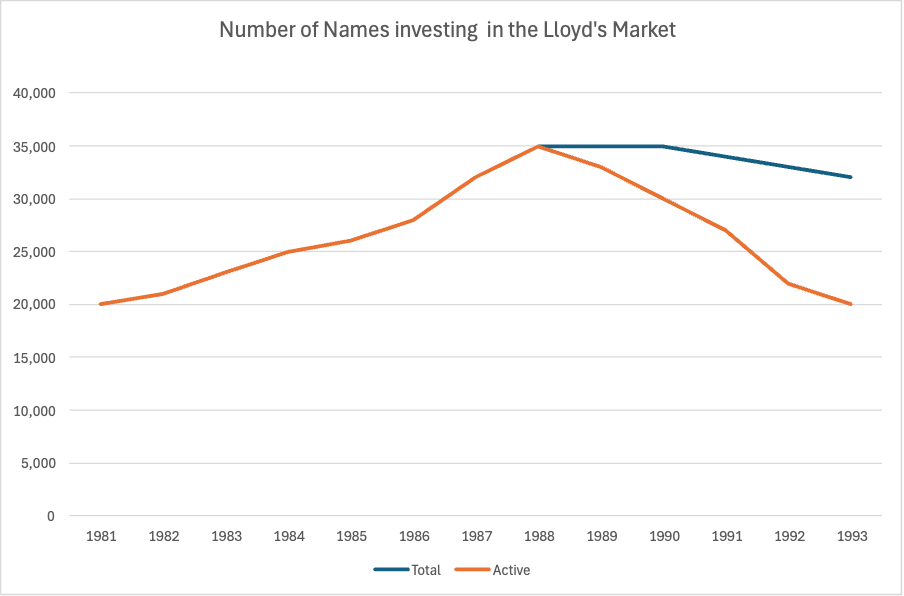
The following graph shows the total number of Names at Lloyd’s, and the number of active Names - those continuing to write business. The difference is the number of Names who want out, but cannot leave. The number of active Names went into sharp decline. It became close to impossible to recruit new Names.
Some of the problems were of Lloyd’s own making. Lloyd’s had expanded in the 1980’s by admitting Names who did not have knowledge of the industry or sufficient finances, unlike the original investors in the seventeenth century. Lloyd’s admitted Names who did not treat their participation as an investment but rather spent the profits received each year.
Faced with the continuing losses and the failure of previous piecemeal attempts to solve the problem a Task Force was established under Sir David Rowland with strategic advice from McKinsey. Among the Task Force’s many recommendations were that the cost of the old liabilities was now to be finally faced up to, and those liabilities were to be transferred out of the market. In addition, others besides Names were to contribute, those who had advised Names on whether to enter the market or not, for example.
The estimation of the liabilities fell to the international firm of consulting actuaries, Tillinghast Towers Perrin, now part of Willis Towers Watson. A team was formed which included leaders in the developing of methods for estimating asbestos liabilities, pollution liabilities, who had a deep understanding of the London insurance market and whose approach was to first understand the business, identify the key components of the problem and only then do the numbers. It was an international team of actuaries who knew each other personally and routinely worked together. At some stages over half the firm’s property casualty actuaries were involved in the project in one way or another. It was – and still is – the largest actuarial exercise ever undertaken.
I was part of that team and what I most remember from that time is what I saw. I saw people who had grown up in this market, many of whom had long made their fortune and for all of whom the survival of the market mattered. If a problem emerged a solution was to be found, and a great pool of talent was drawn on: claims handlers, underwriters, brokers, lawyers, accountants, actuaries, bankers, consultants and others. I saw the collective brain of the City of London in action. If something needed to be done then it was done. The iconic building of Lloyd’s was sold, and then leased back. Arrangements were made to admit companies to the market, to write business alongside the wealthy individuals who traditionally were members. Membership was now to include companies, some of which were longstanding competitors of the market. These new members were to be insulated from the problems of the past.
All of this mattered. But what also mattered was something else. Luck. Other insurers had written the same liabilities as Lloyd’s of London, and had suffered the same problems, but they had failed; they had had insufficient resources to meet Tillinghast’s estimates of their ultimate liabilities. Companies which were once dominant players are now long forgotten names. Lloyd’s, however, could meet its liabilities and on the 4th September 1996 funds were transferred to a newly formed company, Equitas; the reserves accumulated by syndicates over decades, additional contributions by Names to achieve finality, contributions from market advisers and from the Corporation of Lloyd’s.
The break from the past liberated the market. No longer at results time were there endless questions to underwriters about the deterioration in claims which long predated their entry into the market. They could concentrate on the inevitable problems of today’s business, and the opportunities. Equitas become a centre of excellence in managing the problems of the past. In 2009 under the terms of a new Act of Parliament the connection between the Names and these liabilities was finally severed through novation. All valid claims have been paid, and continue to be paid.
The market survived and is stronger – and substantially larger – than it was before. It was a tremendous transformation, and it did not happen lightly.
A remarkably bowdlerised account of the near-collapse of Lloyds. As is well known, a generation of names was defrauded.