


Ebeling in Brief is a weekly series, published every Saturday, of shortened chapters from economist Dr Richard M. Ebeling’s Liberty and the History of Economic Ideas: From the Ancients to the Austrian Economists (2026).
This is instalment No. 3: Frédéric Bastiat
Dr Richard M. Ebeling is an American libertarian author who was the president of the Foundation for Economic Education from 2003 to 2008.
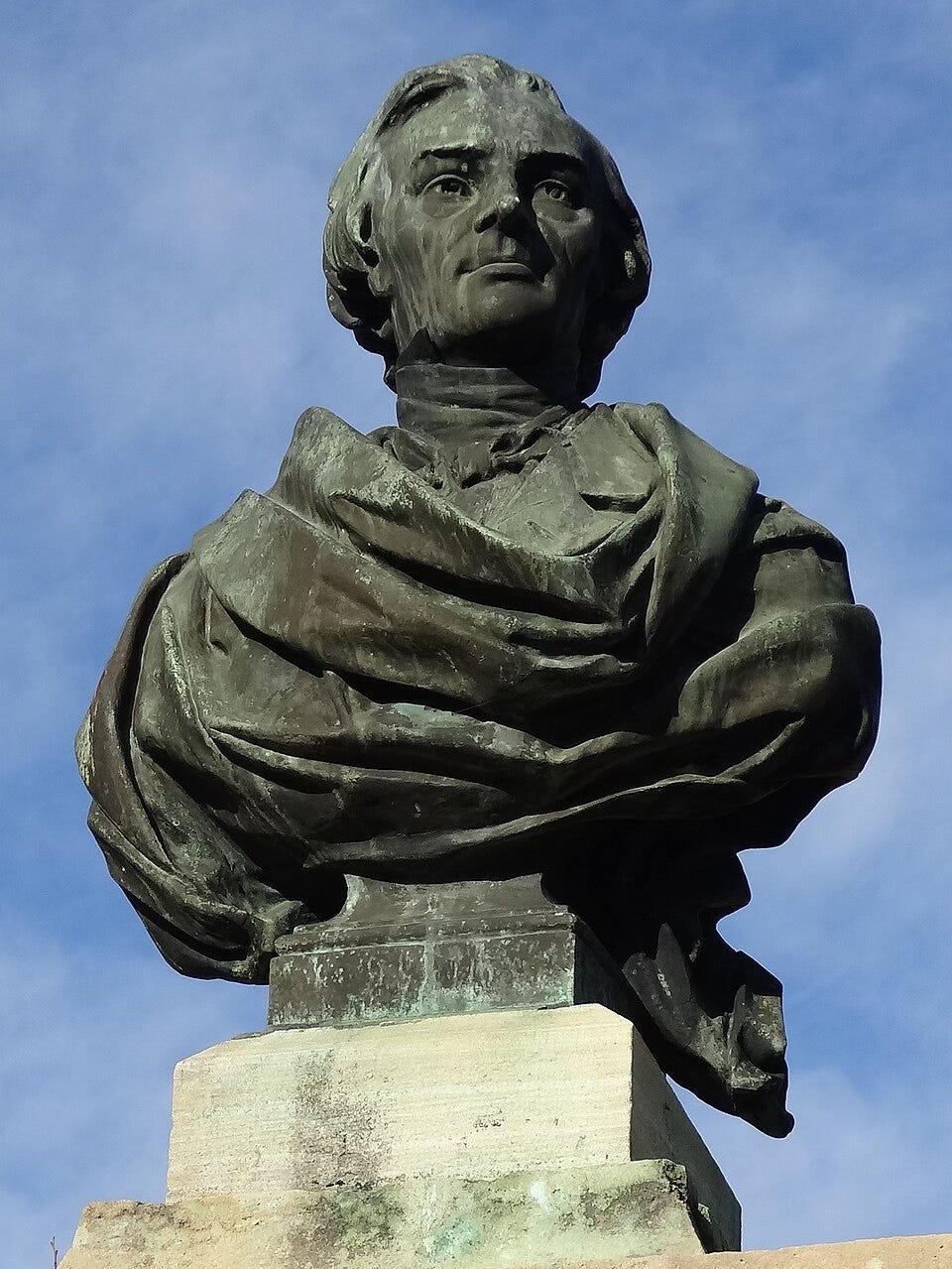
The defence of economic liberty has never been an easy task. In the nineteenth century, however, there was one champion of personal freedom and the free market who mastered the art of making the complexities of economic reasoning understandable to the layman: the French classical-liberal economist Frédéric Bastiat. More than one historian of economic thought has emphasised Bastiat’s special abilities in undermining the rationales for protectionism, socialism and interventionism.
Other authors have modelled some of their own works after him. And surely the most famous and influential adaptation of Bastiat’s method and approach in the twentieth century was Henry Hazlitt’s (1894–1993) Economics in One Lesson(1946), in which the author said, “The present work may, in fact, be regarded as a modernisation, extension and generalisation of the approach found in Bastiat’s pamphlet”, known by the title “What Is Seen and What Is Not Seen”.[1]
Bastiat’s Life and Discovery of the Liberty Literature
Claude-Frédéric Bastiat was born on 30 June 1801 in Bayonne, France, the son of a prominent merchant. His mother died when he was seven years old, and his father passed away two years later, when Frédéric was only nine. He was brought up by an aunt, who also saw to it that he went to the College of Sorèze beginning when he was 14. But at 17, he left without finishing the requirements for his degree and entered his uncle’s commercial firm in Bayonne. Shortly afterwards, he came across the writings of the French classical-liberal economist Jean-Baptiste Say, and that transformed his life and thinking. He began a serious study of political economy and soon discovered the works of many of the other classical-liberal writers in France and Great Britain.
In the late 1820s and 1830s, he began writing monographs and essays on a variety of economic topics, but his real reputation as a writer began in 1844, when he published a lengthy article in defence of free trade and then a monograph on Cobden and the League: The English Movement for Free Trade. While writing these works, Bastiat began a correspondence with Richard Cobden, one of the primary leaders of the British Anti-Corn Law League, the association working for the repeal of all barriers to free trade. These two proponents of economic freedom became fast friends, supporting each other in the cause of liberty.
Following the revolution of February 1848, Bastiat began a career in politics, serving first in the French Constituent Assembly and then in the Legislative Assembly. Having devoted most of his previous writings to demonstrating the fallacies in the arguments for protectionism, Bastiat turned his attention to a new enemy of economic liberty: socialism. In the Legislative Assembly, he delivered powerful speeches against public-works programmes, guaranteed national-employment schemes, wealth-redistribution proposals, nationalisation of industry and rationales for the expansion of bureaucratic controls over social and economic life. But because of a worsening tuberculosis that weakened his voice, he turned to the written word, producing a large number of essays detailing the absurdities in the arguments of the socialists.
He died in Rome on 24 December 1850, at the age of 49.[2]
The Law of Liberty versus the Politics of Legalised Plunder
Bastiat is perhaps most famous for an essay entitled “The Law”, which he wrote shortly before his death in 1850. He asked, “What, then, is law?” He answered that it is to protect every individual’s natural right to his life, liberty and honestly acquired property.
The purpose of government and the law, therefore, is to prevent and punish “illegal plunder”, that is, the wrongful taking of another man’s property (including his life). Thus, the role of the law is to uphold morality and justice, because it is both immoral and unjust to violate another man’s right to his life, liberty and honestly acquired possessions. He argued, however, that the law can be “perverted”. Instead of protecting people from the plundering of others, the law can be used to serve the act of plundering, what he called a system of “legal plunder”.
Bastiat argues that there are three ways of organising the political system of a society: either the few plunder the many, the many plunder the few or attempt to plunder each other, or no one plunders anyone else, under a system of protection for everyone’s right to their own honestly acquired property. Under the rule of absolute kings, favours and privileges at the expense of others were given to those who were close to and could influence the economic policies of the monarch. It was a system of political plunder by a few at the expense of the many in society.
But under democracy, the process of political plunder has been democratised, Bastiat warns. Now all groups in society use their voting power in an attempt to lobby and influence those holding political office to grant them favours and privileges at the expense of other individuals and groups, who are also attempting to do the same. Thus, Bastiat concluded that in the democratic society, the government becomes a great fiction through which everyone tries to live at the expense of everyone else. The cumulative consequence of this is a vast waste of resources and wealth in the competition for political favours, rather than the production of useful goods and services to sell to consumers on the market.
The Sources of Legalised Plunder: Robbery and Wrong-Headed Charity
Bastiat believed that there were two primary ideas behind the establishment of legalised plunder: the first was “stupid greed”, by which Bastiat means that some desire to obtain the wealth of others that they find themselves unable to acquire through the open, honest competition of the marketplace. Hence, individuals and groups lobby those with political power for trade protections from more efficient foreign competitors, anti-competition regulations that restrict domestic rivals in their part of the market and government subsidies to cover costs of production that consumers are unwilling to pay because they do not value the goods these producers offer on the market.
The second was “false philanthropy”, by which Bastiat means those who believe that they know what is good for people and therefore want to use government to create economic outcomes different from what they might have been if people had been left alone to make their own choices and spend their own money as they thought best. Thus, some in society lobby and try to influence government policy to redistribute income and wealth by taxing one segment of society and giving it to others in that society, for example, and taxing people to undertake spending projects for public education, support for the arts, public-works projects or charity work.
Bastiat calls for the end to all forms of political and legal plunder. In its place, there should be a system of liberty in which all have the same individual rights, protected by law and government, not violated and abused by government.
What Is Seen and What Is Not Seen in Economic Understanding
Another famous essay of Frédéric Bastiat’s is “What Is Seen and What Is Not Seen”. In it, he argues that too often people see and appreciate only the immediate or “present” effect of an event or action and do not consider the longer-term or more indirect and less immediate consequences.
He considers this to be especially true when analysing various types and forms of government policy. He first explains this in terms of what he calls the “broken-window” fallacy. A young boy throws a brick through the plate-glass window of a bakery store. At first, a crowd of people form and criticise the destructiveness caused by the young vandal. But then someone in the crowd says, “Well, yes, this is a misfortune for the store owner, who has to pay to replace the broken window. But think of the extra work for the glazier and the jobs for those in the glass-window industry who will be hired and will increase their spending with the income they earn.”
But what is not seen, says Bastiat, is that the store owner and the society in general are made poorer due to this destruction. If the window had not been broken, the store owner might have spent the replacement money instead on buying a new oven to add to the production and supply of bread available to consumers in society. Or he might have bought a new coat for his wife or new shoes for his daughter, which would have generated employment and income in the clothing or shoe industries.
Either way, the store owner and society would have had the window and these other goods, all of which also would have created employment and income for those making these different things. Instead, the owner and society have to use scarce resources just to produce what they already had (a window), and, thus, economic improvement is delayed or prevented.
The Good vs the Bad Economist: The Long-Run vs the Short-Run View
The hallmark of clear-thinking economists, therefore, is whether they include and carefully weigh the longer-run consequences from various short-run policies that may be advanced:
“In the economic sphere an act, a habit, an institution, a law produces not only one effect, but a series of effects. Of these effects, the first alone is immediate; it appears simultaneously with its cause; it is seen. The other effects emerge only subsequently; they are not seen; we are fortunate if we foresee them.
There is only one difference between a bad economist and a good one: the bad economist confines himself to the visible effect; the good economist takes into account both the effect that can be seen and those effects that must be foreseen.
Yet this difference is tremendous; for it almost always happens that when the immediate consequence is favourable, the later consequences are disastrous, and vice versa. Whence it follows that the bad economist pursues a small present good that will be followed by a great evil to come, while the good economist pursues a great good to come, at the risk of a small present evil.”[3]
Bastiat was a master at demonstrating the absurdities in the thinking of those who turned to the state for favours and privileges. In a famous example, he imagines the candlestick producers calling for the government to prohibit the unfair competition of a rival who offers illumination for a good part of the day for free! They want the government to command everyone to shutter their windows during the daytime to prevent the sun from supplying that free lighting they cannot match. That way, day or night, the public will have to buy their candles to provide lighting in their homes and places of business. Just think of all the extra jobs that would be created!
Bastiat’s Legacy
Historian of economic thought Sir Alexander Gray said of Bastiat, “No one has ever been quite so skilful in making the case of his antagonist look extremely foolish. Even now his most ephemeral work remains a joy to read, by reason of its wit, its merciless satire and the neatness with which he pinks his opponents”.[4]
Those qualities led Joseph A. Schumpeter to call Bastiat “the most brilliant economic journalist who ever lived”,[5] and Ludwig von Mises praised him as a “brilliant stylist, so that the reading of his writings affords a quite genuine pleasure. . . . His critique of all protectionist and related tendencies is even today unsurpassed. The protectionists and interventionists have not been able to advance a single word in pertinent and objective rejoinder”.[6]
Even though more than 175 years have passed since Frédéric Bastiat’s death, there are few writers on economic topics who remain as readable or relevant to the issues of our own day. Anyone interested in the issues of liberty and prosperity can do no better than discover, or rediscover, the essays of this master of economic insight and wit.
[1]Henry Hazlitt, Economics in One Lesson (New York: Harper & Brothers, 1946), ix.
[2]Dean Russell, Frédéric Bastiat: Ideas and Influence (Irvington-on-Hudson, NY: Foundation for Economic Education, 1965); George Roche, Frédéric Bastiat: A Man Alone (Hillsdale, MI: Hillsdale College Press, 1977).
[3]Frédéric Bastiat, “What Is Seen and What Is Not Seen”, in Selected Essays on Political Economy, trans. Seymour Cain, ed. George B. de Huszar (Princeton, NJ: D. Van Nostrand, 1964), 1.
[4]Alexander Gray, The Development of Economic Doctrine: An Introductory Survey (London: Longmans, Green, 1931), 244–45.
[5]Joseph A. Schumpeter, History of Economic Analysis (New York: Oxford University Press, 1954), 500.
[6]Ludwig von Mises, Liberalism: The Classical Tradition (Indianapolis, IN: Liberty Fund, 2005; first published 1927), 155.