



Dr Valentin Boboc is Chief Economist at the Institute of Economic Affairs.
Britain’s public finances have deteriorated since March. The Government now faces even higher borrowing and debt interest. I compared the Office for Budget Responsibility’s March and October 2026 forecasts to better understand how the Government’s underlying economic assumptions have changed. Here are five key observations.
1. Borrowing falls more slowly
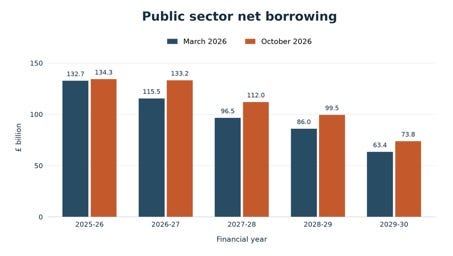
Compared with its March forecast, the OBR now expects borrowing to be £17.7bn higher in 2026-27, £15.5bn higher in 2027-28 and £13.5bn higher in 2028-29. That is £46.7bn more borrowing over three years than was forecast just seven months ago.
There is still an annual improvement in public sector borrowing, but from a worse starting position. Most of the upward revision comes from changes in the underlying forecast, but some increases can be attributed to new policy decisions. Lesson one is that public finances are hard to fix if the Government is tempted to keep making new spending commitments.
2. Growth predictions are down
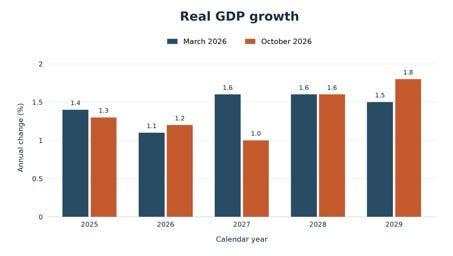
The most interesting discovery is that the OBR has cut its 2027 growth forecast from 1.6 per cent to 1 per cent, with the economy’s projected size in 2029 staying around 0.2 per cent below March’s forecast.
Whilst the OBR’s forecast was finalised before the latest GDP figures were published, it’s important to note that weak growth means that the large national debt becomes more difficult to manage in the short and medium term.
3. Real wages are poised to decline
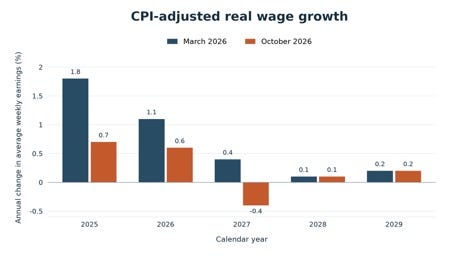
Real wage growth in 2026 is now projected to be just 0.6 per cent compared to the 1.1 per cent prediction made in the March forecast. To make things worse, real wages are set to decline in 2027 and then flatline between 2028 and the end of the Parliament.
Current policies, such as successive minimum wage increases and the Employment Rights Act 2025, have created a very cool labour market, and now living standards are predicted to stagnate for the foreseeable future. Youth unemployment is at its highest since 2011, mirroring the aftermath of the Great Financial Crisis. The biggest lesson to remember here is that a highly inflexible labour market could delay economic recovery (assuming that even is on the horizon).
4. Debt interest is a hard constraint on future governments
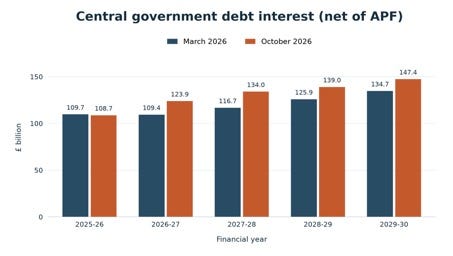
Britain is currently caught in a vicious “chain” in which debt interest crowds out Government spending, which, in turn, crowds out private spending. This pincer movement will continue to erode consumer wellbeing until we get serious about fiscal consolidation.
The worst-case scenario is a debt default forcing the country into a very harsh consolidation programme. Outside that scenario, this is a question of how abrupt and how harsh we want balancing the books to be, with the observation that the earlier we act, the less disruptive this will be.
5. The current Budget surplus is set to arrive later
Perhaps the one fact binding together all previous Budgets is that each new Budget delays balancing the books by one more year. Most Budgets also delay unfreezing various tax thresholds and either add or take twopence off a pint of beer in the pub.
Gilt markets are uneasy about British debt in particular because Britain has failed to commit to a credible programme of fiscal discipline. What discipline there is has been incidental rather than planned, and given that successive governments have pushed back the promised current Budget surplus by a year at every fiscal event, the gilt markets understandably refuse to believe it will ever happen.
Given the pressure that growing debt interest puts on government spending, and a Government willing to spend more, it’s no wonder that other think tanks have also predicted painful years ahead.
The most distressing thing about the chart below is that – much like the gilt markets – I find it hard to believe a surplus will be achieved at any point by the end of this Parliament. Happy to be proved wrong, though.
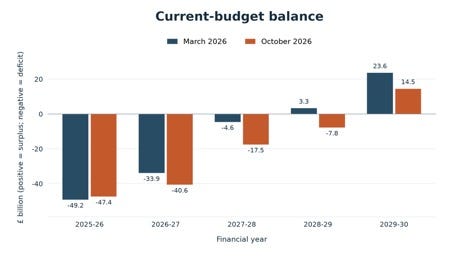
All charts sourced from: OBR, Economic and fiscal outlook, March and October 2026