


Ebeling in Brief is a weekly series, published every Saturday, of shortened chapters from economist Dr Richard M. Ebeling’s Liberty and the History of Economic Ideas: From the Ancients to the Austrian Economists (2026).
This is instalment No. 4: David Ricardo
Dr Richard M. Ebeling is an American libertarian author who was the president of the Foundation for Economic Education from 2003 to 2008.
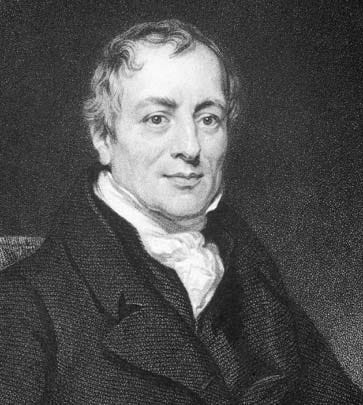
David Ricardo (1772–1823) was one of the most influential economic theorists of the first half of the nineteenth century. He was born in London, England; his father’s family were Orthodox Jews originally from Portugal who had moved to England from Holland. His father was a highly successful stockbroker. David Ricardo learned the family business and most likely would have inherited it from his father, but he fell in love with an English Quaker, converted from Judaism to Christianity, and at the age of 21 eloped without his family’s knowledge.
His father disowned him, and his mother never spoke to him again. He had to go out on his own and set up his own brokerage company. He soon showed himself to be an expert at all financial and brokerage dealings. He made a fortune dealing in British government securities during Britain’s long war with France and then retired in his early forties to an estate in the English countryside.
Ricardo became interested in economics when he read Adam Smith’s The Wealth of Nations during a holiday in 1799. He began writing on economic topics in 1809 and published a series of articles and a monograph on the causes of inflation in Great Britain that gained him wide acclaim.
The publication of The Principles of Political Economy and Taxation in 1817 soon established his permanent reputation as one of the leading economists in the world. He also served as a member of the House of Commons in the British Parliament from 1819 until his death in 1823, when he was 51 years old.
War, Government Debt and Paper-Money Inflation
Ricardo’s reputation as an economist emerged out of his writings during the long war that broke out between Great Britain and Revolutionary France in 1793 and continued until 1815, when Napoleon was defeated in the Battle of Waterloo in Belgium.
The British government’s war costs increasingly grew to cover the expenses of its own fighting forces, and at various times, it also subsidised war expenditures of other European countries that were also fighting France. By 1797, the British government was covering over 70 per cent of its expenditures with borrowed money from the Bank of England, a private bank with the “privilege” of having a monopoly on issuing banknotes in Great Britain.
The Bank of England supplied the necessary loans by the issuance of increasing amounts of banknotes. As the government spent the banknotes, the paper money passed into the hands of people in the private sector, who in turn proceeded to spend it on desired goods and services. Prices began to rise, resulting in a growing demand to redeem the banknotes for gold from the Bank of England by people wishing to either hoard valuable gold rather than hold depreciating paper money or to export gold to buy less expensive goods from other countries.
Fearing insolvency, or even eventual bankruptcy, the Bank of England said it could no longer extend loans to the government under these conditions.
As a consequence, the British government passed the Restriction Act of 3 May 1797, freeing the Bank of England from redeeming banknotes for gold. The banknotes, therefore, were no longer claims to gold previously left on deposit by bank customers but were still de facto legal tender: irredeemable paper money.
The Restriction Act of 1797 remained in effect until 1 May 1821. During the remaining war years, the government continued borrowing from the Bank of England, and between 1797 and 1801, the quantity of Bank of England notes in circulation had almost doubled, from 9.7 million to nearly 17 million. The value of the paper pound fell nearly 10 per cent against gold, while the foreign-exchange rate of the paper pound lost more than 13 per cent of its value.
The supply of Bank of England notes continued to expand until 1817, two years after the defeat of Napoleon and the end of the wars with France, when it reached nearly 30 million, three times the money supply 20 years earlier when the Restriction Act had been imposed. The Bank of England notes reached their greatest loss of value against gold in 1813, when the paper pound decreased by 36 per cent, and its foreign-exchange value fell by 30 per cent on the Hamburg exchange market. The gold and foreign-exchange value of the paper pound returned to near par value only in 1819.[1]
Controversies Concerning the Cause of Inflation
From the time of the Restriction Act of 1797 to the Resumption Act of 1819, a great debate went on in Great Britain about the causes of the depreciation of the paper pound and the rise in prices. On the one hand, the officials of the Bank of England and its supporters insisted that the price inflation had nothing to do with the issuance of banknotes to cover the government’s war borrowing. They insisted that the paper pound’s fall in value was instead due to a shortage of goods caused by the war; speculators betting against the pound in terms of Great Britain winning the wars with France; and the demand for foreign goods, which created a “premium” on gold and other currencies relative to the paper pound.
On the other hand, there were those who traced the fall in the paper pound’s value precisely to the increase in the quantity of Bank of England notes in circulation. They argued that the increase in the banknote supply put upward pressure on domestic prices, which resulted in greater profitability from importing less expensive foreign goods. At the same time, greater amounts of paper pounds were offered for either gold (to hoard or illegally export) or for foreign currencies in whose monies goods could be purchased in other countries for import into Great Britain. Hence, the increased quantity of paper pounds caused prices to rise at home and the paper pound to lose value against gold and other currencies on the foreign-exchange markets.
Ricardo on the “High Price of Bullion”
Ricardo took the side of those who argued that the price inflation had its origin and cause in the expansion of the banknote money supply to cover the British government’s war expenditures. In 1810, he published his famous essay, “The High Price of Bullion”, in which he explained the workings of the inflationary process:
“If a bank were established, such as the Bank of England, with the power of issuing its notes for a circulating medium; after a large amount had been issued, either by way of loans to merchants or by advances to Government, thereby adding considerably to the sum of the currency, the effect [would be that] . . . the circulating medium would be lowered in value, and goods would experience a proportionate rise.[2]
[….]
“Parliament by restricting the Bank from paying in specie, have enabled the conductors of that concern [the managers of the Bank of England] to increase or decrease at pleasure the quantity and amount of their notes; and the previously existing checks against an over-issue [i.e., gold redemption on demand] having been thereby removed, those conductors have acquired the power of increasing or decreasing the value of the paper currency. . . . There can be no limit to the depreciation which may arise from a constantly increasing quantity of paper.”[3]
Ricardo on the Importance of Private Property in a Free Society
Private property and private enterprise were the foundations of a prosperous society. Explained Ricardo:
“The quantity of employment in the country must depend, not only on the quantity of capital, but upon its advantageous distribution [among alternative productive uses], and above all, on the conviction of each capitalist that he will be allowed to enjoy unmolested the fruits of his capital, his skill, and his enterprise.
[….]
“To take from him this conviction is at once to annihilate half the productive industry of the country, and would be more fatal to the poor labourer than to the rich capitalist himself.”[4]
[1]Edwin Cannan, ed., The Paper Pound of 1797–1821: A Reprint of the Bullion Report (London: P. S. King, 1919), vii–xlvi; Edwin W. Kemmerer, Money: The Principles of Money and Their Exemplifications in Outstanding Chapters in Monetary History (New York: Macmillan, 1935), 198–229.
[2]David Ricardo, “The High Price of Bullion” (1811 edition), in The Works and Correspondence of David Ricardo, vol. 3, Pamphlets and Papers, 1809–1811, ed. Piero Sraffa (Cambridge: Cambridge University Press, 1951), 54–55.
[3]Ricardo, “The High Price of Bullion”, 75; 78.
[4]David Ricardo, “Observations on Parliamentary Reform” (1824), in The Works of David Ricardo, with a Notice of the Life and Writings of the Author, ed. John R. McCulloch (London: John Murray, 1888), 555.