


This article grew out of James Turk’s talk at the IEA’s Food for Thought session on 27 October, which drew on his paper in the IEA’s academic journal Economic Affairs.
James Turk is the founder of Goldmoney Inc. and the author of several books on money and gold.
For decades Westminster has treated the housing crisis as a problem of bricks and mortar. The script never changes. Ministers promise building targets, the Opposition demands more social housing and councils quarrel over planning. Thousands of pages later, the housing ladder is still out of reach for a generation.
That is because the diagnosis is wrong. Britain does not have a housing crisis. It has a money crisis.
House prices have outrun wages for 30 years. Planning delays alone cannot explain that. Too many pounds can.
More than a decade of ultra-low interest rates and quantitative easing, from 2009 to 2022, flooded the financial system with cheap credit. That new currency flows into property before it ever reaches wages. We now see a home not as shelter but as an investment.
To see how distorted the market has become, we must stop pricing houses in a melting currency and price them in gold sovereigns instead. The sovereign, the Coin of the Realm first struck under Henry VII, has been minted with the same weight of gold since 1817, when it was worth £1. Gold is the ultimate store of purchasing power. For generations Britons have used the sovereign to protect their savings from inflation, and it still works.
The chart tells the story. In 1913 the average British house cost £243. Today it costs about £276,000, a rise of 1,136 times.
Priced in sovereigns, the average house cost 243 coins in 1913 and 344 today: up just 1.4 times in 113 years. And today’s house, with central heating and an indoor bathroom, is a far better house than its 1913 counterpart.
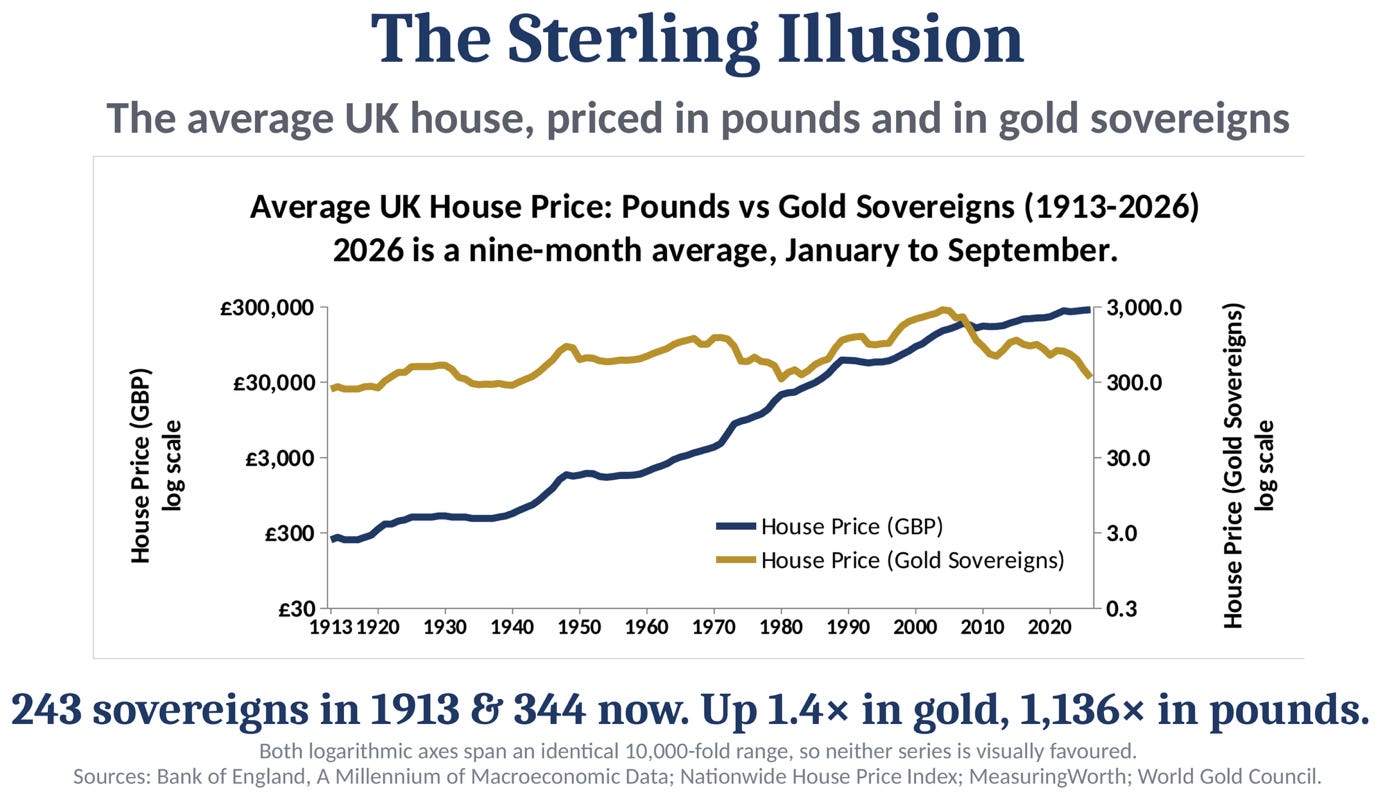
Houses have barely become dearer. The pound has become cheaper. A young couple saving for a deposit are not losing a race against the builders. They are losing a race against the Bank of England, which erodes their savings while the deposit they need keeps rising.
Building more homes is necessary, but it cannot fix a broken yardstick. A lasting solution means fixing the money, beginning with the 2 per cent inflation target that is called price stability. A pound that loses nearly a fifth of its value every decade is not stable.
Planning reform alone cannot close the gap between those who own and those who rent. That requires money that no bank or government can create at will: gold.
The British people want a welfare state, “free” healthcare, “free” public services. Since no economy can produce enough wealth to support such a thing which grows and grows, not least to fund the 15 million “refugees” who have arrive over the last 30 years, and leave a surplus. Large scale borrowing and money printing to pump non-value backed money into the economy to pay the wages of the non-wealth creating and feed the beast is inevitable, as is the monetary inflation, then price inflation that results. People want less tax on motor fuels, but want more money spent on the “free” stuff.
Until the population is educated in economics, and accepts the abolition of the welfare state and return of public services to the private and voluntary sectors nothing will change, even if the political colour of Government does.
Everything has a cost. The money has to come from somewhere. Somebody has to pay.
I believe the only way this will end is if there is complete economic collapse and we end up like the Weimar Republic or Zimbabwe.
In 1938 my house sold at auction for £75, which at the time represented eight months' wages for an agricultural worker (40/- a week). How much of a house could someone buy today for eight months' worth of minimum wage? A doormat?