


Dr. Bryan Cheang is the Academic and Research Director at the Institute of Economic Affairs. He is also the Director of the Hayek Program and Fellow at the London School of Economics.
John Healey presented his first Budget last Wednesday, accompanied by an Office for Budget Responsibility (OBR) forecast that runs to 2031-32 for the first time. That forecast was finalised in March, before the conflict in the Middle East pushed up prices and borrowing costs. Any headroom the Chancellor found by assuming faster productivity growth is a tax rise postponed, and households will pay it when the forecast misses.
The Budget’s most revealing choice, however, concerns lending rather than taxing. The National Wealth Fund, the state-backed investor that ministers want to pick winners in sectors such as AI, defence and clean energy, has been allocated a further £15.4bn. The British Business Bank gets another £5bn. Together, the two lenders receive £20.4bn of borrowed money, which the OBR estimates will add £3.4bn to debt by 2031-32. Yet because a loan counts as an asset, the debt rule largely ignores it. A rule designed to restrain ministers instead lets them carry on borrowing to lend.
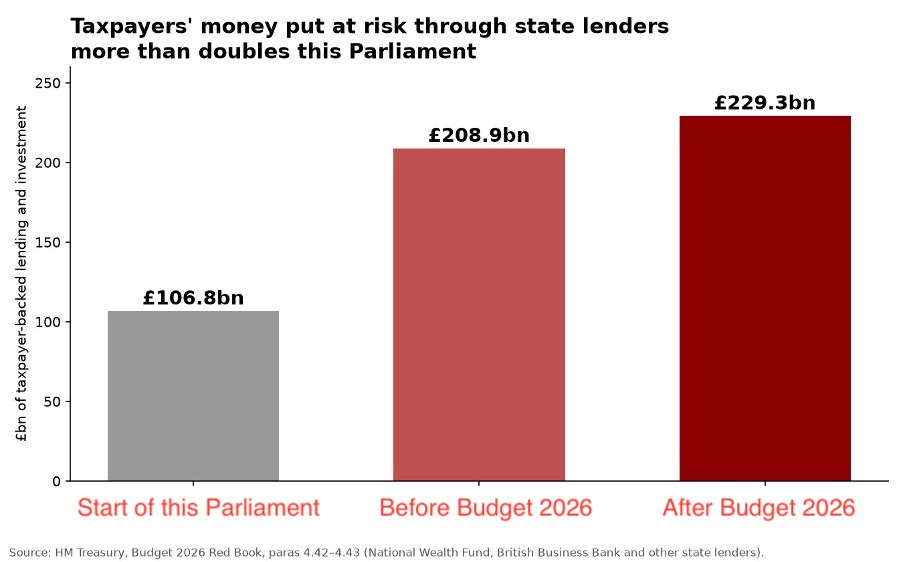
This comes on top of a dramatic expansion already under way. The amount of taxpayers’ money that UK state-owned lenders can put at risk has more than doubled this Parliament, from £106.8bn to £229.3bn, with most of the rise stemming from earlier decisions.
The National Wealth Fund’s track record hardly justifies such confidence. It has made a pre-tax loss in each of the last four years: £152.2m in 2024-25 and £67.5m in 2025-26. Even the improvement in the latest year is flattered by a single deal. Without its biggest loan, to the Sizewell C nuclear power station, the 2025-26 loss would have been £144.4m.
UK state bodies have a poor record of picking winners, and this Budget doubles down on that failure. Industrial policy typically lacks clear measures of success, making waste hard to spot, especially when the organisation that makes the investments is also the one that judges whether they have added value. Exempting state lending from the debt rule all but guarantees more of it, whatever the quality.
The deeper problem is one of knowledge and incentives. Officials at a state lender do not risk their own money, face no real threat of bankruptcy and answer to political priorities as much as commercial ones. A private investor who backs the wrong firm loses capital and learns quickly; a public body that does the same can simply be topped up at the next fiscal event. Nor is it obvious what problem the extra cash solves. AI, defence and clean energy already attract substantial private investment. Where a project is genuinely viable, private finance will usually fund it. Where it is not, state lending simply shifts the risk onto taxpayers while crowding out capital that might have been better deployed elsewhere.
There is one welcome decision in the Budget: the cut in capital gains tax for founders to 10 per cent on their first £10m of gains. Founders can now keep more of the proceeds of their success to reinvest, and private investors allocating their own money make better decisions than officials allocating taxpayers’.
This measure points to a better path. The Budget pulls in two directions at once, trusting entrepreneurs with their own gains on the one hand while handing ever larger sums to state lenders on the other. If the Government wants growth, it should follow the logic of its capital gains reform rather than its lending spree: lower the tax burden on investment, remove the barriers that hold it back, and let the market, not ministers, decide where capital goes.