



Matthew Lesh is a Public Policy Fellow at the Institute of Economic Affairs and a Director at Freshwater Strategy.
Andy Burnham is expected to use his first Labour Party conference leader’s speech this week to once again declare a break with the 40 years of ‘neoliberalism’. The Prime Minister is indicating a new social and economic model is on its way, though what shape that will take and how and whether it will actually deliver growth remain, to put it politely, murky.
But before we get to what’s next, it’s important to pause and figure out what Burnham actually means by ‘neoliberalism’. He often uses it as a pejorative strawman. That is, neoliberalism is simply defined as ‘what went wrong since the 1980s’, without any detail. This is a weak theory that ignores that, for significant periods over recent decades, Labour was in power, including with him in Cabinet. It also ignores that the size and power of the state have markedly increased, whether in spending or the regulatory state, which few could attribute to neoliberalism.
When used as a broad brushstroke to describe recent decades, therefore, neoliberalism is meaningless, both academically and for the public – who also have little sense of what the terminology actually means. But in a more concrete sense, according to Tom McTague’s recent profile in the New Statesman, he seems to believe it involves (1) centralisation in Whitehall; (2) deindustrialisation outside of London and the South East; and (3) privatisation of utilities and public services.
On the first point, it’s hardly neoliberal to want to centralise power; in fact, quite the opposite. In 2015, the IEA, an organisation often associated with ‘neoliberalism’, published Federal Britain: The case for decentralisation, arguing that the British state should devolve power to encourage experimentation, better matching of services to local preferences, and greater competition between providers of government-funded services. A key part of this has always been decentralising fiscal power, that is, linking local service delivery to revenue raising to ensure accountability, and putting downward pressure on taxes, something that Burnham has shown less interest in.
On the second, there is significant confusion and nostalgia around industrialisation. The reasons Britain has become less industrial are aplenty, from productivity gains that have allowed factories to make more with fewer workers, to rising incomes shifting demand towards services, to the opening of global trade that allowed Britain to specialise in what it does best further up the value chain – the likes of financial services, consulting, law, technology, and higher education.
None of these is a peculiarly British or Thatcherite phenomenon. Manufacturing’s share of employment has fallen across virtually every rich economy, including those rarely accused of neoliberalism: France, with its dirigiste traditions, has a manufacturing sector not much bigger as a share of its economy than ours. The decline in manufacturing employment also goes back much further, beginning in the mid-1960s. On the other hand, the state has tended to encourage deindustrialisation, with our planning system making it painfully slow and expensive to build a factory, industrial electricity prices the highest in the developed world, and Net Zero policies making Britain uncompetitive. Hardly neoliberalism to blame on all these counts.
There’s an interesting interrelated point here, which brings us to the third bogeyman, privatisation. The industrial model failed atop nationalised, loss-making industries that were kept afloat by the taxpayer, precisely the kind of state-directed model Burnham seems nostalgic to recreate – or is he? The British state didn’t just own water and the railways; it also owned the National Coal Board, Rolls-Royce, British Airways, British Telecom, and British Leyland, the carmaker that became the emblem of industrial decline and strikes. We don’t actually hear very much from Burnham about nationalising these particular industries.
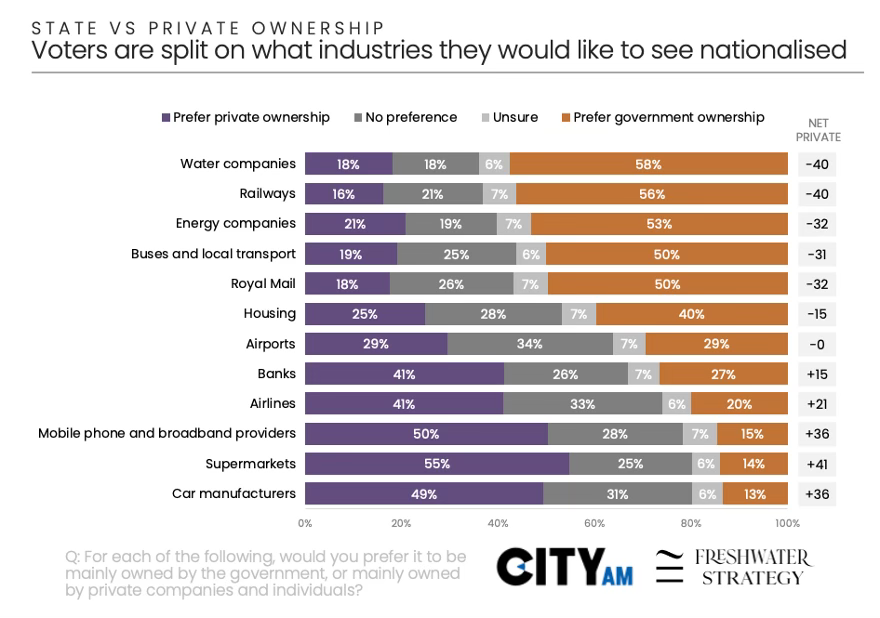
Our latest City AM / Freshwater Strategy poll provides some interesting insights on this front. While a majority of the public supports renationalising water, railways, energy companies, local transport, and Royal Mail, the same doesn’t hold for much of the rest of the economy. Just 20% would support bringing airlines into government ownership, 15% want to see telecommunications in state hands like in the days of British Telecom when it took weeks to months to get a phone line installed, and even fewer, 13%, want a re-run of British Leyland.
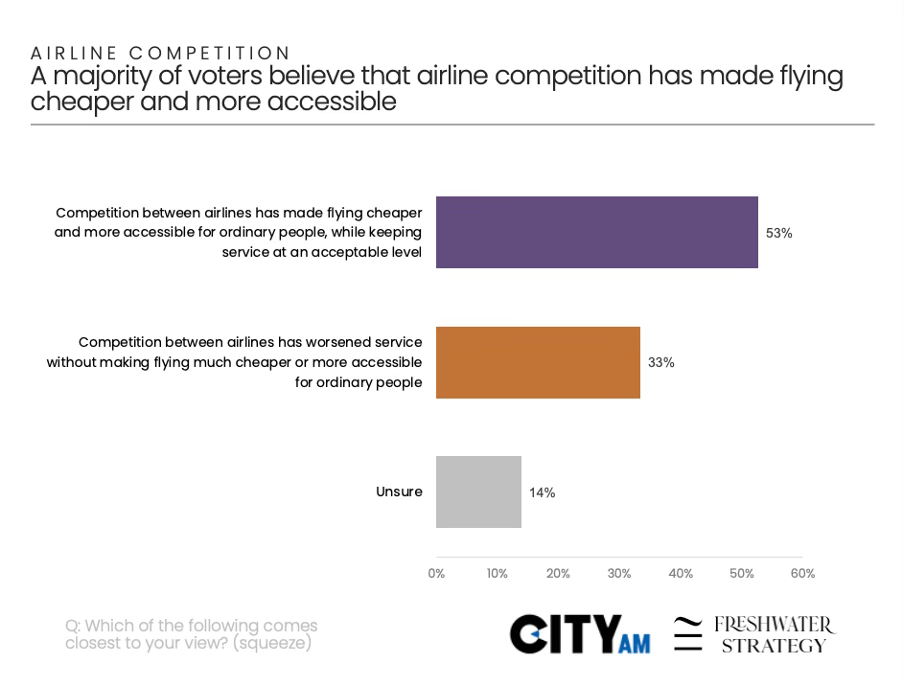
When asked specifically about the aviation industry, a majority (53%) agree with the notion that competition between airlines has made flying cheaper and more accessible for ordinary people, while keeping service at an acceptable level; just one-third (33%) believe competition has been bad.
It’s a similar story in the telecommunications sector, where a majority (55%) back the concept that competition between mobile phone and broadband providers has made staying connected cheaper and more accessible for ordinary people, with 36% taking the opposite view.
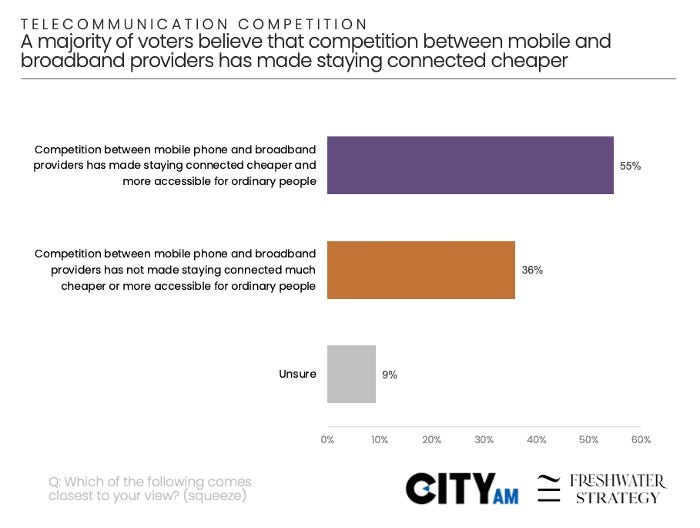
The dichotomy here is interesting: the industries people are happy to keep in private hands are those perceived to be working best, benefiting from competitive market dynamics, and providing the most benefit to consumers over recent decades. This suggests that support for nationalisation stems from frustration with the status quo, rather than from any grand ideological attachment to the concept of a state, as in the past. It also means that, for those involved in these sectors, people want better outcomes as much as, if not more than, a change in ownership structure.
Whether Burnham likes it or not, we are not actually in a re-run of the 20th-century ‘third way’ dynamics that led to the earlier bipartisan nationalisations. A ‘real’ socialist would be disappointed here – a bit of talk about ‘more public control’ is hardly the same as putting the means of production into the hands of the proletariat. Burnham isn’t really proposing the end of neoliberalism, more like a bit of fiddling on the edges.